
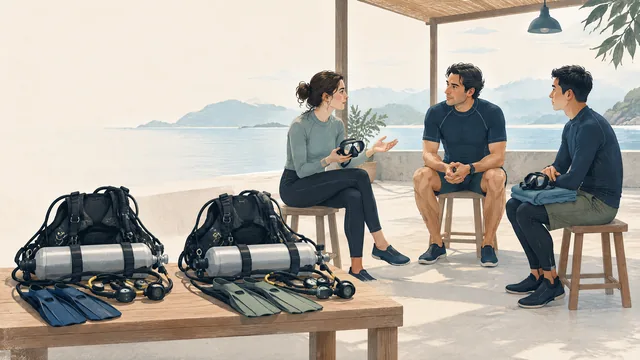
Describe the difference before choosing a lesson
Avoid introducing yourselves as the brave one and the nervous one. Those labels tell an instructor little about what needs attention, and can become roles that are difficult to shake. Instead, each partner should describe the situations that feel comfortable or unfamiliar: swimming in a pool, being on a boat, wearing a mask, hearing instructions in a second language, or having someone watch a new skill.
For example, one person might say, ‘I swim regularly but have never used scuba equipment.’ The other might say, ‘I enjoyed a supervised try-dive years ago, but I want to understand the plan before committing.’ Neither statement establishes readiness on its own. They give the instructor a better starting point than ‘We are both beginners’ or ‘My partner will help me.’
Also separate confidence from the desired outcome. One person may be curious about an introductory session; the other may want an entry-level qualification for future trips. DiveHarbour distinguishes supervised introductions, refresher sessions and recognised training on its couple-lesson guide. Choosing the same afternoon does not necessarily mean choosing the same route. Discuss that mismatch before payment, while changing the plan is still a decision rather than a disappointment. [S1]
Choose attention, not a promise of matching progress
Private teaching can give a couple a more focused conversation, but it does not turn two learners into one assessment. DiveHarbour’s guide to private scuba lessons for couples Hong Kong explains that the instructor still observes both participants and that separate practice moments may be needed. Ask how supervision would work if one person needs more explanation while the other is ready for the next exercise. Do not assume private means an exclusive instructor for each partner. [S1]
If certification is your goal, ask for the named agency and course. PADI describes its Open Water Diver course as performance based: a student earns certification by demonstrating the required knowledge and skills, progressing at their own pace. That is a useful reason not to tie completion to an anniversary weekend. Confirm the requirements of the actual course rather than applying PADI’s description to every agency. [S5]
Use the comparison below to identify what you need to discuss. It is a planning aid, not a verdict on which arrangement is suitable or currently available. A couple can share the interest while choosing different teaching arrangements.
| Your situation | Arrangement to discuss | Question that changes the decision |
|---|---|---|
| Both are new; one wants more explanation | A shared private introduction with time for questions | How will each person receive attention if their pace differs? |
| Both want certification; one needs more repetition | A course plan that permits separately assessed progress | What happens to supervision, dates and charges if one needs additional practice? |
| One is certified; the other has never used scuba | Different routes, with any shared activity assessed separately | Does the certified partner need a refresher, and can any part appropriately be shared? |
| One is interested but undecided about entering water | An enquiry before committing to water participation | What is the agreed plan if that person decides not to participate? |
| Both want to learn but have little calendar flexibility | A realistic split-session proposal, if feasible | Can the available dates accommodate training and a possible interruption? |
Agree what support sounds like when someone pauses
Before the lesson, make a simple agreement: neither person has to protect the other’s enjoyment by concealing discomfort. ‘Would you like me to listen while you speak to the instructor?’ is more useful than ‘You will be fine once you get in.’ The first offers help; the second predicts an outcome and may make refusal harder.
DAN states that any diver can call off a dive at any time, for any reason or no reason. Its discussion of peer pressure also warns that encouragement can become harmful when a buddy keeps challenging the decision. Apply that principle to the relationship: a pause is information to respect, not a debate to win. Avoid reminding a partner how much you paid or how long you have been planning the day. [S4]
Ask the instructor to explain and confirm the signals for needing attention and ending an activity before water participation. If either of you does not understand the briefing, say so then. Follow the instructor’s taught communication and safe procedures rather than inventing a private underwater code. Ask what happens to both learners when one stops, so nobody assumes the other will be left waiting or can simply continue independently. [S1]
Keep the partner role separate from the instructor role
A more experienced partner may be tempted to translate every instruction, supply answers or correct equipment handling. Resist becoming an unofficial assistant. Let the instructor hear each learner’s questions directly and observe their own responses. If language is a concern, discuss the teaching language beforehand rather than assuming your partner can interpret a safety briefing accurately while also learning. A helpful partner can make space for a question without answering it on the learner’s behalf.
Keep practical support on land and within what has been agreed. You might organise transport or help remember a question about equipment fit. Underwater, follow your assigned role and the instructor’s plan. A certification card held by one partner does not authorise them to teach the other, and a private booking does not make unsupervised practice appropriate. DiveHarbour’s couple guide keeps introductory participation under instructor supervision. [S1]
Health information also belongs to each individual. Complete the requested medical questionnaire honestly, and disclose relevant health changes or concerns rather than having your partner decide they are ‘just nerves’. DAN advises consulting a physician when the questionnaire indicates it; if the physician needs diving-specific advice, DAN can offer consultation or referral. Ear or breathing concerns, illness and recent surgery should go through the appropriate screening and clinical assessment. Affection, confidence and a booked date cannot provide medical clearance. [S6]
Give different progress somewhere to fit in the diary
The confidence gap becomes harder to manage when the calendar leaves no room for it. If you have only one free weekend before travel, say that at the first enquiry. Ask whether your goal is realistic in the available window rather than asking the instructor to make the window sufficient. Keep a post-lesson meal flexible, so needing further discussion does not mean missing a prepaid celebration.
For couples who need to separate learning stages, DiveHarbour’s private scuba course with flexible schedule Hong Kong guide is a useful starting point for discussing preferred dates. It makes clear that instructor arrangements, venues or boats, training requirements and safe operating conditions still govern the plan. Ask whether extra practice would need a separate session and whether both partners must attend it; do not assume either arrangement is included. [S2]
Keep safety decisions separate from financial expectations. DiveHarbour’s current public fee notice says all paid fees are non-refundable. Make-up sessions are available only when the written registration terms permit them; dates, location, places and any deadline require written confirmation. Before paying, ask how those terms apply if one partner stops, needs additional practice or cannot attend a changed session. A weather interruption does not create an automatic refund or freely chosen replacement date. [S1] [S2]
Review the lesson without scoring each other
Afterwards, let each person describe their own experience before comparing it. Ask, ‘What felt clearer by the end?’ and ‘What would you want explained again?’ rather than ‘Who was better?’ An instructor’s recommendation for more practice is not a judgement on the relationship. Record that recommendation separately for each learner, including any unfinished training and the conditions for returning.
If one person wants another lesson and the other does not, avoid an immediate commitment made to preserve the mood. You can keep the shared interest through a waterfront outing or a conversation about future plans without requiring both people to enter the water again. If you both wish to continue, take the individual feedback into your next enquiry rather than assuming the previous booking format remains the best fit.
When you are ready to compare next steps, DiveHarbour’s scuba diving course Hong Kong overview can help you distinguish a first experience, a certification route and support for an already trained diver. Send both partners’ goals, experience and remaining questions, then request a written proposal with the supervision arrangement and inclusions. The next shared decision is whether that proposal works for each of you—not whether you can promise to progress together. [S3]
Questions you may be asking
Should we hide the confidence gap so we can stay in the same lesson?
No. Describe each person’s experience and concerns before booking. That lets the instructor discuss suitable supervision and whether parts of the learning should be separate. Concealing the difference removes useful information; it does not make a shared format more appropriate. [S1]
Does paying for a private course mean we both receive certification?
No. An introductory session is not automatically certification, and a shared payment does not replace individual performance requirements. Confirm the agency, course outcome and assessment arrangements. PADI’s Open Water course, for example, awards certification on demonstrated knowledge and skills. [S1] [S5]
Can my certified partner teach me before the lesson?
Do not substitute partner-led water practice for qualified instruction. Discuss prior experience with the provider and let the instructor teach and assess the required skills. Your partner can support planning and listen to your questions without taking over the lesson. [S1]
What if I want to stop but my partner wants to continue?
Tell the instructor using the communication taught in the briefing. Do not continue to avoid disappointing your partner. Whether any further activity can happen depends on the supervision plan and circumstances; it is not for the couple to improvise. DAN supports any diver’s right to call off a dive. [S4]
Is a private lesson a treatment for fear of water?
No. Focused teaching may allow more questions, but it is not a medical or psychological treatment and cannot establish fitness to dive. Discuss participation concerns honestly and follow the medical-screening process, including appropriate professional evaluation when indicated. Choosing not to participate remains an option. [S6]
Sources & further reading
- [S1] DiveHarbour — Private Scuba Lessons for Couples in Hong Kong
- [S2] DiveHarbour — Private Scuba Course with a Flexible Schedule
- [S3] DiveHarbour — Scuba Diving in Hong Kong
- [S4] Divers Alert Network — Use Peer Pressure for Good
- [S5] PADI — Become a Certified Scuba Diver FAQs
- [S6] Divers Alert Network — Health Status Overview