
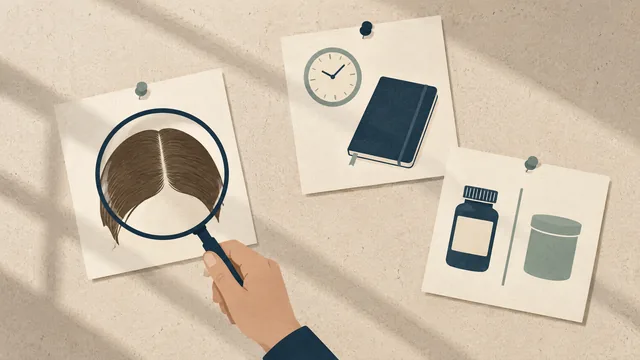
Agree what this review is actually evaluating
Open with the concern you wanted help with last time. Perhaps it was a widening part, repeated shedding or uncertainty about a changing hairline. Ask the practitioner to repeat the agreed goal in plain language. A cleaner-feeling scalp may matter to you, but it does not answer whether the thinning area has changed.
For a follow-up linked to DT Hub’s tcm hair loss treatment information, ask which findings belong to the TCM assessment and whether the medical cause of your hair loss has been established. Its service page describes a TCM consultation; that description is not evidence that every cause can be identified through it. [S7]
Clinical evaluation can involve questions about onset, examination of the scalp and hair, and tests when indicated. A dermatologist may also find more than one contributing cause. A salon scalp observation or a reassuring image is not equivalent to that assessment. If the cause remains uncertain, ask what further evaluation would be useful rather than assuming the original explanation is settled. [S1]
Compare evidence, not just a better hair day
Choose photographs that make comparison fair: the same parting, similar lighting, camera angle and distance, and similarly dry or wet hair. Note a haircut, colour change, concealer or different styling product that could affect appearance. You need a usable comparison, not a large album of daily close-ups.
If a plan is described as hair regrowth treatment, ask what observation supports the word ‘regrowth’. DT Hub describes several components and different practitioner roles. Ask which component addresses your goal and how its outcome will be assessed, rather than treating a combined package as one measurable effect. [S9]
Less shedding and greater visible coverage are different findings. Some hair loss can improve on its own, so improvement after starting a service does not by itself show that the service caused it. Equally, a single disappointing photograph cannot settle whether a plan is helping. Ask the reviewer to explain the comparison and its uncertainties. [S1]
| What you notice | What to record | What to ask |
|---|---|---|
| The part looks narrower | Comparable photographs and any styling change | Is this a coverage change or a presentation difference? |
| Less hair seems to fall during washing | Dates, wash frequency and whether the pattern persists | How should we interpret this alongside the scalp examination? |
| Short hairs are more noticeable | The location and when you first noticed them | Can you assess whether these represent growth or breakage? |
| Sleep feels better but hair looks unchanged | Separate notes for wellbeing and hair appearance | Which goal has changed, and which remains unassessed? |
| A new symptom followed treatment | Its timing, duration and the products or sessions involved | Does this need assessment before anything is repeated? |
Bring medicines back into the conversation
Update your medicine list even if you supplied it at the first visit. Include prescribed treatments, over-the-counter products, supplements and anything applied to the scalp. Record what started or changed since the last appointment. A photograph of a label or the written formula is more useful than ‘the usual tablets’.
When discussing chinese herbal medicine for hair, ask for a clear record of what is being supplied and whether the formula has changed. DT Hub’s page identifies a herbal service, but suitability still needs an individual discussion. Ask your pharmacist or prescribing clinician to check the proposed combination with your existing medicines. Herbal products can alter another medicine’s effect or increase side-effect risks. [S8] [S4]
Do not stop, reduce or replace a prescription because you have begun complementary support. Tell each clinician what the other is providing. Pregnancy, breastfeeding, liver or kidney disease, and planned surgery are particularly important to disclose before herbal treatment. Feeling well after previous use does not settle whether a new formula or combination is suitable. [S2] [S4]
Ask about adverse effects before another session
Mention discomfort before discussing results or renewing a package. Describe when it began, how long it lasted and whether it recurred. You do not have to prove that treatment caused it to ask for advice. A rash, stomach upset or worsening scalp symptom deserves attention, not an automatic explanation that the treatment is ‘working’. [S4] [S6]
Use DT Hub’s tcm acupuncture kwun tong information to ask who will carry out the session, what their qualifications are and how they will review your health history. It is first-party service information, not an independent clinic ranking or proof of hair restoration. [S10]
Acupuncture can cause soreness, minor bleeding, bruising or dizziness; improper delivery can cause serious complications. Disclose blood-thinning medicines, bleeding disorders and previous reactions. Ask which symptoms require contact before another session. Evidence supporting acupuncture for certain pain conditions does not establish a benefit for hair regrowth. Serious or worsening symptoms need timely medical attention rather than waiting for a routine follow-up. [S3] [S5]
Decide what would change the plan
Ask for a review point tied to your situation, not a universal number of sessions. Hair-treatment outcomes can take months to assess and vary with the cause and treatment. That does not justify carrying on indefinitely without explaining what is being monitored. Ask what information would support continuing, reconsidering or seeking another clinical opinion. [S1]
If several things started together, ask how any observed change will be interpreted. A new prescription, herbal formula and scalp service introduced around the same time make attribution difficult. Report missed appointments or interrupted use honestly so the reviewer is working from what actually happened.
A new bald patch, rapidly changing loss, burning, marked tenderness or sores should prompt appropriate medical assessment. Do not use a scalp-cleaning appointment to defer that conversation. The next step may be to revisit the evaluation rather than add another service. [S6]
Leave with a specific decision and a way to ask for help
Before leaving, ask for a short explanation you can repeat: what was observed, what remains uncertain, what the agreed next step is and when it will be reviewed. Request separate costs for the consultation, medicines and other services. If more visits are suggested, ask what each visit contributes and what happens if you decide not to renew.
DT Hub’s hair growth center hong kong information lists its Kwun Tong venue. Confirm the current follow-up arrangements and whether you will see the practitioner needed for your question. An appointment for scalp care is not automatically the same as a medicine review. [S11]
Take one unresolved question into the booking conversation: ‘Can we compare the same area and review the new formula before deciding on more sessions?’ That gives the next appointment a purpose and makes room for an informed decision.
Questions you may be asking
Should I count every shed hair between visits?
Ask whether counting would help your particular review. A brief record of noticeable changes and wash frequency may be more manageable. Counts alone do not establish the cause or whether regrowth is occurring.
Does better sleep mean the hair treatment is working?
It is worth reporting, but keep it separate from the hair outcome. Ask which hair findings support the assessment rather than using a wellbeing change as evidence of regrowth.
What if I forgot to mention a supplement last time?
Tell the practitioner and your pharmacist now, with its name or label. Do not assume it is irrelevant because it is sold without a prescription; herbal products can interact with other medicines. [S4]
Can a scalp photograph replace a dermatology review?
No. It can help document appearance, but clinical assessment may need history, examination and sometimes tests. Ask what the image can show and what remains unanswered. [S1]
If nothing looks different, must I buy another package?
No. Ask why continuation is being suggested, what will be monitored and what alternatives are appropriate. You can request the findings and proposed costs before deciding whether to proceed.
Sources & further reading
- [S1] American Academy of Dermatology — Hair loss: Diagnosis and treatment
- [S2] NCCIH — Traditional Chinese Medicine: What You Need To Know
- [S3] NCCIH — Acupuncture: Effectiveness and Safety
- [S4] NHS inform — Herbal medicines
- [S5] Guy’s and St Thomas’ NHS Foundation Trust — Acupuncture
- [S6] American Academy of Dermatology — Hair loss: Signs and symptoms
- [S7] DT Hair Growth — TCM Diagnosis for Hair Loss
- [S8] DT Hair Growth — Chinese Herbal Medicine for Hair Growth
- [S9] DT Hair Growth — Hair Regrowth Therapy
- [S10] DT Hair Growth — Best TCM Acupuncture in Kwun Tong
- [S11] DT Hair Growth — Centre service information