
Name the change you want to see, not just the cap you want
Perhaps your familiar side sweep now falls over your glasses, or you want a centre part for work and an off-the-face look at weekends. Those are different requests. Moving the line across the crown concerns the top of the cap. Sweeping everything backwards concerns the front edge. A ponytail may also expose the temples and nape. Describe each look separately so a fitter can inspect the relevant area.
DT Hub’s lace front wig hong kong page is a useful starting point when the problem is the visible front hairline. It describes lace at the front with other construction possible behind it. Ask to see how far that particular lace panel extends, rather than assuming the name tells you where a deep side part will finish. [S2]
Bring photographs of your current look and intended parting. Mark what must stay, such as chin-length ends or temple fullness. Compare those features rather than being distracted by a sample’s different cut.
Look underneath: the parting area matters more than the label
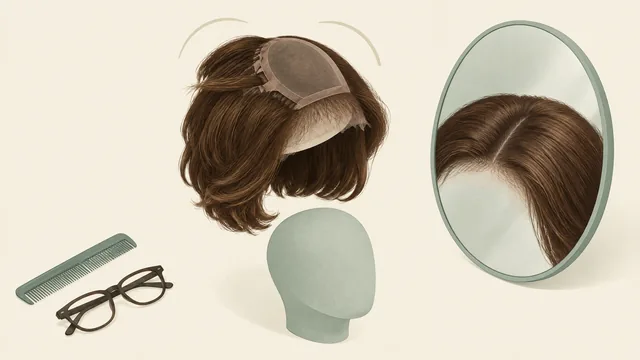
Monofilament is a fine mesh into which hairs are individually tied. A narrow monofilament part gives a scalp-like appearance in its designated strip; a monofilament top provides a larger area for alternative parts. A lace front can accompany either, or a wefted cap. Wefts are rows of hair sewn into the base, so separating them does not create the same appearance as parting an individually tied top. [S1]
A full lace wig uses lace across the cap, making it worth comparing when your desired styles extend beyond a small top panel. However, a hand-tied cap is not necessarily full lace, and a 360-lace perimeter does not establish whole-cap lace coverage. Ask for the actual construction to be shown, including any lining or non-lace sections. [S1] [S3]
Extra lace coverage is useful only where your intended style needs it. Use these checks to compare.
| Your intended change | Inspect this area | What the check tells you |
|---|---|---|
| Sweep hair away from the forehead | Front lace, its width and fit | Whether the newly exposed hairline works on you |
| Alternate centre and side parts | Top panel and its boundaries | Whether both lines remain within a suitable parting area |
| Create a deeper side part | Junction between the top and side construction | Whether the line runs into wefts or a visible seam |
| Wear a ponytail or updo | Temples, sides, nape and fastening points | Which edges become visible or lift when hair is gathered |
| Keep the cap but soften the silhouette | Existing length, density and hair direction | Whether a cut or material-compatible reset could suffice |
Separate a restyle from rebuilding the base
If the proposed part stays within a suitable top panel, the obstacle may be the way the hair falls rather than the cap itself. A fitter can assess whether redirecting the hair and adjusting the face-framing cut would produce a wearable shape. Keep enough length for both parts: a fringe cut to sit neatly on one side may fall quite differently when moved across.
The wig styling hong kong service page lists trims, restyles and material-dependent techniques, as well as internal cap alterations. Ask which of those is relevant to your piece and whether the studio accepts wigs bought elsewhere. An advertised styling service does not establish that every older base can be altered in the way you want. [S4]
A haircut cannot turn a wefted top into a lace top or extend a narrow parting strip. Adding hair, repairing lace or replacing part of the base is a different scope from styling. If reconstruction is proposed, ask what remains unchanged and how the cost compares with replacement. Agree the parting positions before irreversible cutting; removed length will not grow back.
Human hair is a material choice, not a heat permission slip
The phrase human hair wig hong kong describes a material enquiry, not a guarantee of a centre part, free parting or unlimited heat tolerance. DT Hub’s product page discusses several cap constructions. Check the hair specification separately from the top panel, then obtain care instructions for the exact piece being considered. [S5]
Manufacturer guidance illustrates why that matters. Jon Renau gives separate instructions for human hair, ordinary synthetic fibre and heat-friendly synthetic fibre, with controlled heat advice rather than unrestricted tool use. It also discourages colouring or chemically altering its human-hair pieces. Those instructions apply to its products; they are not a temperature prescription for an unidentified wig. [S6]
Bring any label or purchase record, plus the history of colouring, straightening or previous restyling. If the material is uncertain, pause thermal or chemical work until it is identified. Ask whether the new part will need resetting after washing and whether you can realistically maintain that finish during a busy week. The best demonstration is not enough if the everyday workload is wrong for you.
Trial the new part with the things you actually wear
Compare the existing and proposed positions while wearing your glasses, if you use them. Check the front straight on, then at both temples and from above. Request a view of the nape if the goal includes tied-back hair. Moving the part can change which seams or edges become visible, even when the hair looks attractive from the front. [S1]
Look in ordinary room light and near daylight where possible. A phone photograph is useful for remembering proportions, but should not be the only test. Check whether the part appears too wide for your preference, whether one side becomes overly full, and whether the fringe still clears your eyes. Compare the same features in each look.
During a supervised fitting, turn your head, look down and try the intended styling movement without pulling the lace. Note any edge lift, pressure or scratchiness. Report discomfort rather than tightening the cap to chase a flatter hairline. A convincing part is only one part of a style you can comfortably wear.
Pay for the styling freedom you will actually use
When comparing a wig shop hong kong enquiry with a return styling appointment, choose the scope that answers your specific problem. DT Hub identifies its studio at Room 03, 21/F, Lee Bo Times Centre, 50 Hoi Yuen Road, Kwun Tong. Confirm that the intended cap comparison and assessment of your existing piece can be arranged before travelling. [S7]
Request separate quotes for restyling, any base repair or alteration, and a replacement with the required parting area. Ask whether fitting, the final cut and a subsequent adjustment are included. Also check altered-piece return terms and how long you would be without your current wig. A low trim price is not a useful comparison with a replacement quote that includes different work.
If you only want to alternate two parts across the top, first test whether your current panel already supports them. If the aim is an exposed hairline plus updos, compare the relevant edges and fastening arrangement, not just the words ‘full lace’. Bring three concrete questions: ‘Can this piece support both of these parts?’, ‘Which change needs cutting rather than resetting?’, and ‘What upkeep will each look need after washing?’
Questions you may be asking
Can a lace-front wig still have a fixed part?
Yes. Lace front describes the front hairline, while a narrow monofilament part or other top construction may restrict where a convincing part can sit. Inspect both features on the actual piece. [S1]
Would a monofilament top be enough instead of full lace?
It may be enough if your only goal is switching parts across the top. Full lace becomes more relevant when styling exposes other areas. Compare the desired looks in a fitting rather than buying extra lace coverage automatically. [S1]
Why does my old part return after washing?
The hair’s existing direction and material-specific setting behaviour may be involved; a returning part does not by itself prove the cap is fixed. Ask a wig stylist to inspect the construction and explain the compatible resetting method. [S6]
Can a stylist thin the hair to make a new part look less bulky?
Possibly, but first check whether the bulk comes from the cut, hair direction or base. Removing hair is irreversible and may reduce coverage. Agree which parting positions must still work before approving thinning.
Does changing the part mean changing how I secure the wig?
Not necessarily. A new part within the existing top may leave the fastening unchanged. Swept-back or tied-up styles deserve a separate fit check because they expose more edges. Ask about product compatibility and skin comfort rather than choosing an attachment from the cap name alone.