
Separate the curl from the finishing work
A reference may show large waves with an unusually smooth surface, carefully separated ends and lift around the face. You might love the wave size but not want the root height. Or you may want the overall outline without the glossy finish. Tell the stylist which feature matters most; otherwise, a request to copy the photograph leaves the everyday goal unclear.
Bring a normal front and side photo of your own dry hair alongside the inspiration. For a hair perm kwun tong enquiry, specify whether the change should begin below the chin, throughout the lengths or only around the face. DT Hub's menu distinguishes several perm goals, which makes the location of the texture a more useful starting point than simply asking for curls. [S1]
Include a less polished reference too. Choose one whose looser separation or flatter front you would still enjoy wearing, and explain why it works for you. That gives the stylist an acceptable everyday alternative instead of only an ideal finish. If you cannot find one, describe the compromise directly: ‘I can accept less definition at the back, but I want the front to bend away from my face.’ This is more precise than asking for the same photograph with less maintenance.
Ask whether the reference was air-dried, diffused, brush-dried or finished with a curling tool. If that information is unavailable, treat the image as a design direction. Agree separately on the minimum finish you expect without extra tool work.
Digital is a method; Korean and Japanese need translating
A digital perm hong kong brief concerns a method using heated rods and perm solution. Professional salon guidance describes digital curls as often more pronounced when dry than wet. That does not mean a polished wave appears automatically: the cut, placement and drying technique still affect the finish. Ask what the proposed method should look like with your simplest drying routine. [S1] [S5]
For a korean perm hong kong reference, translate the label into something visible: broad S-shaped waves, ends turning inward, or movement framing the cheeks. DT Hub describes Korean perming as a styling approach that can use digital or cold techniques. The useful question is therefore which method supports your preferred shape and routine, rather than whether Korean and digital are opposites. [S3]
A japanese perm hong kong reference might mean airy, loosely separated waves rather than a uniform ringlet pattern. DT Hub positions this service around soft, natural-looking movement. Still ask which process is proposed and what happens when it dries. A country label does not establish suitability for your particular hair or guarantee that a formulation will be gentler. [S4]
Two photographs carrying different country labels may share the same curl size and placement. Conversely, two labelled identically can demand very different styling. Compare those visible details before choosing the service name.
Check three stages, not one finished photograph
Wet, partly dry and fully dry hair tell you different things. Cold-permed curls are often more defined wet and relax as they dry, while digital curls can become clearer dry. These are general tendencies, not a way to identify a technique from a photograph. Request examples with a comparable length and cut, and ask how each stage was styled. [S5]
Use the questions below to turn a beautiful image into a wearable brief. The aim is not identical wet and dry hair; it is knowing which version you are agreeing to maintain.
| Reference detail | Wet-to-dry question | Everyday decision |
|---|---|---|
| Large, defined waves | Will they stay visible when fully dry without a curling tool? | Accept a softer dry wave, or budget for shaping. |
| Airy, tousled movement | How much definition remains after air-drying? | Decide whether subtle movement is enough. |
| Face-framing bends | Do the front sections need separate drying? | Allow attention to the front, or simplify placement. |
| Lift above smooth lengths | Is the height from the cut, perm or blow-dry? | Make crown volume a separate request. |
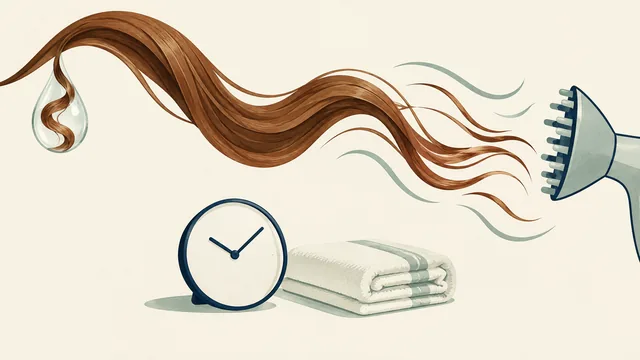
Put a clock beside the curl you want
Separate hands-on styling from total drying time. A routine that needs only a few minutes of attention may still leave your hair damp when you need to leave. Think about wash days and mornings between washes separately. Does your commute begin soon after showering, or do you normally wash at night?
Choose a personal allowance, not a promised salon saving. For example, a five-minute morning budget might mean accepting softer definition and concentrating attention on the front. A fifteen-minute allowance may leave room for more deliberate drying. These are planning examples, not estimates of how long any perm takes: length, density, tools and familiarity change the task.
Ask the stylist to demonstrate the everyday finish before adding any photo-ready embellishment. Watch what is needed to establish the shape, then distinguish optional polishing from essential work. If possible, try the handling yourself so you can judge whether it fits your morning rather than merely watching an expert do it quickly.
Avoid making hotter tools the solution to a time mismatch. The American Academy of Dermatology advises using the lowest heat setting and reducing heat-tool frequency to limit damage. A simpler finish may suit a rushed routine better than repeatedly forcing the hair into the reference shape. [S6]
Your treated lengths may change the choice
Tell the stylist about bleaching, colour, straightening and previous perms, including treatments still present in the ends. The newest growth and oldest lengths may need different consideration. DT Hub's perm page includes hair-condition and chemical-history assessment; use that discussion to check feasibility before settling on a method. [S1]
Chemical processing can damage hair, and conditioning is not permission to ignore fragile lengths. [S6] Ask whether your preferred wave can be achieved now, whether the plan needs adapting, or whether a cut and temporary styling would be a better first step. Disclose scalp discomfort or a previous reaction before an appointment. Do not book overlapping chemical services simply because the reference combines colour and curls.
Choose the explanation, not the country label
When comparing a perm salon kwun tong, look for an explanation that connects your reference, hair history and available styling time. DT Hub's Kwun Tong page lists different techniques and describes a home-styling demonstration. Ask how those arrangements apply to your requested texture; the range on a menu alone does not settle which choice suits you. [S2]
Request a complete quote for the proposed method, clarifying the cut, conditioning, finishing and any length-related additions. Ask how much appointment time is needed, including the demonstration. Published figures across the service pages differ, so a current quote for your actual plan is more useful than choosing the lowest headline price. [S1] [S2] [S3] [S4]
End the conversation with two concrete questions: ‘Which part of this photograph will need extra styling at home?’ and ‘What would my hair look like on a day when I skip that step?’ If the simpler version still appeals to you, you have a much stronger basis for choosing the salon and the curl.
Questions you may be asking
Can I use a curling-iron photo as my perm reference?
Yes, as a shape reference. Point out the wave size and placement you like, then ask which details depend on tool styling. Agree on the routine result separately from the fully polished photograph.
Does a looser wet curl mean the digital perm has failed?
Not necessarily. Digital curls may be more prominent dry. Assess the fully dried shape using the demonstrated routine, and contact the stylist if it differs from what you discussed rather than trying another chemical treatment yourself. [S5]
Can an air-dry-friendly perm work for an early commute?
Only if the total drying time fits your schedule. Air-dry-friendly describes a possible finish, not how quickly your hair becomes dry. Tell the stylist when you wash and when you must leave, as well as your hands-on styling allowance.
What if I want waves at the ends but no extra width at the cheeks?
Mark the point where you want movement to begin and bring a side-view reference. Ask how curl placement and the haircut will affect the outline. Do not rely on a Korean or Japanese label to communicate where you want fullness.
How should I show a disappointing result at a follow-up?
Bring ordinary-light photos of the hair fully dry, explain the products and drying method used, and identify the mismatch: curl size, placement, width or time needed. Ask about assessment arrangements before assuming that an adjustment is included or requires another perm.
Sources & further reading
- [S1] DT HUB: Hair Perm in Kwun Tong — Digital Perm, Korean Perm, Cold Perm & Volume Perm
- [S2] DT HUB: Perm Salon in Kwun Tong — service options and styling demonstration
- [S3] DT HUB: Curl Styling & Perm Techniques in Hong Kong
- [S4] DT HUB: Japanese Perm in Hong Kong — Soft, Natural Waves & Volume
- [S5] Hayato Salons: Digital Perm — method, cold-perm comparison and drying guidance
- [S6] American Academy of Dermatology: 10 hair care habits that can damage your hair