
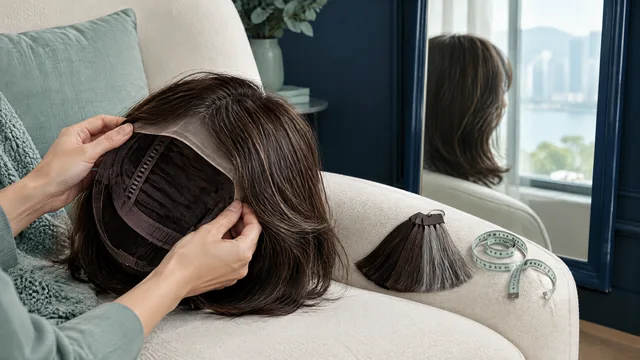
Name the mismatch before choosing another wig
Start with one sentence: ‘I like the length and colour, but the cap lifts at the back,’ or ‘The fit feels right, but the sides look too full.’ This preserves useful features instead of treating an almost-right piece as a complete failure. It also gives a fitter something more actionable than ‘make it look natural’.
OWNSTRAND's guide to custom vs ready-made wigs frames the choice around the specific piece and the decisions still available, rather than a premium-versus-basic ranking. Use that distinction to compare three routes: adjusting the current piece, choosing a different ready-made specification, or commissioning a custom piece. [S1]
| What feels wrong | Possible adjustment to ask about | When custom deserves consideration |
|---|---|---|
| Cap shifts or sits unevenly | Correct positioning and the cap's own adjustment range | An important shape or dimension mismatch remains |
| Colour looks unlike your reference | Another available shade; assessed colour work on the exact human-hair piece | The required tone or blend is unavailable in suitable existing options |
| Hair looks too full | Styling or selective professional thinning, if suitable | The desired distribution cannot be achieved without compromising the piece |
| Fringe or outline feels wrong | A wig-experienced stylist's assessment of the cut | There is insufficient length or the design cannot support the intended shape |
Check cap fit separately from the hairstyle
The American Cancer Society notes that sizing can vary between brands and that many wigs have adjustable tabs. That supports checking the actual cap, not assuming an ‘average’ label will settle the question. Ask the fitter to assess its position and built-in adjustment before discussing alterations. [S4]
Describe where the problem occurs: pressure around the edge, excess space at the crown, or movement at the nape. Bring your usual glasses and explain how you intend to arrange any retained hair underneath. A circumference adjustment and a front-to-back shape mismatch are different concerns; ask which one the fitter thinks you have.
Do not tighten a cap simply to make every concern disappear. If the piece only stays positioned with an uncomfortable setting, ask whether another size or cap design is more suitable. Custom earns consideration when measurement can address a persistent fit problem, not merely because you have reached the end of an adjustment strap.
Decide whether colour is wrong—or poorly represented
A phone photograph is a weak basis for deciding that a shade must change. Compare the wig with your chosen reference near a window and in the indoor light where you will usually wear it. The American Cancer Society recommends natural light for comparing hair with wig swatches. [S4]
Be specific about the difference. ‘Too dark overall’ is not the same request as ‘the temples need more grey’ or ‘the brown looks too warm’. If you wear a full wig, your preferred overall appearance may matter more than matching hair hidden underneath. Where your own hair remains visible, inspect the transition as well.
Another existing shade may solve the problem without a custom order. If considering colour work on a human-hair wig, ask the supplier or an experienced wig stylist whether the exact piece can accept it, given its processing history and care instructions. Human hair is not blanket permission to bleach, dye or guarantee a match.
Separate excess density from a cut that creates bulk
Density describes how much hair is present; visible fullness also depends on the cut and styling. A rounded finish at the sides can create an outline you dislike even when the crown looks right. Identify where you want less volume before requesting a lower-density piece everywhere.
Macmillan notes that wigs can be cut and styled by a hairdresser or wig consultant, while the American Cancer Society mentions professional fringe trimming and thinning. These are possible routes to assess, not proof that every wig can take the same alteration. Ask for someone experienced with wigs and agree the shape before hair is removed. [S5] [S4]
A useful brief might be ‘keep the crown coverage, soften the sides and leave enough length to tuck behind my ears’. Ask whether styling alone can show the intended direction first. Shortening is irreversible, and adding missing length is not the reverse of a trim. A major change may be better served by another design rather than increasingly aggressive cutting.
Give a custom order a specific job
For a custom human hair wig Hong Kong enquiry, explain the unresolved mismatch alongside what you want to preserve. OWNSTRAND describes sample viewing, head measurement and a return fitting with washing, cutting and blow-drying. These stages provide opportunities to discuss the specification and finish; they do not make every requested feature available. [S2]
Ask which proposed choice addresses your problem. If fit is the priority, how will the measurements inform the piece? If the colour blend matters, what sample or agreed reference can you assess? If fullness is wrong, can the desired distribution be specified? A more expensive construction is not automatically the answer to a fringe-cutting concern.
Custom is a stronger proposition when suitable ready-made alternatives still miss a non-negotiable requirement and the maker confirms a workable specification. It is weaker when the main issue is a modest, feasible cut—or when the custom proposal remains vague about the feature you most need changed.
Compare a scoped quote with a scoped adjustment
Before comparing a custom human hair wig price Hong Kong quote with an alteration, write down the named option, intended length, colour direction, density request and final cutting scope. OWNSTRAND's price guidance recommends confirming the selected option and which process steps apply. Ask which preferences can be supplied and which remain unresolved before accepting the figure. [S3]
For the existing piece, obtain an assessment of the proposed change, its price and its limits. If you already own it, the original purchase cost has been spent; compare the additional adjustment expense with the new order, rather than letting that earlier outlay force a poor choice. If you have not bought it, compare purchase plus confirmed adjustments against the custom quote.
Ask about adjustment terms, approval before cutting, and whether a retailer will assess a piece bought elsewhere. OWNSTRAND's only showroom is in Kwun Tong; confirm the visit's purpose first. Its approximate 3–5 working days refers to custom production, not the whole enquiry-to-final-fitting schedule. [S2]
Leave with answers to three shopping questions: ‘What exactly will change?’, ‘What will remain as it is?’, and ‘What happens if that change does not resolve my main concern?’ Those answers are a better basis for spending than either the custom label or a lower headline price.
Questions you may be asking
Is a ready-made human-hair wig still ready-made after a haircut?
Yes. Styling an existing piece does not make its cap made-to-measure. The useful question is whether that piece, after a suitable cut, meets your fit and appearance priorities.
Should I keep an uncomfortable wig because the colour is perfect?
Treat fit as a separate requirement. Ask whether positioning or the built-in adjustment can resolve it. If not, carry that colour reference into enquiries about another suitable piece rather than accepting uncomfortable wear.
Can I ask for less hair only at the sides?
You can describe that preference. A stylist must assess whether selective thinning or styling is suitable for the existing construction. For custom, ask whether regional fullness can actually be specified.
Does custom mean I can select any colour and cap combination?
No. Available choices depend on the maker and the named option. Ask for the specific combination to be confirmed, using samples where possible, before treating it as part of the order.
Should I cut a nearly suitable wig before deciding whether to keep it?
Check the applicable purchase and alteration terms first. Agree the intended cut and who will perform it. Do not assume a changed piece can be returned or that removed length can be restored.
Sources & further reading
- [S1] OWNSTRAND — Custom vs Ready-Made Wigs: How to Choose
- [S2] OWNSTRAND — Custom human hair wig Hong Kong & bespoke human hair wig
- [S3] OWNSTRAND — Custom human hair wig price Hong Kong: quote guidance
- [S4] American Cancer Society — Wigs for Hair Loss
- [S5] Macmillan Cancer Support — Wigs for cancer treatment