
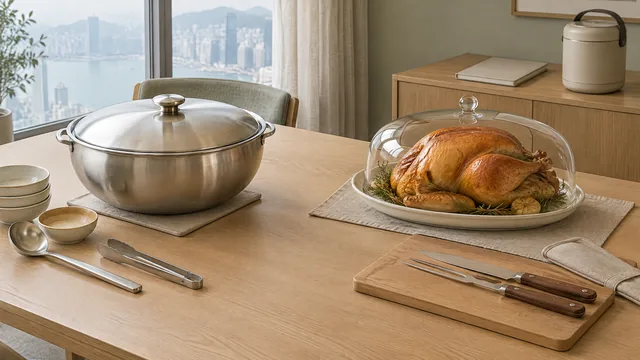
Start with the dining rhythm, not the photograph
A basin feast makes most sense when a group can sit down together and reach shared dishes comfortably. Check the table footprint, including individual bowls and accompanying food. One large basin at the far end of a long table may be awkward; ask whether smaller basins or assisted serving would suit the layout. The decision is about access, not simply the largest advertised serving size.
For a reunion-style meal, explore Poon Choi Delivery as a starting point for basin formats. YumYum describes the page as a traditional basin-feast service. [S1] Ask for the current contents, container dimensions and serving guidance for your proposed order. A page title alone does not settle whether the dish arrives ready to eat or requires work in your kitchen.
Compare edible portions, not basin counts and bird weights
Write down who is eating a full dinner and what else that dinner includes. If turkey is the main protein, ask how much carved meat the proposed size is expected to provide. A whole bird’s weight is not the weight of meat guests receive. For poon choi, ask what the stated diner count assumes about appetites and accompaniments. Check whether rice or other starches are included rather than inferring this from a photograph.
The Christmas Roast Turkey Delivery page describes whole and portioned turkey formats. [S2] Compare those formats against your serving plan: a whole bird offers a table presentation, while prepared portions can remove a practical task. Confirm the actual cut, quantity and whether sauces or sides form part of the quotation; do not treat everything pictured or mentioned as included.
If you want both centrepieces, tell the supplier that they are sharing the main-course role. Request quantities on that basis rather than buying two packages each intended to feed the whole party. Keep a separate allocation for guests who cannot eat either dish, with their requirements agreed individually.
Use the room and equipment as the deciding test
Measure the usable kitchen and dining space before committing to an impressive format. In a Hong Kong flat, the obstacle may be an oven opening or crowded fridge shelf; in a function room, it may be a kitchen that guests cannot use. Obtain the packed dimensions as well as the serving dimensions. Packaging that reaches the venue is not necessarily suitable for heating.
| Meal format | Check before ordering | Choose a simpler format when… |
|---|---|---|
| Poon choi | Basin footprint, serving access and any required heating equipment | Guests cannot comfortably share the basin or the venue cannot heat it as instructed |
| Whole roast turkey | Oven and fridge fit, carving surface, tools and the person doing the work | The whole presentation creates a task nobody can take on |
| Prepared turkey portions | Edible quantity, presentation, sauce containers and handling instructions | Guest service matters more than a whole-bird reveal |
| Both centrepieces | Reduced quantities for each, separate working space and coordinated service | One dish would wait without suitable temperature control while the other is prepared |
Plan the route from arrival to the first serving
Ask whether each item will arrive hot, chilled or in another specified condition, and obtain instructions for that exact product. If reheating is required, check the method against the equipment you actually have. Do not assume a deep basin can be handled like a shallow tray, or that instructions for sliced turkey also cover a whole bird. Resolve any mismatch before ordering.
Work backwards from the meal: receiving, moving food inside, storing or reheating as instructed, preparing the serving area, then serving. Allocate time around those tasks using the supplier’s confirmed guidance. Building access and lift arrangements also need checking. If arrival changes, the receiver should know whom to contact and where food can be safely kept; leaving it on the festive table is not a contingency plan.
The Centre for Food Safety’s Five Keys include clean hands and utensils, separation of raw and cooked food, thorough cooking and safe temperatures. [S3] Keep any raw ingredients for homemade sides away from delivered cooked food. Use dedicated serving utensils rather than guests’ eating cutlery. Those principles guide your own handling; they do not establish a supplier’s certification.
Let the rest of the menu support the main dish
Read the centrepiece contents before selecting sides. With poon choi, look for accompaniments that add variety rather than another large dish with the same ingredients. With turkey, decide which starch, vegetables and sauces are genuinely needed. Offer a clearly identified alternative main for anyone whose requirements the centrepiece cannot meet, rather than expecting them to make dinner from garnish.
Explore Christmas Party Catering when comparing the wider festive meal. Keep the quotation organised by main dishes, sides and desserts so additions remain visible. Ask about ingredients and cross-contact separately: vegetarian, vegan, halal and gluten-free requests are different requirements, and a seasonal menu name answers none of them.
Give a seasonal birthday its own moment
A December birthday dinner need not become a Christmas buffet with a cake squeezed in. Agree whether the cake comes before or after the main meal, and reserve its storage and presentation space. A birthday speech should not interrupt an unplanned reheating or serving task. If the programme changes, review the food-handling plan rather than extending table display by default.
For a combined celebration, Birthday Catering is another resource to explore alongside the seasonal dishes. Make the birthday priorities explicit in the enquiry, including dessert plans and guests’ eating times. Ask whether a proposed dessert is an addition or replaces another item; a seasonal package should not quietly determine the birthday menu.
Send one clear enquiry and prepare a receiving checklist
Use this enquiry: ‘We are planning a seated seasonal dinner on [date] at [venue], with [number] confirmed meal guests. We are considering [poon choi / turkey / both], alongside [other dishes]. Please propose quantities for that meal role and confirm contents, edible portions or serving assumptions, packed dimensions, arrival condition and product-specific handling instructions. Please itemise sides, sauces, containers, equipment and any serving assistance. Our available facilities are [details]; our dietary requirements are [details]. Please confirm access arrangements, the proposed delivery window and any substitutions for approval.’
On arrival, have the order confirmation ready. Match the containers, sides and sauces against it, check packaging condition and obtain the handling instructions. The receiver should then transfer food to its agreed storage or preparation location, while the serving lead clears and prepares the dining area. Any discrepancy goes back to the supplier before improvisation. A centrepiece earns its place when its practical requirements are settled before the guests sit down.
Questions you may be asking
Can poon choi and turkey appear in the same dinner?
Yes, if quantities reflect their shared role and the venue can handle both. Ask for a combined meal proposal rather than two independent full-dinner allocations. Confirm how each dish will reach the table without one waiting in unsuitable conditions.
What should I ask if a turkey quotation gives only its weight?
Ask whether that is raw or cooked whole-bird weight, what carved-meat yield is expected and what diner count assumes about sides. Use those answers to compare proposals; whole weight alone does not tell you the portions available.
Is the communal basin suitable for a guest with a food allergy?
Do not assume so. Request ingredient and cross-contact information for the actual dish. Ask whether a separately prepared and served alternative can meet the guest’s requirements. Removing an ingredient at the table does not establish safety.
What if the venue has no usable kitchen?
Tell the supplier before choosing the format. Seek an arrangement that does not depend on unavailable reheating equipment, and confirm suitable temperature control until service. If that cannot be arranged, change the dish or venue rather than improvise.
Should I choose poon choi or turkey for a seasonal birthday?
Start with the birthday guest’s preference, then check the dining layout and preparation facilities. Either can work. Protect the cake’s storage space and presentation time, and choose the centrepiece whose serving tasks fit around that programme.