
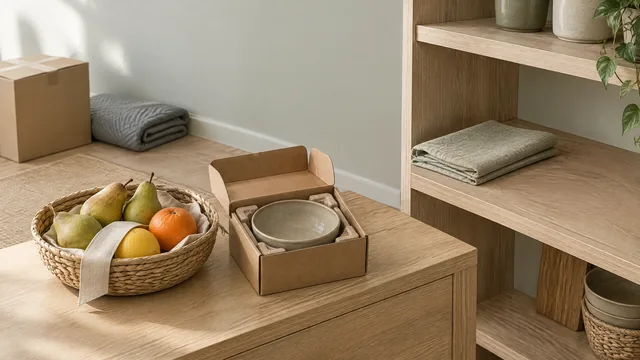
Ask what the home can actually use
Start with the household, not its decorating style. Someone renting a furnished flat may already have enough mugs and bowls; someone setting up an unfurnished home may welcome a specific missing item. Ask, ‘Would something to share, or something for the home, be more useful?’ This leaves room for an honest answer without requesting a shopping list.
Then establish the gift's destination inside the home. Is there a clear shelf, a working kitchen or only a temporary patch of dining table between boxes? If you cannot name a likely place for a permanent object, choose a consumable the recipient likes or wait until they have settled. The gift need not arrive on moving day to mark the move warmly.
Match food to the household, not the party
Separate a gift for the residents from food for a housewarming gathering. A household of two does not need an assortment sized around ten visitors unless the host has asked for something to serve. Ask for the number of intended eaters and the likely eating occasion, then compare actual contents rather than basket height. Request fruit types and counts or packaged-food weights; decorative filler does not describe a portion.
A Housewarming basket is a useful starting point for exploring fruit presentation. The destination discusses assortment, container shape and household preferences rather than one fixed package. [S1] Ask what the recipient genuinely eats and whether anything needs washing, cutting or chilled storage. Whole fruit can still be inconvenient when knives and serving bowls remain packed.
For packaged treats, check ingredient labels and individual storage instructions. Ask about allergies separately from vegan, halal or gluten-free requirements, including cross-contact where relevant. Do not assume a mixed hamper suits everybody because its theme sounds wholesome.
Check the footprint of homeware before choosing it
A permanent gift needs a stronger reason than ‘it looks lovely’. Check whether it duplicates something the recipient already owns, fits their cupboard and can be cared for in their usual way. For a serving bowl, ask about diameter and depth; for cups, check stacking and cleaning instructions. A matching set is not automatically useful if the household prefers a few individual pieces.
Explore Home & living gift sets as presentation references, then request the exact proposed contents and dimensions. The page introduces home-gifting options, but its category description is not an itemised order specification. [S2] Neutral colours can reduce a visual clash, yet they cannot solve an oversized object or an unwanted scent.
Avoid guessing with fragrance, wall decorations or electrical accessories. These choices depend on personal preferences or practical compatibility. If a homeware item is wanted, confirm its material and care requirements rather than treating every ceramic piece as dishwasher-safe.
Choose the format with the least receiving work
Use the table to identify a direction before browsing combinations. These are selection questions, not promises about any supplier's contents. Where the answer remains uncertain, reduce the gift's footprint rather than adding variety to compensate.
When comparing Housewarming hampers, decide whether the container itself has a credible second use. A shallow basket might fit a named shelf; a large rigid box might simply become another object to store. The destination is a home-gifting resource, not evidence that a particular combination is available. [S2] Ask for packed dimensions as well as individual item sizes.
| Household situation | Direction to consider | Question before ordering |
|---|---|---|
| Still unpacking | A small, familiar consumable assortment | Can they store and enjoy it without finding extra equipment? |
| Settled home with a missing kitchen item | The requested object with minimal extras | What size, material and care method do they want? |
| Compact shared flat | Individually labelled items for agreed recipients | Whose cupboard or fridge space will the gift occupy? |
| Hosting a gathering | Food agreed with the host | How many guests will eat it, and what is already on the menu? |
| Minimalist household | A small consumable gift in simple packaging | Would they prefer no permanent container or decorative object? |
Use customisation to remove mismatches
Customisation is most helpful when it allows you to omit something. Describe the recipient's routines: they enjoy evening tea, already own cups, dislike scented products and have limited counter space. That is a clearer brief than ‘a luxurious housewarming theme’. Keep the spending limit separate from the contents so fewer items do not become an invitation to add decorative bulk.
The Bespoke gift hampers guide covers recipient preferences, stable packaging and approval of substitutions. [S3] Use those checks to request a written item list. State which exclusions must not change, and ask to approve replacements that alter ingredients, dimensions or care needs. A different flavour is not necessarily an equivalent choice for the household.
Make the arrival easy for the recipient
Agree who will receive the parcel and where the handover will happen. In a managed building, ask the household whether reception can accept it and whether they can collect it promptly. Confirm access details with the merchant; do not assume the parcel will be carried upstairs. The recipient should not have to leave work unexpectedly to manage a surprise delivery.
On arrival, unpack food on a clean surface rather than among moving tools. Hong Kong's Centre for Food Safety recommends clean hands and utensils, separation of raw and cooked food, and safe food temperatures. [S4] Follow each product's storage directions and put away items that require refrigeration promptly. Keep fragile homeware separate and ask the supplier how any damage should be documented and reported.
Send an enquiry that describes the home
Once the recipient has answered the home-fit questions, send a brief that a merchant can assess. Replace the bracketed details below, including the spending limit you choose. Leave the final combination open until you have the item list and receiving arrangements.
‘I am choosing a housewarming gift for [household size]. They would prefer [food or requested home item] and have [storage or counter-space constraint]. Please exclude [ingredients, scents or unwanted objects]. My total spending limit is [amount]. Could you propose the contents, item sizes or food quantities, storage and care instructions, packed dimensions, protective packaging and an itemised total? Please confirm a feasible handover on [preferred date] to [receiving role and location], and obtain approval before substitutions.’
Add a personal card without turning the gift into an obligation: ‘Wishing you a lovely start in your new home. Enjoy this whenever you have settled in.’ There is no need to suggest that they display the basket, host a meal or send an unpacking photograph.
Questions you may be asking
How can I check their taste without spoiling the surprise?
Ask about one broad preference, such as food versus homeware, and one exclusion. The contents and card can remain a surprise while the format stays welcome.
Must a housewarming gift follow a lucky colour or fruit tradition?
Ask whether that tradition matters to the household. Do not let an assumed symbolic choice override foods they avoid, colours they dislike or space they do not have.
Should colleagues combine their budgets into the biggest hamper?
Combine the budget only after agreeing the recipient's needs. It can fund a specifically requested item instead of a larger assortment. Let one organiser approve the contents and coordinate receiving.
Is reusable packaging always the better choice?
Only if the recipient has a use and space for it. Ask for dimensions and material. Simple packaging that is easy to remove may suit the home better than an unwanted storage basket.
What if the recipient says they need nothing?
Respect that answer. Ask whether a small favourite treat would be welcome; otherwise, a thoughtful card is enough. Avoid substituting an unsolicited decorative object for a declined gift.