
Notice when the screen starts running the dive
Task loading is the extra work added to an activity you are already managing. Underwater, choosing a composition or adjusting a light can compete with noticing depth, gas supply, the route and other divers. In a case analysed by DAN, a diver filming underwater lost contact with a buddy and descended beyond the planned depth. The useful lesson is not the dramatic outcome; it is how an absorbing optional activity can displace essential awareness. DAN recommends adding tasks gradually rather than allowing them to overwhelm existing skills. [S2]
Think back to your last ordinary dive. Were you comfortable with the equipment, or did you spend much of it sorting out straps and controls? Could you follow the briefing and communicate without feeling hurried? If the basics still require most of your attention, a camera is another demand rather than a harmless souvenir. A good land photographer can still be a beginner at combining those jobs underwater.
Watch for a less obvious problem, too: wanting to finish the image before responding to your buddy. A nearly sharp photograph can make a sensible pause feel inconvenient. Decide before entering the water that the picture is always optional. Neither a purchased camera nor a rare-looking subject creates an obligation to keep photographing.
Move camera decisions onto dry land
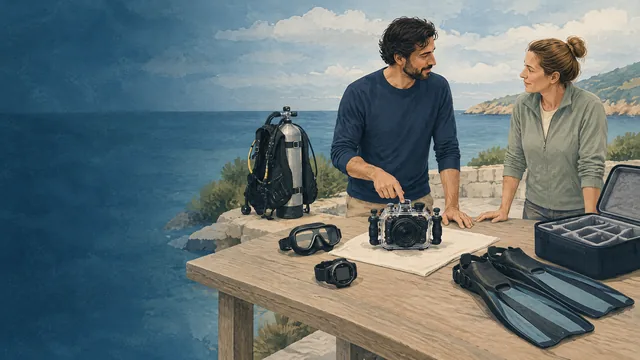
Practise with the camera inside its housing on land, not just with the bare camera at home. Find the controls for starting and stopping recording, changing your chosen setting and recognising whether the camera is actually working. Follow the manufacturer's instructions for the housing and seals. Charge batteries and check storage before the trip so a routine equipment question does not become an underwater puzzle. DAN's camera-safety advice specifically recommends topside familiarisation to preserve attention for the dive. [S3]
Start with a deliberately modest photographic aim, such as noticing shapes in a wider scene, rather than a list of animals to find. Consider what you can leave out: unfamiliar lighting, a complicated mounting arrangement or a new shooting mode. Fewer choices make the first session easier to discuss and review. Ask an instructor to assess how the complete setup affects handling, attachment and access to your diving equipment; do not improvise an underwater rig from accessories that merely fit together.
When enquiring about an underwater photography diving course Hong Kong, send DiveHarbour the camera and housing models as well as your recent dive history. Its photography guide treats buoyancy and situational awareness as part of preparation and asks divers to confirm the water setting and equipment support. That helps distinguish camera familiarisation from the supervised practice you actually need. [S1]
Make photography part of a shared buddy plan
A buddy who enjoys moving steadily along a route may not enjoy waiting while you revisit the same frame. Discuss that difference before the dive. Say whether you want occasional pictures during an ordinary outing or a deliberately slower photography-focused session. Agreement on pace matters as much as agreement on the subject: two photographers can become absorbed in entirely different directions.
Ask the instructor or guide to clarify the buddy arrangement, communication signals and what the team should do if someone cannot continue the photography plan. Include how to indicate a camera problem without confusing it with a diving problem. Each diver remains responsible for monitoring their own gas and surroundings; your buddy is not a substitute for your own checks. DAN's photography advice emphasises both a responsive buddy and individual responsibility. [S3]
Give your buddy an uncomplicated way to interrupt you. A request to move on should not require a debate about whether the next frame might be better. Equally, a non-photographer need not become your lighting assistant or wildlife finder. If a portrait is proposed, obtain agreement beforehand and keep ordinary diving behaviour intact. On scuba, never hold your breath to remove bubbles from a picture or to appear motionless for the camera. [S3]
Let the available space decide the photograph
Before becoming interested in a subject, consider whether there is enough space to observe it without touching habitat or crowding another diver. A small animal tucked into a narrow crevice may be interesting but inaccessible to a responsible photographer. Choosing a wider frame, observing without photographing or leaving the subject alone are all valid creative decisions. The animal does not owe you a clear view.
Green Fins advises photographers to assess their position before approaching, secure loose equipment and avoid touching or holding coral. It also advises against chasing or manipulating marine life and disturbing sediment. Those principles include the camera, its straps and lights, not only the diver's hands. Do not feed an animal, move it into better light or ask a guide to arrange it for a picture. A photograph should record the encounter rather than cause it. [S4]
Repeated lighting and persistent attention can become intrusive. Green Fins recommends keeping flash photography to a minimum and moving on if an animal hides or tries to leave. Follow the site's briefing on photography and lighting, and accept stricter restrictions where they apply. There is no universal distance that makes every animal comfortable, and no subject can be guaranteed for a Hong Kong outing. Preserve space rather than treating another photographer's close-up as a standard you must match. [S4]
Choose preparation for the problem you actually have
The next step need not be another camera purchase. It may be supervised skills review, an ordinary dive without photography or a photography-focused course. Describe a specific difficulty rather than calling yourself an intermediate diver. The comparison below turns that difficulty into a useful conversation; it is not an assessment of fitness or permission to dive.
If you are planning a Hong Kong fun dive, tell DiveHarbour before booking that you hope to carry a camera. Its guide separates recreational outings, refresher support and training, and states that equipment rental and dive-guide service are selected separately. Ask whether the proposed pace and support suit your current experience; a place on a recreational trip should not be mistaken for photography tuition. [S5]
If maintaining position or following the route remains demanding, an Advanced Open Water Diver course Hong Kong enquiry can begin with those specific learning needs. DiveHarbour's advanced guide encourages purposeful skill choices, but the agency, prerequisites and practical options still need confirmation. Do not assume that an advanced course includes your preferred photography component or that a new certification makes camera handling automatic. [S6]
| What you notice | Preparation worth discussing | Question to take to the instructor |
|---|---|---|
| You cannot find controls once the housing is closed | More dry-land familiarisation | Can we check this exact camera and housing before water practice? |
| Ordinary buoyancy or equipment use still feels demanding | Supervised core-skills practice without a camera | Which basic skills should we review before adding photography? |
| You look at the screen and forget the wider dive | A simpler camera task in an appropriate supervised setting | How will you observe my awareness and help decide when to stop photographing? |
| Your buddy wants a much faster pace | A clearer shared plan or a different outing format | Can this trip accommodate photography without disrupting the team? |
| A long diving break coincides with new camera equipment | Readiness review before a photo outing | Would a refresher be more suitable than adding both unfamiliar tasks at once? |
| Your desired shot requires contact with habitat | A different frame or observation without a photograph | What site-specific photography restrictions should shape our plan? |
Review attention, not just image sharpness
Before paying for a photography session, ask what will be reviewed afterwards. Exposure and focus are useful, but feedback should also address whether you stayed aware of the team and maintained clearance from the surroundings. Ask what happens if the camera does not work, conditions change or the instructor recommends removing photography from the plan. A clear alternative is more useful than an expectation that every booked dive will produce images.
Keep camera hire, lighting support, boat arrangements and image review separate in your written questions so none is silently assumed to be included. DiveHarbour states that all paid fees are non-refundable. Make-up sessions are available only when the written booking conditions permit them; confirm the applicable dates, location, capacity and time limit in writing rather than assuming an automatic replacement session. [S1]
After a suitable outing, ask your buddy what it was like to dive with you. Did they feel included, or did they have to work to get your attention? Record one camera difficulty and one diving observation alongside the images. A beautiful frame is not proof of a well-managed dive, while deciding not to take a picture can demonstrate good judgement.
If illness or another health change has affected your return to diving, address that before the camera plan. Complete the formal medical questionnaire honestly and obtain a physician's evaluation when it indicates one is needed; neither this article nor a dive professional can provide medical clearance. [S7] Your next photography goal can then be based on actual readiness, with room to leave the camera behind.
Questions you may be asking
Is an action camera easier to take diving than a larger camera?
It may involve fewer controls and less bulk, but it can still absorb your attention. Assess the complete housing and mounting setup with an instructor, and learn the controls on land before adding it to an appropriate dive. [S1] [S3]
Should I take a camera on my first dive after certification?
There is no need to rush. Share your recent training experience with a qualified instructor and discuss whether ordinary supervised practice would be more useful first. Certification alone does not show that you can manage extra tasks while retaining awareness. [S1] [S2]
Can my buddy watch my gas supply while I concentrate on photographs?
Your buddy can be part of a clear communication plan, but you remain responsible for monitoring your own gas and surroundings. Do not transfer essential diving responsibilities to someone else so that you can keep looking at a screen. [S3]
What if an animal moves away before I get the picture?
Let it leave. Do not pursue it, block its route or ask anyone to move it back into view. Green Fins advises moving on when animals hide or try to swim away, and avoiding repeated intrusive photography. [S4]
What should I do if the camera stops working underwater?
Stop treating the image as the priority, communicate with your buddy and follow your training and the agreed dive plan. Discuss the response with the instructor beforehand. Do not improvise a risky recovery or delay the team's safe conclusion of the dive to save equipment. [S1]
Sources & further reading
- [S1] DiveHarbour: Underwater Photography in Hong Kong
- [S2] DAN: Distraction, Unplanned Exposure, and a Lucky Outcome
- [S3] Divers Alert Network: Four Safety Tips for Underwater Photographers
- [S4] Green Fins: How to be a Responsible Underwater Photographer
- [S5] DiveHarbour: Hong Kong Fun Dives and Refresher Dives
- [S6] DiveHarbour: Advanced Open Water Diver Course in Hong Kong
- [S7] DAN: Health Status and Medical Evaluation Before Returning to Diving