
Give your curiosity a subject, not an entry point
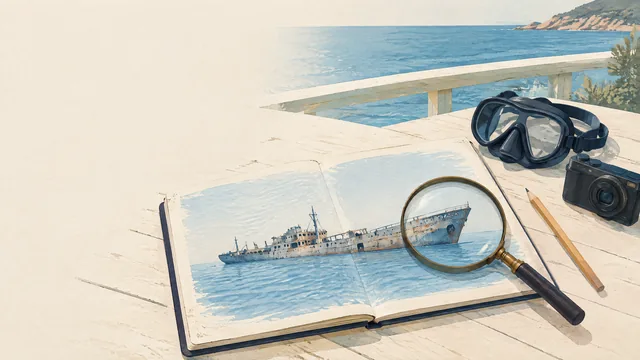
Before looking at courses, finish this sentence: ‘I would enjoy this dive if I could notice…’ Your answer might be the outline of the bow, the way a vessel rests on the seabed, or a construction detail that helps you understand an old photograph. These are specific interests that do not depend on reaching a cabin. Choose a modest subject that can be viewed from an appropriate position outside, and let the instructor assess whether the site and conditions suit that idea.
A little shore-side reading can make a partial view more interesting. Ask the operator whether the wreck's identity and history are established or uncertain. When records are available, look for its former purpose and what is known about its loss. Separate documented history from a compelling story repeated on a boat. DAN notes that learning a wreck's history gives context to its attraction and, sometimes, its tragedy. A photograph alone tells you neither the history nor the present condition. [S2]
Avoid making ‘see the whole wreck’ your definition of success. A large structure, a restricted area or limited visibility may make that unrealistic. A well-observed feature and a thoughtful conversation afterwards can be more satisfying than a hurried circuit. If taking a camera would distract you from ordinary dive responsibilities, leave it behind and write your observations after the dive instead.
A visible doorway does not make entry an ordinary dive
An overhead environment is one in which a structure prevents a direct ascent to the surface. Inside a wreck, a bright opening or another visible exit does not remove that constraint. DAN explains that wreck entry requires specialised training and equipment, and that deterioration, disorientation and disturbed silt can make the interior difficult to navigate. The apparent simplicity of an opening is not a reliable measure of the demands beyond it. [S2]
For someone comparing a Wreck Diver specialty course Hong Kong, DiveHarbour's guide makes the distinction between external survey and any penetration training explicit. Use that distinction to ask for the actual certification name, issuing agency and proposed scope. ‘Wreck specialty’ is not enough information to decide what you will be learning or what boundaries apply afterwards. State clearly if you want exterior observation only, and ask how that preference will be reflected in the training plan. [S1]
Do not let a trip briefing quietly turn into an invitation to try an interior route. Nor should a guide's experience or a buddy's confidence replace your own appropriate training. If an overhead environment is a future interest, arrange a separate conversation about the relevant syllabus and prerequisites on land. There is no need to settle that question while looking through a hatch. For an exterior-only dive, openings remain features to understand from outside, not opportunities to improvise. [S1] [S2]
Outside-only does not mean hazard-free
The exterior has its own demands. DAN describes fishing line and nets on wrecks, loose cables from deteriorating structures and sharp metal edges. NAUI likewise warns that wreck-related hazards remain even when divers do not enter an overhead environment. Staying outside avoids one major category of exposure, but it does not turn the vessel into a safe handhold or a sheltered playground. [S2] [S3]
Ask the instructor which exterior areas are appropriate for observation and which should be avoided. A particular feature may be unsuitable because of the structure, surrounding debris or the day's conditions. If staying clear while keeping track of your buddy feels difficult, that is useful information for a supervised skills review. It is not a reason to move closer and grip the wreck. NAUI identifies buoyancy and trim as important foundations before advanced wreck training. [S3]
Respect living surfaces as well as the vessel. PADI's responsible-interaction guidance advises divers to keep off the bottom, avoid touching or chasing animals, refrain from feeding fish and leave shells behind. Apply those habits to whatever you actually encounter: do not pull growth aside to reveal a fitting, or pursue an animal into an opening for a photograph. Leave artefacts undisturbed and ask about the site's specific access rules. An attractive image is not worth damaging the subject or abandoning the agreed boundary. [S6] [S1]
Treat depth as a separate training question
A wreck is a type of site, not a depth qualification. Being interested in one does not mean its accessible features fall within your current limits. Ask about the proposed observation area rather than assuming that the deepest part, the seabed or the best-known photograph is where the dive will take place. An exterior route can still be inappropriate for your experience even though nobody plans to enter the vessel. [S1]
If the attraction is genuinely a deeper environment, DiveHarbour's Deep Diver specialty course Hong Kong guide offers a separate starting point for discussing training scope and readiness. Keep the questions separate: what deeper-diving training is relevant, and what wreck-specific preparation is relevant? Neither course label answers the other question. Confirm the selected agency's requirements and the instructor's plan rather than collecting qualifications on the assumption that they combine into permission for any wreck dive. [S4] [S1]
Use the table to describe what interests you before you commit. These are questions for a briefing, not alternative routes to attempt underwater. A useful reply should address the particular feature and your experience, rather than simply say that the wreck is popular.
| What catches your interest | Ask before the dive | Do not assume |
|---|---|---|
| The vessel's overall outline | Which exterior view fits my current experience and the proposed conditions? | The whole wreck can be covered on one dive. |
| A dark hatch in a photograph | Can this feature be observed from outside, within an explicitly non-entry plan? | Seeing light beyond it makes entry suitable. |
| A feature near the seabed | Does the planned observation area stay within my training and agreed limits? | An outside-only dive is automatically shallow. |
| Growth or animals around the hull | Where can we observe without touching surfaces or crowding wildlife? | A particular animal will be present. |
| Taking a close-up photograph | Would a camera add too much work for me on this dive? | Getting the shot takes priority over the team plan. |
Agree with your buddy while you are still on shore
Different wreck interests can create a mismatch even between friends with similar certificates. One wants to inspect construction details; the other wants an interior photograph. Say what you do not intend to do before the group is equipped and ready to leave. ‘I want an exterior-only dive and will not enter an overhead environment’ is clearer than ‘I will see how I feel’. Ask the instructor or operator to confirm an appropriate buddy arrangement instead of planning to separate beside the wreck.
The briefing should explain how the team communicates a concern, changes the plan and gets support. Make sure you understand the operator's arrangements for a diver who decides not to participate, and how the in-water team will be organised. Agreeing limits should not require anyone to defend their courage. A useful buddy is someone who respects the plan, not someone who insists that a small detour will be fine.
If your wider concern is recognising stress and communicating earlier, the Rescue Diver course Hong Kong information from DiveHarbour may help you frame a separate learning goal. Its guide emphasises observation, prevention and instructor-led response learning. That can be relevant to a more attentive buddy partnership, but rescue training does not replace wreck or overhead-environment training. Ask about its own agency and first-aid requirements rather than treating it as an extra credential that makes an unsuitable plan acceptable. [S5] [S2]
Keep attention on the return as well as the wreck. NAUI highlights ascent, surface signalling and getting back aboard as parts of the dive that can be demanding. Ask about boat support and return arrangements in the briefing; do not spend all your questions on what lies below. [S3]
Choose a plan you can still value if the wreck changes
Send a concise enquiry with your certification agency and level, last dive date, recent experience and outside-only preference. Mention unfamiliar equipment or a camera you hope to use. If ordinary buoyancy or communication has felt rusty, ask whether a supervised refresher should come first. Useful preparation begins with accurate information, not an impressive total dive count. [S1]
Update your health information too. Answer the formal Diver Medical Participant Questionnaire honestly and seek a physician's evaluation when it directs you to do so. DAN stresses that this screening helps identify the next medical step. Neither an article nor a course enquiry should decide whether a health condition, recent illness or change in medication is compatible with diving. [S7]
Before payment, request the agreed course scope and inclusions in writing, along with the process if the intended site is unsuitable or inaccessible. DiveHarbour's current published terms state that all paid fees are non-refundable. Make-up sessions are available only when the written enrolment terms permit them; their dates, locations, places and deadlines need written confirmation. Do not interpret a weather-related change as an automatic refund or an unrestricted right to choose another date. [S1]
Consider whether you would still welcome a different appropriate site or a revised learning session. If only one named wreck would satisfy you, clarify that expectation before booking rather than carrying it into a safety decision. Afterwards, record what you observed, what remained uncertain and what you would like to discuss next. ‘I kept the agreed exterior boundary and understood one feature better’ is a useful outcome. Entry need never become the measure of whether you enjoyed wreck diving.
Questions you may be asking
Is an exterior wreck dive suitable straight after Open Water certification?
Not automatically. The site's depth, conditions and hazards must fit your qualification, current skills and experience. Course prerequisites also differ. Give the instructor your recent dive history and ask for a site-specific recommendation rather than assuming that staying outside makes every wreck suitable. [S1] [S3]
Does a Wreck Diver certificate always include entry training?
No. Confirm the named syllabus and its scope. External survey and penetration are different training questions. A general course label, a visible doorway or an experienced buddy does not establish that you have the appropriate preparation to enter an overhead environment. [S1] [S2]
What if my buddy wants to go inside and I do not?
Tell the instructor or operator before the dive and request a team arrangement that respects your outside-only choice. Do not agree to split up at the wreck. If the proposed plan depends on participation you are not trained or willing to undertake, choose another plan.
Can I enjoy a wreck dive without taking a camera?
Yes. Pick a feature or historical question to observe, then make notes afterwards. Without a camera you can concentrate on the dive and still leave with a meaningful record. You do not need a close-up or an interior photograph to justify the experience.
Should I remove fishing line if I see it on the wreck?
Do not turn an observation dive into an improvised removal task. Fishing line can be an entanglement hazard. Leave it undisturbed, tell the operator afterwards and ask about an appropriately planned response. Removing something attached to a wreck may create hazards or disturb its surfaces. [S2]
Sources & further reading
- [S1] DiveHarbour — Wreck Diver Specialty Course in Hong Kong
- [S2] Divers Alert Network — Hazards in Wreck Diving
- [S3] NAUI — Wreck Diving Safety
- [S4] DiveHarbour — Deep Diver Specialty Course in Hong Kong
- [S5] DiveHarbour — Rescue Diver Course in Hong Kong
- [S6] PADI — Responsible Marine Life Interactions: The Do’s and Don’ts
- [S7] Divers Alert Network — Health Status