
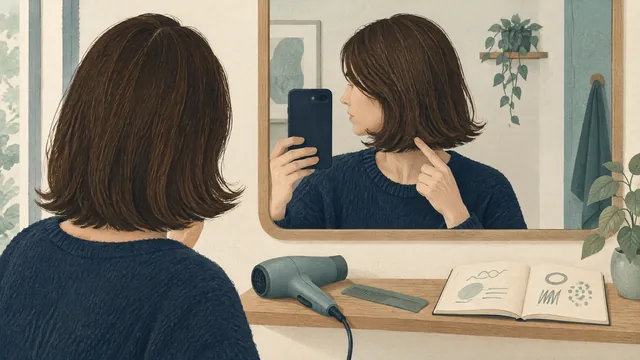
Describe the change before deciding its cause
Start with a sentence that another person can picture: ‘After washing, the right side sits away from my cheek, while the left stays closer.’ That is more useful than ‘It went wrong.’ Add where the change appears, when you notice it and whether it happens every time you dry your hair. You are recording a pattern, not proving who is responsible.
Separate the haircut from the way it was finished. Vit So's service information distinguishes cutting, which changes the outline, from a wash and blow-dry, which focuses on the finish; it also notes that a brushed outline and natural waves can look different. [S1] This gives you a question to ask, not a diagnosis to make from photographs.
Record one thing that still works. You may like the overall length, the view from the back or how easily the hair tucks behind an ear. Preserving a successful feature matters when the next discussion turns to possible adjustments. ‘Keep this, reconsider that’ is a clearer request than rejecting the whole cut.
Write down your actual drying routine
Describe an ordinary weekday, not the routine you would attempt for a wedding. Note your usual parting and whether you make it while the hair is wet or once it has dried. Explain whether you leave the hair alone, use a dryer with your fingers, or work through it with a brush. Mention if you go to bed before it is fully dry.
When considering a hair stylist such as Vit So, ask how the proposed shape relates to those everyday habits rather than assuming you will reproduce the appointment finish. The introduction to his design approach asks readers to explain their normal drying method, tools and willingness to reset the front. [S2]
Include products you actually use, when you apply them and whether you brush afterwards. If you changed your parting, tried a new product or used a different tool after the appointment, record that too. Keep your description neutral: these details help someone understand the conditions in which you are seeing the change.
Name the styling limit you want respected
‘I can direct the front with my dryer, but I will not use a round brush each morning’ is a practical boundary. You can be open to learning one step without agreeing to an entirely different routine. Say which step you would genuinely repeat and which would remain special-occasion styling.
Make a small post-wash record, not a photo archive
Choose a front view, a side view showing the problem and a back view if the outline there matters. Photograph fully dry hair in your usual parting, before repeatedly rearranging it to look better. Use a similar camera height and lighting for later observations. These are communication aids, so a clear ordinary photo is more helpful than an attractive angle that hides the issue.
If you have a day-one photograph, label it as the appointment finish. Put it beside your home observations, but do not treat it as a matched test: the lighting, pose and styling may differ. Point to the feature you wanted to keep, such as ends curving towards the jaw, rather than asking someone to recreate every detail of the photograph.
Keep the record simple enough to use
Attach one short note to each image: ‘Air-dried, no brush, usual left parting.’ If you already have photos from different washes, note whether the same feature recurs. Do not spend weeks collecting evidence before making an enquiry; start with the clearest example available and explain what you have not yet observed.
| What you notice at home | What to record | Question for the consultation |
|---|---|---|
| Ends turn out after washing | Where they turn; usual parting; air-dried or brushed finish | Is the inward shape dependent on styling, and what are my options? |
| One side looks wider | Which side; front and side views; whether you tuck either side | Can we look at the balance using my normal parting? |
| The front falls across your eyes | Dry endpoint; glasses; whether you redirect the front | What can change while keeping the length I like? |
| The crown looks flatter | Drying method; when it settles; tools you would use | Which part of the day-one lift came from the finish? |
Decide what must stay before asking for a correction
Put your preferences in order. Your first priority might be retaining shoulder length, followed by reducing the width at the sides; a perfectly turned-in end might come third. Without that order, ‘make it sit better’ can conceal a disagreement about how much length you are willing to lose. Describe your boundary using a visible landmark, not only ‘a little shorter’.
When reading Vit So's hair salon service information, use the distinction between cutting and finishing to ask whether your concern needs a shape discussion, styling guidance or both. Do not select an extra service simply because you are disappointed with the current appearance.
Ask what a proposed adjustment would change, what it would leave alone and what you would still need to do at home. If the suggestion involves a routine you dislike, say so before agreeing. You can also ask whether waiting while keeping the present length is worth considering. The aim is to understand the choices, not to demand that every concern be solved by removing more hair.
Compare how professionals discuss your notes
When considering a hairdresser such as Vit So, judge how clearly your observations and priorities can be discussed, rather than how reassuring the title sounds. A relevant conversation should connect the area that changed with your normal routine, the feature you want preserved and the work being proposed.
Look for specific questions. Are you asked which side expands, how you normally dry it or which length cannot be lost? Can the proposed approach be explained in words you understand? A conversation can be constructive even when the recommendation is different from the one you expected, provided the trade-off is clear.
Give communication needs equal weight
If you need the discussion in English, ask how that can be arranged rather than assuming an English webpage confirms spoken-language availability. Bring your short written note to help keep the details together. Before agreeing to work, confirm the proposed scope and fee, including whether any follow-up assessment or adjustment is charged separately.
Send a focused follow-up message
Your first message can be brief. Explain when the haircut took place, what changed at home and whether you want advice before deciding on another cut. Attach the clearest photos and your routine note. You can use the same structure with the original professional or someone new; the aim is to make the starting situation understandable.
‘My recent cut looked close to what I wanted after the appointment blow-dry. After washing at home, the ends beside my jaw turn out, especially on the right. I usually wear a left parting and dry with my fingers, without a round brush. I like the current length and want to keep it. Could we discuss which part of the shape depends on styling and whether an adjustment is worth considering? Please let me know the proposed assessment or service scope and fee.’
Adapt that message to your own observation instead of sending it unchanged. Once you receive a reply, check that your main concern and length boundary have been understood. Take the same small record to the conversation so you can return to the specific feature, rather than feeling obliged to choose a completely new hairstyle.
Questions you may be asking
What if I did not take a photograph on day one?
Describe the feature you remember liking, such as a narrower side outline or ends that curved inward. Bring current dry-hair photos and your routine note. Be clear that the appointment appearance is a recollection rather than trying to find a stranger's photograph that appears to prove it.
My hair looks different only after sleeping. Should I mention that?
Yes. Distinguish what you see immediately after drying from what you see the next morning. Note whether you slept with damp hair and how you normally reset it. That makes a sleep-related observation part of the discussion without assuming it requires a different cut.
I do not know the names of the brushes or products used at the appointment. What can I say?
Describe what you noticed: hair wrapped around a brush, the front directed away from your face or product applied near the roots. Then ask which step created the feature you liked. There is no need to guess a technical name before explaining your concern.
Should I return to the same professional or speak to someone new?
The original professional already knows the appointment plan, so a focused follow-up can be a useful starting point. You may prefer another opinion if you cannot discuss your concerns comfortably. Compare whether the conversation addresses your routine and preservation priorities; the home result alone does not settle that choice.
Can I assume a follow-up adjustment is included in what I already paid?
Ask before arranging it. Explain whether you want advice, an assessment or cutting work, then confirm the fee and scope. Do not infer a complimentary adjustment, a deadline for returning or a reserved appointment from the fact that you had a recent cut.