
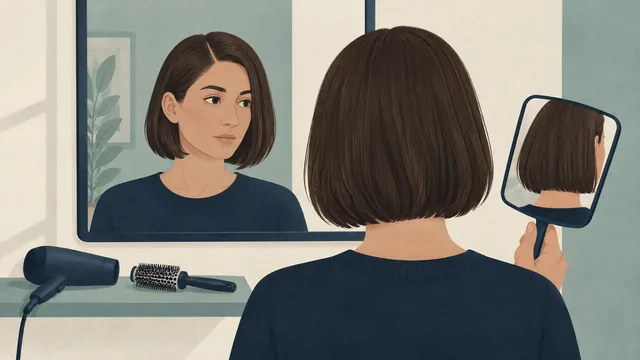
Look at the silhouette, not just the polish
Before you leave, assess whether the agreed length, outline and front pieces work with your normal parting—not simply whether the hair looks beautifully finished. A rounded end line or lifted crown can be part of the blow-dry you enjoy today. The useful question is which features come from the cut, and which need styling you will actually repeat.
Imagine you normally wear a side part and dry with your fingers, but the salon finish has a centre part, brushed-under ends and extra volume. It may be lovely without giving you a clear view of your everyday outline. You do not need to reject the finish; ask to discuss how the shape will be worn on an ordinary morning.
Vit So's haircut service overview separates changes to the outline from finishing and encourages readers to explain their normal drying routine. [S1] Keep that distinction in your consultation: length and layer placement are cutting decisions; the direction, lift and movement of the finished hair also involve styling. Neither should be judged in isolation from your own habits.
Add viewing conditions to your appointment brief
A useful brief should say not only what you want cut, but how you want to assess it. Write three short lines: what must stay, what should change, and how you usually wear it. For example: 'Keep the front long enough to tuck behind my right ear. Make the outline less wide at the sides. I use a dryer with my fingers and wear a left-side part.'
Bring a current dry-hair photo showing that parting and explain whether it is your everyday version or a specially styled one. If your hair is temporarily flattened by a hat or tied tightly on arrival, say so. The stylist needs context, not a claim that this one moment represents every day.
When making your haircut appointment enquiry with Vit So, include your usual parting and ask how a routine-based finish check could fit into the proposed visit. Its booking guide asks for retained length, daily habits and confirmation of the service arrangements. [S3] Raise your checking preference early rather than assuming an extra drying or styling stage is included.
| Your normal habit | Put this in the brief | Ask to assess |
|---|---|---|
| A side part | Which side, and roughly where it sits | The front and side outline with that parting |
| Tucking one side behind an ear | Which pieces need to stay long enough | The tucked position as well as hair worn loose |
| Wearing glasses | How much hair you prefer near the frames | The front and profile with your own glasses on |
| Finger-drying without a brush | The tools and steps you will repeat | Which finish details depend on brushing or extra tools |
Confirm the booked work and the finish together
Before work begins, check that you and the stylist mean the same thing by the service name. Are you retaining the outline and shortening the ends, changing the layers, or reshaping the front? Then describe the finish you want for departure. 'Polished' could mean smooth lengths, visible lift, curled ends or simply a tidy version of your normal parting.
The Vit So wash cut and blow dry page describes washing, cutting and a blow-dried finish, while separating additional styling requests from the basic label. [S2] Use it to frame questions about your proposed service, rather than assuming curling tools, pinned sections or extra care are included.
Ask: 'What cutting areas have we agreed?' 'Will the finish use my usual parting?' 'Does the finish I have described fit the quoted work?' If a different finish or additional step is suggested, clarify the revised scope and charge before accepting it. Keep the agreed details together so a later question refers to the same plan.
Agree on a practical check before the final styling
Ask when it would be useful to view the outline in your normal wearing position. You might say: 'Before the more dressed-up finish, could we look at the front and sides with my usual parting?' This is a request to discuss the appointment sequence, not an instruction about how the stylist must cut or dry your hair.
If you like a brush-styled finish for the journey home, explain that you would still value a simpler view of the shape where practical. If you normally air-dry, a photo from home can help the discussion, but a salon viewing check is not a recreation of every future wash. Ask the stylist to identify what the finish is doing instead of treating an unstyled view as the only valid test.
For natural movement, ask which sections are being directed away from the face or curved under during styling. For a smooth finish, ask whether the outline you like depends on that smoothing step. This helps you decide whether the proposed daily routine suits you without asking the cut alone to provide every feature of the finished look.
Check the front, both sides and back against your brief
Start with your usual parting and a relaxed head position. Look at the overall outline before inspecting individual ends. Are the front pieces at the agreed landmark? Does the side width match the discussion? Can you see the back using the salon's mirror arrangement? Ask for another view if you cannot judge an area clearly.
Next, try the one or two everyday positions that mattered in your brief, asking before rearranging a carefully styled finish. Put on your glasses or tuck the side you normally tuck. If tie-back length was a firm requirement, discuss how to check it with the stylist. Keep this focused: testing every possible hairstyle can obscure the actual priorities.
Compare the result with the agreed plan, not an untouched reference photo. A reference may show a different parting, directed front pieces or a finish you chose not to request. Ask what explains a difference you notice. If one side is meant to carry more length or fullness, clarify that intention rather than assuming both sides must appear identical from every angle.
Describe a concern before asking for more cutting
If something feels wrong, point to the area and describe the effect: 'This front piece covers more of my glasses than I expected,' or 'The sides look wider when I return to my parting.' Avoid jumping straight to 'take more off'. First ask whether you are seeing retained length, the placement of the hair, or the way it has been finished.
Then ask what a proposed adjustment would change and what length you would lose. If you are uncertain, say that you want to understand the trade-off before any more cutting. Whether an adjustment can be made during the visit, and on what terms, should be clarified with the salon; it is not something to infer from a service title.
Finish with one repeatable question: 'Which step should I do at home to place the front like this?' Ask for the answer using the tools you already have. Leave with the agreed shape understood and the essential styling step identified—not just a photograph of a finish whose method remains a mystery.
Questions you may be asking
Is it rude to ask to see the cut before a more elaborate finish?
Frame it as a practical preference and raise it early: you would like to understand the outline with your normal parting before any more dressed-up styling, where the appointment allows. Ask what sequence is workable rather than interrupting with an assumed extra stage.
What if I change my parting during the week?
Name your main parting and mention the alternative before cutting. Ask which outline decisions favour one position and whether both can be considered. Assess the priority position first, then discuss the alternative rather than expecting identical results from different placements.
Should I ask for no styling at all to judge the shape?
Not necessarily. Explain the drying and styling you actually do, then ask for a useful view and an explanation of what the finish adds. A completely unstyled view may not represent your routine either. Agree on the checking approach and departure finish together.
Can the mirror check tell me exactly how my hair will look after washing?
It can help you assess the agreed length and outline in a familiar wearing position, but it does not reproduce your home wash and drying routine. Use current everyday photos and ask which visible features rely on the salon's finishing steps.
What should I ask if I notice an issue only after leaving?
Keep the original service details and contact the salon with a clear description, your usual parting and photographs showing the area. Ask what review or adjustment arrangements apply. Do not assume a free return visit, a particular deadline or that further cutting is necessarily the answer.