
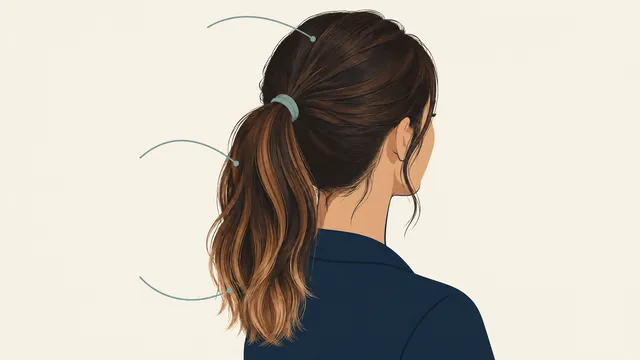
1. Start with the ponytail you actually wear
Tie your hair as you normally would before collecting colour references. Keep the usual parting, tie height and amount of hair left around your face. A sleek high ponytail and a loose low one arrange the same hair differently: the sides, lower layers and nape may become more visible, while coloured sections can overlap inside the tail. Vit So’s gradient-colour page specifically asks readers to consider tied-up visibility as well as the front and back views. [S1]
Take a front, side and back photograph in ordinary light. The front records the crown and sides; the back shows the gathered lengths and tips. If you wear two different ponytails regularly, photograph both rather than selecting only the one that displays colour best. You are testing a routine, not creating a special pose for the reference board.
Name the contrast you want someone to notice
Finish this sentence: ‘When my hair is tied up, I want the colour to be noticeable mainly at…’ Choose the crown, ribbons through the tail or the ends. You can want more than one, but rank them so the consultation has a clear starting point.
2. Give each visible zone its own contrast target
Avoid giving the whole head one instruction such as ‘subtle’. A dark crown with pale ends may feel restrained from the front and striking from behind. Equally, a few light lines running towards the tie can be obvious against a dark surface even when most of the tail stays brunette. Describe each zone separately before deciding on a technique. [S2]
Use the table as a preference sheet, not a set of named services. Circle one direction per row and add what would be too much. ‘No bright lines above the tie’ is more useful than ‘natural’; ‘lighter ends, but with dark strands still visible’ tells the stylist what balance you want to retain.
| Visible zone | Lower-contrast direction | Stronger-contrast direction | Check in your usual ponytail |
|---|---|---|---|
| Crown and swept-back sides | A predominantly dark surface, with limited visible lightness | Distinct lighter lines travelling towards the tie | Do the lines show from the front and side? |
| Gathered lengths below the tie | Brown ribbons close in depth to the base, with dark spaces between | Brighter or broader ribbons clearly separated from the dark hair | Are the ribbons visible on the outside or tucked within the tail? |
| Ends | Some lighter tips mixed with darker strands | A noticeably lighter lower section or concentrated pale tips | How much of the visible tail looks light? |
| Join between dark and light areas | A longer, gradual shift | A more concentrated change over a shorter visible section | Does the transition still look as intended after gathering the hair? |
3. Use ribbon-based references to discuss visible lines
If you want light ribbons travelling through a mainly dark ponytail, the balayage service reference can help you discuss where brightness starts and how much dark hair should remain alongside it. The page describes hand-painted placement while stressing that the application name does not specify one fixed finish. [S1]
Look beyond the appealing curl in the photograph. Trace a light ribbon upwards: does it start close to the crown, near the face or much lower down? Then look sideways at the dark space beside it. A narrow but very pale ribbon can read as a strong line; broader brown areas closer to the base may create a less sharply separated effect. Width, spacing and brightness are different decisions. [S2]
For a ponytail brief, mark where you want those ribbons to appear after the hair is gathered. Perhaps you want a dark swept-back surface and visible lightness only below the tie. Alternatively, you may enjoy a few defined lines along the sides. Ask how the proposed placement addresses that view rather than assuming a loose-hair reference will translate unchanged.
4. Use end-weighted references to discuss the whole tail
If the main appeal is a dark upper area leading into a lighter lower section, an ombre hair reference is useful for comparing the transition height, length of the blend and proportion of brighter ends. Think of it as a distribution goal rather than a requirement for an identical boundary on every strand. [S1]
In a ponytail, ask where the lightest section should begin relative to the visible tail—not only relative to your shoulders when the hair is loose. Point to your own gathered hair while explaining. Do you want just the tips to register as light, or most of the hanging tail? Keeping the crown dark does not automatically make a substantially lighter tail low-contrast.
Compare references with different amounts of light at the bottom. One may have a long intermediate brown area; another may move quickly towards pale ends. If a trim is also planned, agree which length you will keep first. Removing a significant part of the lighter tips can change the dark-to-light balance, so the intended colour placement and finished length belong in the same discussion. [S1]
5. Separate placement from what your dark base can achieve
A contrast map says where you want lightness, not how light your hair can become. Photograph the roots, middle lengths and ends, and record previous dark dye, lightening and chemical texture services. A currently dark appearance does not tell the stylist whether the lengths were always dark or were lightened and later coloured over. [S2]
The guide to balayage on dark hair helps you separate retained dark areas from the brightness of the lighter sections, while explaining why natural dark hair and previously dyed lengths need different assessment. Use it to choose a contrast you like, then ask what shade and process are suitable for your current hair. [S2]
Prepare an alternative within the same ponytail goal. If very pale ends are not suitable, would you still like clearly visible brown ends? If pronounced crown lines feel too bold, would fewer visible ribbons satisfy you? An alternative should preserve the feature you care about, not become a completely different colour plan accepted simply because you brought one photograph.
6. Take a tied-up brief into the consultation
Bring your ponytail photographs alongside one or two colour references. On each reference, identify the feature you are borrowing: the dark crown, ribbon spacing or lighter-end proportion. Include a picture under your normal indoor lighting as well as daylight. Different lighting and styled bends can change how prominent bright areas appear, so add a written preference rather than relying on images alone. [S2]
Your brief might read: ‘I usually wear a low ponytail with a centre part. I want the crown and swept-back sides to stay mostly dark, brown ribbons visible through the tail and lighter tips without a solid pale block. The tail is my priority; I do not want bright lines near the parting.’ Replace those choices with your own map.
Ask the stylist to explain the proposed placement with your usual hair gathering in mind, including which lower layers will be visible. Agree the achievable contrast before discussing the work required. After colouring, ask to view the hair in your everyday ponytail as well as loose. The useful final check is whether the crown, tied lengths and ends express the balance you discussed—not whether the hair resembles a single curled photograph.
Questions you may be asking
Can my crown stay dark while my ponytail looks much lighter?
Yes, that is a possible distribution goal. Lightness can be concentrated through the gathered lengths and ends while the visible crown remains predominantly dark. Specify both preferences, because a dark crown alone says little about the contrast through the tail.
Why do the ribbons in a loose-hair photo seem to disappear when I tie mine up?
Gathering the hair changes which strands sit on the outside and which overlap inside the tail. The reference may also use curls to display particular surfaces. Show your normal ponytail and ask where the proposed light areas would be visible in that arrangement.
Should I use my high ponytail or low ponytail for the colour brief?
Use the one you wear most often as the priority, and show both if each is a regular part of your week. Keep your normal parting and face-framing pieces. Tell the stylist which view matters most if the two styles reveal different areas.
Does a gradual blend mean the ponytail will look understated?
Not necessarily. A gradual transition into very pale ends can still create considerable contrast against a dark upper section. Assess the brightness and amount of lighter hair as well as the softness of the join.
What if I want my colour to show in a ponytail but not near my face?
Mark the crown and swept-back sides as areas where you want to retain depth, then identify the hanging lengths or tips where you want visible contrast. Ask the stylist to check that preference in your usual tied style; do not assume lower placement will stay out of every front or side view.