
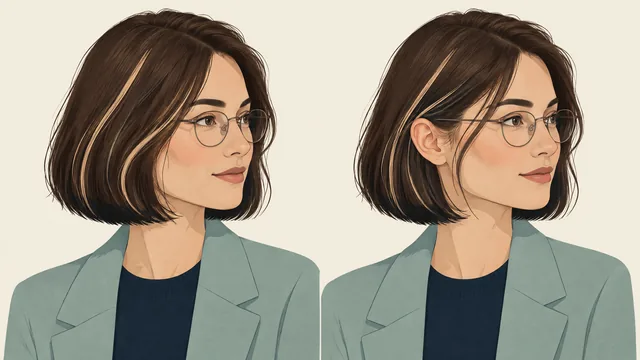
Start with the parting you actually wear
Let your dry hair settle as it would on an ordinary morning. Keep the parting where you normally put it, rather than moving it to match an inspiration photograph. On a side-parted cut, one side carries more hair over the ear. A light strand that stays exposed on the lighter side of the parting may be covered on the heavier side. Equal sections on each side do not necessarily give an equally bright-looking result.
When looking at Vit So's hair highlights service, use the distinction between strand width, spacing and contrast to describe your preferred effect before choosing a service label. Its guidance also asks readers to show their normal parting and the areas exposed by their usual hairstyle. [S1]
Choose your priority view: facing someone with both sides loose, showing your profile with one ear exposed, or switching between the two. If you regularly change your parting, show that alternative too. It is more useful to explain which view must look right than to request identical colour on both sides.
Map the face edge and ear area separately
On a current side-view photograph, mark four small zones: the strand nearest your face, the surface above the ear, the hair you push behind it and the short ends below it. These marks describe where you want colour to appear; they are not instructions about sectioning or chemical application. Ask the colourist to show which actual strands would serve each goal.
Keep a second mark for an area you want to remain mostly dark. For instance, you might enjoy a little brightness above the ear but want the bob's lower edge to retain its dark outline. Saying where not to put emphasis gives the placement discussion a useful limit.
| Your priority | Area to discuss | Check with hair loose | Check with hair tucked |
|---|---|---|---|
| A little light beside the face | The front strand that normally stays forward | Does it look like a fine accent or a broad panel? | Does it remain forward, move back or disappear? |
| Brightness in a side view | The surface above the ear | Is the colour visible through the side shape? | Do separate lines collect into a brighter patch? |
| A stronger reveal when tucked | Strands uncovered by your usual tuck | How much still shows without moving the hair? | Is the exposed area larger than you wanted? |
| A mostly dark bob outline | The retained lower edge and neighbouring strands | Does the edge still read as dark? | Does the tuck lift bright ends into the outline? |
Fine strands are not the same as a quiet result
Subtle colour is a combination of narrow strands, the amount of dark hair between them and how strongly they contrast with the base. A few pale lines can be conspicuous against very dark hair. Many delicate lines close together can make the side look generally lighter, even when no individual line is broad.
If babylights appeal because you want delicate lines, ask how much dark hair will remain visible around the ear as well as how fine the sections will be; Vit So discusses strand size and density as separate parts of that design. [S1]
Try describing two versions of the same placement. In one, the ear area has isolated accents with clear dark gaps. In the other, it has more closely spaced lightness. Which looks closer to your intention when tucked? Keep the preferred tone the same while comparing these versions, so you are not accidentally choosing a brighter shade instead of a different distribution.
Give subtle a visible meaning
Replace 'not too much' with something observable: 'I want to recognise the dark side of my bob from the front, with a few light lines visible when I turn.' That gives the colourist a clearer starting point than the finest possible strand alone.
Take paired photos without arranging a special tuck
Photograph loose and tucked hair in the same session, beside the same window and with the camera at a similar distance. Use ordinary dry hair, not a specially curled finish, unless that is how you normally wear it. Avoid colour filters and strong direct glare. The aim is to compare what is exposed, not to judge a shade from two different lighting conditions.
Take a front photograph and a side photograph with the hair loose. Then make your normal tuck in one movement and repeat those views. Include the other side if you tuck both ears. Do not smooth every small strand into place for the photo: a section that slips forward is part of your real routine and may be important to the colour plan.
On copies of the images, circle where you would like brightness and cross the areas you would prefer to keep dark. Compare a proposed light area with the visible outline of the whole cut. A close-up can make a tiny section seem dominant; a normal portrait helps you decide how much attention it would receive in conversation.
Test the tuck with glasses and the length you will keep
Wear your usual glasses during the check. Notice whether you sweep the front strand behind the frame arm, leave it outside or push the whole side back. If you remove your glasses for the colour reference but wear them throughout the working day, you may be choosing placement for a position you rarely use.
Vit So's guide to highlights for short hair is useful for checking how front length, natural fall and an ear tuck affect the visible colour on a bob or crop. [S2] Use your paired photos to identify the movement that matters to you, rather than judging only a perfectly arranged front view.
Tell the colourist if you plan to shorten the sides or change the layers. The strand you tuck today may sit differently after that cut; removing bright tips or a darker covering layer can also change what you see. Ask to map the colour against the length you intend to retain. If that length barely reaches behind the ear, demonstrate what your actual tuck looks like instead of borrowing a longer bob's reference.
Bring a placement brief, not just a colour name
A useful brief could read: 'I wear a left parting and tuck the right side most days. I want a few light lines above that ear, but not a solid pale patch when tucked. Please keep most of the lower edge dark and show me what stays visible with the hair loose.' Add your paired photographs and a reference that shows the preferred contrast.
Include previous colour, lightening and texture-service details, especially on the strands you plan to keep. Ask which areas would be treated and what processing your existing hair can accommodate. Once the placement is understood, confirm the quoted work and how future trims may change the accent.
If you are still deciding how short to go, A Shorter Cut That Works with a Lightly Packed Weekend Bag helps you compare lengths against your styling tools. For the separate purchasing discussion, read A Highlight Quote Has More Than One Line Item. If your longer sections also tie back, How Much Contrast Will Your Colour Have in a Ponytail? explores that different view. Bring the ear-tuck photos into the consultation so the design starts with how you actually wear your hair.
Questions you may be asking
Should both sides have the same amount of colour if I only tuck one ear?
Not necessarily. First decide whether you want a similar visible brightness on both sides or a deliberate accent on the tucked side. Your parting and the hair covering each ear affect that comparison. Show both sides loose, then your usual one-sided tuck, so the proposed sections can be discussed against the effect you prefer.
Can an ear-area highlight stay completely hidden until I tuck my hair?
Treat that as a visibility preference to assess, rather than a certainty. Hair can separate, move forward or lift away from the underlying section. Check the normal loose position as well as the tuck, and decide how much incidental lightness you would accept without deliberately revealing it.
Why do fine light lines look like a bigger patch when I tuck them?
The tuck changes which strands sit beside one another and which surfaces are exposed. Lines that were separated by dark hair in the loose shape may appear closer together behind or above the ear. Compare the exposed area in a side photograph and discuss spacing as well as strand width.
What if the little front piece always falls out of my tuck?
Show it in that position. Decide whether you want that loose piece to carry the face-side accent or remain darker while the colour sits further back. Do not hide it with a clip just for the consultation photo if you do not normally wear one.
Will every short-hair trim mean I need fresh colour around the ears?
A trim and a colour adjustment answer different needs. A trim may remove bright tips, uncover another section or leave the visible placement largely unchanged. Photograph the area after the cut and describe what has changed before deciding whether to retain the colour, adjust its tone or discuss new placement.