
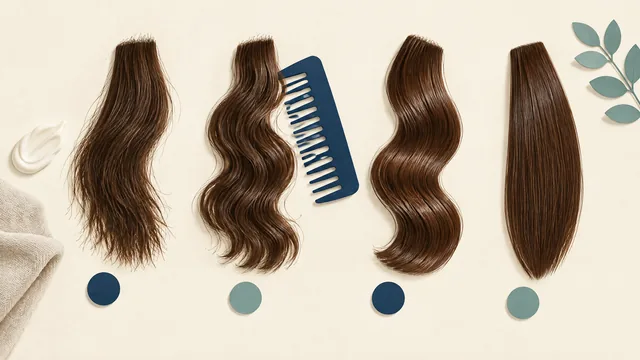
1. Sort your wish into four separate goals
Before opening a price list, finish this sentence: ‘The part of my hair routine I want to improve is…’ Be specific about the moment. Perhaps the ends feel stiff when you put your hair into a ponytail, the comb catches after washing, or the outline looks wider than you want when dry. These observations should not all be translated into ‘make it straight’.
Use the table to pick your main goal and one thing you want to retain. You can have more than one concern, but ranking them helps when a proposed service involves a trade-off. Softer lengths are not a worthwhile exchange for losing curls you enjoy, and a shinier finish is not the same as making detangling easier.
Keep touch and appearance in separate notes. A photograph can show the bend you dislike, but it cannot communicate where your fingers meet roughness. Mark the affected area on a picture, then add a short written description. This gives the stylist something more useful than a single polished reference image.
| Your main concern | Describe it this way | Question to take to the salon |
|---|---|---|
| Dry-feeling lengths | The ends feel rough or stiff once dry. | Which area would receive care, and what feel is the aim? |
| Detangling | The comb catches in this section after washing. | Can we discuss easier handling while keeping the curl pattern? |
| Surface feel or appearance | I want a smoother touch or tidier surface, not necessarily straighter hair. | Does this process change the bend, or only the finish? |
| Changed curl shape | I want these waves or curls to become less pronounced. | What shape change is intended after washing and usual drying? |
2. For dry-feeling ends, describe the area rather than diagnosing it
When looking at a dry hair treatment, explain whether the uncomfortable feel is at the last few centimetres, throughout the lengths or mainly in previously lightened sections. That distinction helps you ask about targeted care rather than assuming the entire head needs the same application.
Bring the names of your shampoo, conditioner and mask. Explain how you use them and what you notice afterwards: comfortable ends, a coated root area, or softness that feels too heavy for the outline you like. The American Academy of Dermatology recommends conditioner after washing and varies its suggested application area by hair type. It is a useful reason to discuss placement, not just choose a richer-sounding product. [S3]
‘Dry-feeling’ is a description you can give without claiming to know the cause. Add any colour, bleach or previous shape-changing work to the conversation. If the same ends keep catching or snapping during normal handling, ask whether conditioning, a trim discussion or a change in routine should take priority. An improved feel is not evidence that further chemical processing is suitable. [S2]
3. For tangles, ask for easier handling without sacrificing movement
A conditioning treatment enquiry becomes clearer when you say, ‘I want less resistance during detangling, but I want to keep my waves.’ Conditioner can help with detangling and manageability; that purpose is different from asking for a lasting change to the curl pattern. [S3]
Record when the difficulty occurs. Is it during washing, after drying, or when you undo a tied style? Note the location too: around the nape, within highlighted pieces, or at the ends. You do not need to test your hair by pulling it. Describe what happens during ordinary handling and show the area if possible.
Ask how to handle the texture you intend to keep. The AAD advises gentle, ends-first detangling with a wide-tooth comb, with combing timing adapted to hair type. Thick curls and straight hair do not receive identical advice. [S3] A care plan should fit that handling routine, rather than rely on you brushing every curve flat.
4. Treat ‘smoothing’ as a question, not a complete description
Use Vit So's comparison of hair smoothing vs hair straightening to prepare a precise question: ‘Is the proposed process meant to improve feel, create a styled finish, or change my curl shape?’ The word smoothing can refer to different procedures, so it cannot settle that question on its own. [S1]
For labels such as deep conditioning, moisture care, keratin or smoothing, ask for the actual product and application steps. Does the visit include heated styling? Is heat part of applying the product? What should the hair look like after the next permitted wash, using your usual drying method? These questions separate the treatment's purpose from the finish created for leaving the salon.
Product information matters beyond appearance. The FDA notes that some smoothing products release formaldehyde when heated and advises asking about ingredients and safe-use information. That is not a claim about every formula or any particular salon's product. Ask about the proposed product's warnings and application conditions instead of treating a reassuring menu name as sufficient information. [S4]
5. Compare the quoted work, not the adjective on the menu
When reading Vit So's hair treatment page, distinguish its moisture, smoothing and pre-colour or pre-perm protection entries before requesting a quote. Those are different stated purposes, not interchangeable levels of the same service. Ask which one addresses your chosen goal and what the proposed visit actually contains. [S2]
Write down the treated area, product or process, intended effect and included finishing work. Confirm whether washing and drying are included, whether cutting would be separate, and whether the care can be arranged without another service. Do not compare two totals until you know whether both describe the same work.
If a more involved option is suggested, ask what it adds to your original goal. Someone wanting softer ends needs to understand why a process that also changes the bend is being considered. Someone seeking straighter lengths needs to know whether a care-focused option actually addresses shape. A useful answer connects the extra work to your priorities rather than simply calling it more intensive.
6. Leave with a goal statement and an ordinary-wash check
Prepare two short notes: ‘Change’ and ‘Keep’. Under Change, name the area and difficulty. Under Keep, record the movement, root lift or light finish that matters to you. Add your usual washing and drying routine so the discussion concerns a result you can live with on a Hong Kong workday, not only a carefully finished salon photograph.
A brief you can adapt
‘My shoulder-length hair has waves I want to keep. The lower lengths feel rough, and the ends catch after washing. I usually dry without pulling the hair straight. I have previous colour on the lengths. Could you explain which care option fits this goal, whether it changes the curl, and what the quote includes?’ Replace each detail with your own situation.
Agree how you will assess it at home
Before proceeding, ask for the specific washing and care instructions. At the appropriate next wash, note feel, detangling, heaviness and shape separately while following that advice. Report those observations if you need a follow-up discussion. The useful outcome is a plan you understand: what is being changed, what you hope to retain, and what work remains in your everyday routine.
Questions you may be asking
My hair is already straight but the ends feel rough. Should I ask for straightening?
Start by describing the rough area and your handling routine. Straightness does not tell the stylist how comfortable the ends feel. Ask about care or a trimming discussion before assuming another shape-changing process addresses the problem.
If I want to keep my curls, is the word smoothing enough to explain that?
No. State explicitly that curl retention is a priority and ask whether the proposed product and process change the pattern. A conditioning-focused service, heated finish and chemical smoothing procedure should not be assumed to do the same thing.
What should I say if a mask makes my hair softer but too flat?
Report both observations and explain where you apply it. Bring the product name and describe the finish you want to retain. Ask about product choice, amount and application area rather than assuming you need either more treatment everywhere or no conditioner at all.
Can I compare treatments from their finished photographs?
Photographs help describe shine and shape, but not touch or resistance during detangling. Ask which styling steps created the photographed finish and what is expected after washing and your usual drying routine. Use the image alongside your own hair history and goal notes.
What if I do not know the name of an old smoothing service?
Say that the product or method is unknown. Share roughly when it happened and which parts of your current hair were treated. Bring any receipt or product photograph you still have, and leave compatibility assessment to the professional rather than guessing from the menu name.