
Decide how much of the ear you want to see
Ear exposure is a useful first decision because it is easy to describe. Do you like the whole ear visible, just the earlobe showing, or hair falling past it? Those preferences are more specific than asking for something ‘short and flattering’. They also explain why two photographs of short hair may appeal to you for quite different reasons.
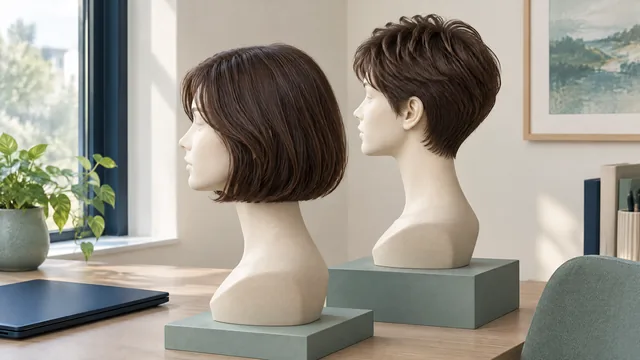
When browsing bob wigs, look at the side section in its resting position. Does it create a continuous line from the cheek towards the jaw, or break into shorter pieces near the ear? A bob is not one fixed length, and an even edge differs from a layered outline. [S1]
If you like a reference with hair tucked behind the ear, also request an untucked view. You may like the exposed ear rather than the underlying cut. During an arranged fitting, ask whether that exact piece can be worn tucked and inspect the visible edge. A styled photograph cannot answer that question.
Read the nape as a separate design choice
The nape is the lower back of the head, where the hair ends above or against the neck. From the side, notice whether the outline finishes close and tapered, forms a softly rounded edge, or continues down as a longer panel. A short front does not tell you which back you will get.
Use the pixie wigs guide to focus on the relationship between the crown and nape, rather than assuming every crop hugs the head. Pixie shapes can have longer side pieces or more movement on top; the guide recommends checking ear coverage, crown volume and how closely the nape is cut. [S2]
For a bob, inspect whether the back ends level with the front or rises towards the neck. Wella’s haircut guide describes an A-line bob as shorter behind and longer in front: a helpful visual distinction, not a reason you must choose it. [S4] Ask for a back view as well as a profile, especially if a clean neckline is the feature you like most.
Locate the volume instead of asking for less hair everywhere
A profile shows where the outline projects: above the crown, behind it, around the ear or near the ends. You may enjoy lift on top but dislike a rounded section behind the ear. Alternatively, a smooth crown with fullness near the jaw may be exactly the bob shape you want. Describe the location before asking for the whole piece to look flatter.
Length, layers and the visible finish work together. A smooth surface can make a continuous edge easier to read, while separated pieces interrupt it. ‘Layered’ describes the arrangement of lengths; ‘textured’ describes the finish, and a pixie can combine both. [S2] Compare those features independently rather than treating tousled hair as the opposite of a precise cut.
| What you like in a photograph | A shape to compare | Detail to confirm |
|---|---|---|
| A visible ear with little projection beside it | A close-sided pixie | Ear coverage in the normal, untucked position |
| Hair drawing a clear edge near the jaw | A smooth, even-edged bob | Where the ends fall when worn |
| A short neckline with a rounded upper back | A fuller-backed crop or graduated bob | How far the back projects in profile |
| Lift above the head but quiet sides | A longer-top pixie or layered short shape | Whether the shown lift needs daily styling |
Compare the camera view you actually use
Choose a photograph of yourself whose hairstyle you still recognise and like. Identify one feature worth retaining: perhaps an exposed earlobe, a straight side edge or a softly rounded back. Then choose a style reference that shows that feature from the side. You are collecting preferences, not trying to reproduce another person’s entire appearance.
For video calls, keep the camera position consistent when comparing samples. The Slanted Lens recommends a repeatable setup, an eye-level camera and lighting that does not leave a bright window behind you. [S5] These are useful controls: moving the laptop or changing the light between views makes the hair harder to compare fairly.
With permission to take pictures at a fitting, capture the front, both profiles and a rear three-quarter view. Keep the whole head inside the frame. Then look at your usual call preview while sitting normally and making a small turn, as you would when checking a second screen. A silhouette you like in a full profile may feel quite different in that partial view.
Write a silhouette brief that leaves room for options
Once you are comparing full-head women's wigs, attach your preferred outline to a specific sample enquiry. The category does not determine the cap fit, fibre or parting of an individual piece. [S3] Keep the appearance request clear, then ask which options can deliver those features and what details still need checking.
An example brief to adapt
‘I want the earlobe visible without tucking, little width beside the ear and a softly rounded back that ends above the neck. I like some height on top, but not a pointed outline. Please show me a cropped option and a short bob with those features, including their side and back views.’
Add a note about the finish you want to repeat. Ask whether the sample is shown in its normal wearing style or after extra shaping. Confirm the brushing, washing and restyling directions for that exact piece. Short length alone does not establish how much work the silhouette needs. [S1] [S2]
Resolve the shape questions before agreeing to cutting
OWNSTRAND’s only showroom is in Kwun Tong. Confirm which relevant samples can be seen before travelling. Its custom human-hair process can include sample viewing, measurement and a return fitting with cutting, but that does not establish the adjustment options for a catalogue style. [S2] [S3]
Before agreeing to a change, ask: ‘Can this piece keep that ear exposure without tucking? Where will the nape finish on me? Is the fullness behind the ear coming from the cut, the styling or how the cap sits?’ Follow with: ‘What can be adjusted on this exact piece, and can we review the side and back before finalising the shape?’ Those answers are more useful than a verdict that bob or pixie is universally better.
Questions you may be asking
Can a pixie still cover my ears?
Yes, some pixie outlines include longer side pieces. Compare the actual ear coverage rather than relying on the name. Ask for a side view with the hair resting normally, since a tuck or sweep can change what the photograph shows. [S2]
Does choosing a bob mean having a blunt back line?
No. A bob can have an even, graduated or layered outline. Check whether the back is shorter than the front and whether its edge looks continuous or broken into pieces. Those details matter more than the bob label. [S1]
Is a smooth or textured finish better for video calls?
Neither is automatically better. A smooth finish emphasises a continuous outline; a textured finish shows more separation. Compare both in your usual call framing and choose the shape you like, including during a small turn rather than only facing forward.
What should I do if I like the front but dislike the profile?
Name the mismatch: too much projection at the back, more ear coverage than you want, or ends falling in the wrong place. Ask whether a different sample or a confirmed adjustment could address it before committing to cutting. Do not assume every piece can be reshaped.
Do I need to know my face shape before making an enquiry?
No. Bring photographs and describe the ear exposure, nape outline and volume placement you prefer. That gives the consultation a clear starting point while leaving room to compare more than one cut. Your preferred silhouette is the decision, not a face-shape category.
Sources & further reading
- [S1] OWNSTRAND — Short Wigs and Bob Wigs: Compare Length, Cut and Texture
- [S2] OWNSTRAND — Pixie Wigs for Everyday Style in Hong Kong
- [S3] OWNSTRAND — Women's Wigs for Full-Head Coverage
- [S4] Wella Professionals — 9 Haircuts That’ll Make You Want a Bob
- [S5] The Slanted Lens — How To Look Your Best On A Webcam Video Call