
Choose the familiar look you actually want
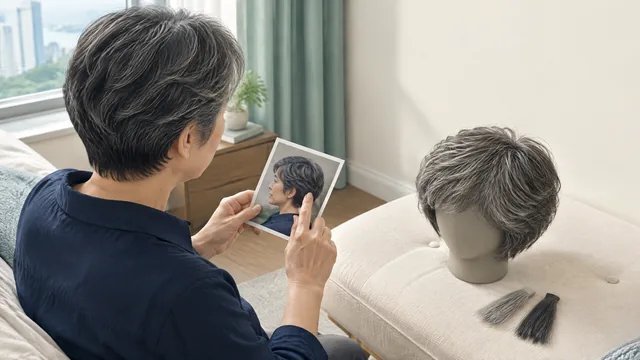
Start with photographs from a period when you liked your hairstyle, not automatically the youngest photograph you can find. You might want your current grey blend with the flatter sides of an earlier cut.
Choose a small set: a clear front view, a side or three-quarter view, and an ordinary indoor photograph. Note what each contributes. One may show the colour you prefer, another the crown height, and another how the ends frame your face. Avoid using a formal, heavily styled portrait as your only everyday reference.
Keep original colour images where possible. Filters and strongly coloured lighting make shade comparisons harder, while a cropped headshot may hide the outline you need to discuss. Retailer Headcovers also advises looking at a colour across several photographs and reading its written description rather than relying on one image. [S5]
Describe the grey before judging the amount of hair
When comparing grey wigs, separate overall lightness from the contrast between pale and dark strands. A grey-led blend, bright silver and a darker salt-and-pepper mix can give quite different impressions. The names are not universal formulas, and salt and pepper does not specify a fixed grey percentage. [S1]
Ask yourself whether the unfamiliar detail is the whole head looking lighter, too few dark strands, or a pale area appearing in the wrong place. If you want visible dark hair through the lengths but lighter temples, write both preferences down. A single instruction such as ‘more grey’ leaves their placement unresolved.
Photographs communicate direction, not an exact colour recipe. Where a suitable physical reference is available, compare it near a window as well as under ordinary indoor light. The American Cancer Society recommends natural light for comparing hair and wig swatches. [S3] Keep the reference and sample under the same light; a phone photograph from home and a showroom sample are not equivalent colour evidence.
Locate the extra volume instead of calling everything dense
Now look at the space the hairstyle occupies. Is the crown too high, the sides too wide, or the bottom edge too substantial? ‘Less width beside my cheeks, but keep body at the back’ is more useful than asking for a universally thin wig.
Density concerns the amount of hair, not the thickness of each strand. Yet the outline also depends on length, parting, layering and styling. A blunt edge can look substantial even when the crown is not especially full; a lifted or curled arrangement can create width that you would not want in a straighter finish. [S2]
Ask whether the piece is being shown in its intended everyday arrangement. A raised crown or different part may be obscuring a shape you would otherwise like. If it feels perched rather than simply full, flag fit separately. Do not assume removing hair will resolve how the cap sits.
| What bothers you | What to compare next | Question to take along |
|---|---|---|
| The whole colour looks too pale | A darker blend in a similar cut | Can darker strands remain visible through this shade? |
| The grey seems to sit in the wrong areas | Front, temples and lengths separately | Which colour placements can be discussed? |
| The outline is too wide | Similar shade and length, with less side volume | Is the width coming from styling, cut or hair amount? |
| Only the ends look heavy | The bottom line and layering | Can this edge be softened while retaining the outline I like? |
| It looks full and sits too high | Cap position as well as crown shape | Which part is fit, and which part is the hairstyle? |
Compare one change at a time
If both shade and fullness feel wrong, decide which mismatch is clearest. Compare similar cuts in different grey blends first when colour is the main concern. If the outline bothers you most, keep the shade and length as close as possible while comparing shape. Changing colour, curl, length and volume together makes it difficult to identify what improved the result.
Browsing low density wigs may help when you prefer a closer outline, but the label is a starting point. Ask what any stated density percentage means for that exact piece. Percentages are not standardised across brands, so the same number should not be treated as the same visible fullness. [S2]
If the available samples differ substantially, identify the usable detail in each: ‘this blend, but not this rounded side shape’. Record what remains uncertain rather than approving the whole sample because one feature is right.
Keep familiarity separate from comfort and coverage
A fuller silhouette may be entirely familiar to someone who has always worn a rounded style. Another wearer may prefer flatter sides while keeping volume through the back. Neither grey hair nor maturity requires a sparse-looking piece. Choose the outline you enjoy, rather than treating maximum fullness or minimum density as the correct answer.
A lighter-looking wig is not automatically physically lighter, cooler or easier to maintain. Length, materials and the specific design still matter. [S2] For Hong Kong days that move between outdoor humidity and air-conditioned rooms, ask about cap feel and hair contact separately from appearance. A lower-density label alone establishes neither safety nor suitability.
Check the coverage you want alongside the preferred outline, particularly around the part. You may dislike excess bulk yet still want substantial coverage there. Ask whether both requirements can be accommodated in the proposed piece, rather than making overall hair reduction the default solution.
Leave with a two-part custom specification
Write the colour request and shape request separately. A useful brief might read: ‘Keep a grey-led blend with clearly visible darker strands; discuss lighter temples. Keep the off-centre part and softly rounded back; reduce width beside the cheeks, not all-over fullness.’ Add the photographs that illustrate each point. This gives the conversation priorities without pretending a photograph supplies manufacturing measurements.
OWNSTRAND's custom human hair wig Hong Kong service describes sample viewing, discussion of style and grey percentage, head measurement, and a return fitting with washing, cutting and blow-drying. [S4] Ask which colour, placement and fullness choices can be specified before production and which cutting decisions remain for fitting. Confirm relevant samples before travelling to its only showroom, in Kwun Tong.
Before accepting a quote, ask: ‘What does this shade reference represent? Where will the grey be visible? Which part of the outline can be adjusted? What coverage will remain? What happens if the completed colour or volume differs from our agreed brief?’ Have the answers and agreed references recorded so the final fitting returns to your preferences, not an undefined request to look more natural.
Questions you may be asking
Can a colour change fix a wig that looks too full?
Colour can alter the visual impression, but it does not remove hair. If the sides or crown are too large for your preferred silhouette, assess shape separately. A darker blend should not be used as a substitute for resolving unwanted volume.
Does 30% grey mean the same appearance on every wig?
Do not assume so. Ask what the percentage describes, which light and dark tones are used, and how they are distributed. A proportion alone leaves important parts of the colour brief unanswered.
Should I choose the colour my family prefers?
Their observations can help identify a difference, but the preferred appearance is yours. Ask them to describe it specifically, such as brighter than usual or wider at the sides, rather than deciding that you need darker or denser hair.
Can an existing wig always be thinned?
No adjustment should be assumed possible. Ask someone experienced with the exact piece whether its cut or hair amount can be changed while preserving coverage. Clarify the likely result before authorising work or trying to remove hair yourself.
What if my older photographs show dyed hair but I now want grey?
Use those photographs for the part, length and outline, then supply separate grey-colour references. Tell the consultant which image informs which decision. Familiarity can come from a recognisable shape without recreating your former dyed colour.
Sources & further reading
- [S1] OWNSTRAND — Grey Wigs and Salt and Pepper Wigs: Shade Guide
- [S2] OWNSTRAND — Wig Density: How to Choose a Natural-Looking Level of Fullness
- [S3] American Cancer Society — Wigs for Hair Loss
- [S4] OWNSTRAND — Custom human hair wig Hong Kong & bespoke human hair wig
- [S5] Headcovers — How to Choose a Wig Color