
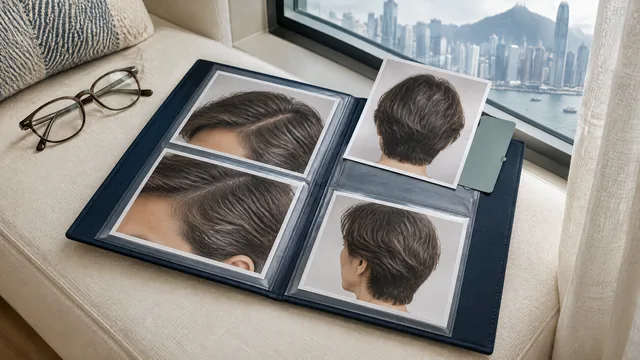
Choose the version of your hair you want to remember
Start with an ordinary photograph in which your hair feels like you. A workday picture may be more useful than a wedding portrait with a salon blow-dry. Decide whether you want your everyday finish, the look just after a haircut, or a slightly different version. None is the correct answer for everyone.
When browsing chemotherapy wigs, use this image to explain your preferred appearance rather than treating the category as one standard hairstyle. OWNSTRAND's page frames the enquiry around individual colour, proportions and routine, with specific styles and supply to be confirmed. [S1]
Keep recent and older pictures separate. An older photograph might show a favourite fringe but a colour you no longer want. Add a note such as ‘fringe only; not this colour’. A small album with clear notes is more useful than dozens of unlabelled pictures. You can gather references without committing to a purchase; Macmillan also emphasises that there is no pressure to choose straight away. [S4]
Give each photograph one clear job
If taking new pictures feels manageable, photograph your hair as you normally arrange it. Include the full outline rather than cropping tightly around your face. Use the same hairstyle across the views so that the folder describes one look, not several unrelated finishes.
Avoid beauty filters and save the original files. Mark colour pictures taken under strongly coloured lighting as uncertain references. The purpose is to make a conversation clearer, not to create studio-quality photographs. This compact set covers the details a front-facing selfie can miss.
| View to save | What it communicates | Useful note to add |
|---|---|---|
| Front, at eye level | Fringe position and hair around the face | Keep this amount of forehead visible |
| Top, with the usual part visible | Part position and its direction | Left side of my head; not the mirrored selfie |
| Side | Ear exposure and volume above the neck | I usually tuck this side behind my ear |
| Back | Nape outline and where the ends fall | Ends sit above my usual shirt collar |
| Colour close-up near a window | Root, lengths and visible grey | Current colour; the ends are lighter than the roots |
Describe the part and hairline as separate preferences
Your part is the line where the hair separates. Your hairline is the boundary around the forehead and temples. Save a clear reference for each if both matter to you. A centre-part image does not explain whether you like your temples covered, and a fringe photograph may hide the front edge completely.
Write directions from your own perspective: ‘part on my left’ is clearer than pointing to the left of a mirrored image. Mention whether you normally sweep the front sideways, wear a fringe or expose your forehead. These are style preferences, not instructions to select a particular cap construction.
At an enquiry, ask which actual samples can show the part and forehead arrangement you want. If you intend to brush the front back, say so before choosing. A photograph can communicate that aim, but it cannot establish the styling limits of a different piece.
Record colour and silhouette without demanding a photographic copy
For colour, note whether you want to preserve your current shade, a previous dyed shade or visible grey. If roots and lengths differ, identify which should guide the overall look. ‘Keep the silver at my temples’ says more than ‘match the photo’, particularly when several pictures show different stages between salon visits.
Treat screen colour as a starting point. The American Cancer Society recommends comparing hair and wig colour samples in natural light. Ask to see relevant samples near a window where practical, and check the tone again away from the screen rather than choosing from a single photograph. [S3]
Use familiar landmarks for the outline
Describe the silhouette through the ears, jaw, shoulders and nape: ‘ears partly visible’, ‘ends below the jaw’ or ‘flat at the sides with a soft bend at the ends’. Note whether the picture shows freshly styled hair or your usual finish. These descriptions explain the shape you want; they do not replace the retailer's hair-length measurements or fitting assessment.
Add a short note that makes the folder usable
Choose one main image, then write three short statements: what you want to retain, what you are willing to change and what remains undecided. This prevents a favourite photograph from becoming an instruction to copy every detail. Put the most important feature first so that a sample can be discussed even when it differs elsewhere.
For example: ‘Keep my left part and the soft fringe. A slightly shorter nape is fine. I am undecided about colour and want to compare samples.’ This leaves room for useful alternatives while keeping your own priorities visible.
Add one line about the finish you would actually maintain: perhaps lightly arranged hair rather than a daily blow-dry. Ask what routine would be needed to reproduce the sample's finish on the particular wig. Keep inspiration images in a separate album, labelled with the detail you like, so they do not get confused with your usual hairstyle.
Use the folder to ask about samples and dates
For a custom human hair wig Hong Kong enquiry, send your main reference and priority note first, and ask how the retailer would use them. OWNSTRAND describes sample viewing and head measurement, followed by handmade production and a return fitting with washing, cutting and blow-drying. Ask what can be specified before ordering and what remains for the completion visit. [S2]
Keep your preferred shopping dates separate from medical questions. Your healthcare team should answer questions about treatment, hair changes or scalp symptoms; the retailer can clarify service arrangements. OWNSTRAND's only showroom is in Kwun Tong, at Unit 2103, 50 Hoi Yuen Road. Confirm appointment scope and relevant samples before travelling. [S1]
Finish your enquiry with specific questions: Can I compare samples with this part and colour? Which details in my folder can be achieved with the option being quoted? When could sample viewing, measurement and a return fitting be arranged? What adjustment and styling work does the quote include? Ask for the whole sequence, not just a production estimate, before choosing dates.
Questions you may be asking
What if I have no recent photograph that I like?
Use the clearest available picture and label what you would keep or change. A written description can fill gaps. You do not need to take new photographs or recreate an old hairstyle simply to begin an enquiry.
Can I include a celebrity or salon photograph?
Yes, as an inspiration reference. Identify the detail you like, such as the fringe or nape, and keep it separate from pictures of your usual hair. It communicates a preference, not a promise that a particular wig can reproduce the entire look.
Do I need to cut off and save some of my hair?
No cutting is required to make this folder. Start with photographs and colour notes. Ask whether an existing hair sample would be useful before arranging anything extra; the retailer can explain how it compares colour for the chosen option.
Should I send medical records with my style pictures?
Medical records are not part of a style-reference folder. Share the appearance preferences and appointment information relevant to your enquiry. Keep clinical questions and any concerns about suitability with your healthcare team.
Can the folder stay useful if I decide not to buy yet?
Yes. Date the main reference and retain your notes. You can use them later or change your preferred look. The folder records what you like; it does not commit you to a wig, a custom order or a shopping deadline.