
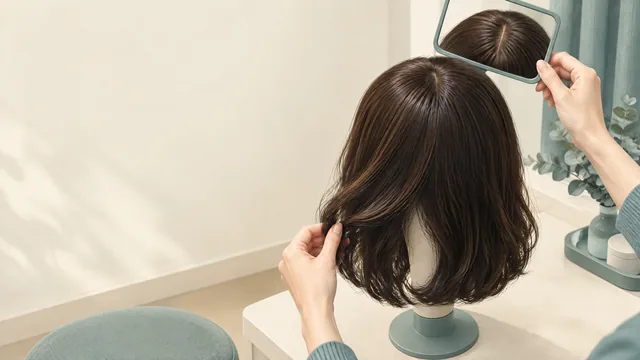
Start with two questions, not two competing labels
If your concern is that hair looks rigid when you turn towards someone, begin with movement. If your concern is the visible line between the hair at your usual part, begin with the top. These concerns can coexist, but an answer to one does not automatically answer the other.
OWNSTRAND's hand tied wig guide explains that hairs are knotted by hand in the areas specified, rather than attached along sewn strips. It also distinguishes a hand-tied section from a fully hand-tied cap. Before attributing the behaviour of a whole wig to the label, ask which areas are hand-tied and what is used at the sides and back. [S1]
Its silk top wig guide addresses the top construction and visible part instead. The wording alone does not confirm the material, layers, knot treatment or parting range of a particular model. Use that page to frame questions about the sample you are considering, not to assume that its entire cap is silk fabric. [S2]
Give hand-tying a movement-and-settling task
Individual attachment points can allow hair to move more freely than attachment in rows. Estetica describes this movement benefit for its hand-tied backs. That makes movement a sensible inspection priority, but it is not a guarantee that every hand-tied piece will fall the way you want. The actual fibre, length, density and styling still matter. [S3]
Have the fitter place the sample correctly before comparing it. Turn gently from one side to the other, pause and look at where the hair settles. With the fitter's permission, move a small section in the way you normally would when speaking or clearing hair from your face. Notice whether it falls back into the intended shape or needs arranging again.
Keep movement of the hair separate from movement of the cap. Hair that swings while the cap stays positioned is a different observation from the whole piece shifting. Tell the fitter exactly what you noticed rather than asking for 'more hand-tying' as an automatic fix. A fit or preparation issue needs its own answer.
Do not tug the base or pull on delicate areas to test flexibility. Ask the fitter to show the relevant cap zones with the piece supported. What you observe while wearing it helps assess the style; it cannot prove how an unseen section was manufactured. [S1]
Give the top a visible-part task
Begin with the part you actually intend to wear. A narrow side part and a prominent centre part expose different amounts of the top. Ask the fitter to arrange the sample in your preferred position, then look from above and from a normal conversational angle. A close-up is useful for detail, but it should not be the only view that decides the choice.
Look at the visible base colour beside the hair roots, where the hair appears to emerge, and how the part continues towards the crown. If you notice a line or change in surface, ask whether it is a construction boundary, the current styling or something else. Avoid assuming that every visible detail has the same cause.
Check the appearance under the available ordinary indoor light and, if practical, near daylight. A photograph with permission can help you remember the difference, provided both samples are photographed from comparable angles. It records that view of the sample; it does not reveal its hidden layers.
If you want to alternate parts, ask the fitter to demonstrate only the positions permitted for that model. Establish how far the named top area extends and whether changing the part needs restyling. A scalp-like description does not itself establish a movable part. Nor does the appearance of the top settle what happens at an exposed front hairline. [S2]
Compare combined features on a level basis
Combined constructions are not a contradiction. Estetica, for example, describes a French-part top with a hand-tied interior and silk layer, offered with a machine-made back or a hand-tied back. This illustrates how a top feature and an attachment method can sit within one cap. Its definition belongs to its own range; it does not supply the specification of another maker's silk-top piece. [S3]
For each candidate, record the top construction separately from the attachment method elsewhere. Keep the fibre, approximate length and density as similar as the available samples allow. Comparing a heavily styled long piece with a shorter, lighter one makes it difficult to isolate a construction difference. If the samples are unlike, note that before drawing a conclusion.
Ask for comparable preparation
Ask how each sample was prepared and whether that reflects the routine you would use. A carefully finished display style may require more arranging than you expect. The comparison is more useful when you understand the preparation behind the look, not just the label attached to it.
| Your priority | What to observe | What to confirm |
|---|---|---|
| Hair falls back after a turn | How the lengths settle without rearranging | Attachment method in the relevant cap zones |
| A visible everyday part | Base colour, emergence of hair and continuity | Named top area, materials and coverage |
| Changing between two parts | Both intended positions, if permitted | Allowed range and any restyling required |
| Both movement and part appearance | Run each observation separately | Which features coexist in that exact model |
Leave with a movement decision and a part decision
Write two short observations: 'The lengths settle where I want after turning' and 'The part looks right in my usual position', or describe what remains unresolved. This is more actionable than deciding that one construction is simply more natural. You may like the part but dislike the surrounding shape, or like the movement but want a different top appearance.
Before an OWNSTRAND visit, enquire about relevant samples and the arrangements for seeing them. Its only showroom is in Kwun Tong; a construction guide does not confirm that a matching piece is available to inspect. Sending the exact style name and your intended part helps make the enquiry specific. [S2]
Finish with questions the fitter can answer about that piece: Which areas are hand-tied? What top area will my part expose? Can you show my preferred part and any permitted alternative? Is the difference I noticed a fit, styling or construction issue? Which care instructions apply, and what adjustment or cutting is included in the quote? Those answers give you a practical reason to choose, rather than a hierarchy of names.
Questions you may be asking
Does a hand-tied label mean every part of the cap is hand-tied?
No. It may refer to specified sections only. Check the description for the top, sides and back, and ask what 'fully hand-tied' includes if that wording is used. [S1]
Can one wig have hand-tied areas and a silk-related top construction?
Yes, construction features can coexist. Manufacturer examples include hand-tied sections alongside a top incorporating a silk layer. Check the exact model rather than transferring another range's definition to it. [S2] [S3]
Does silk top mean the whole cap is made of silk?
Not by itself. The term points to the top construction. Ask which materials and layers are specified and how much of the cap that description covers. [S2]
Can I diagnose the construction just by watching the hair move?
No. Movement helps you assess the worn style, but the cut and preparation also affect what you see. Confirm construction from the model information and a supported cap inspection, not movement alone.
Which task comes first if I always keep the same part?
Start by viewing that part in its intended position, then observe the hair settling after gentle turns. You need not prioritise changing the part if you will not use that option, but movement and fit still deserve attention.