
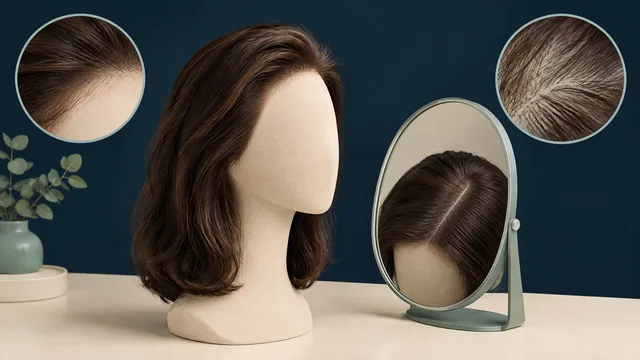
Name the hairstyle before the cap feature
Describe an ordinary day rather than your most polished reference photograph. Do you leave a fringe down, sweep the front back before a meeting, or keep a clear side part? A small habit can change which cap area becomes visible. Your part may stay exposed even when your forehead is covered; brushing hair back may reveal the front without creating a prominent part.
When browsing women's wigs, separate the full-head style you want from the construction details needed to achieve it. The category does not establish a particular hairline or top. Write two short requirements: how much forehead you want to show, and where you want the part to sit. Those requirements make unlike cap descriptions easier to compare. [S3]
For an exposed forehead, look across the front edge
A lace front wig has lace at the front hairline. That makes the forehead the relevant inspection location, not proof of a particular top construction. OWNSTRAND's guide notes that the lace width, material and remaining cap vary by style. Manufacturer Jon Renau likewise describes its own lace-front technology in relation to off-the-face styling, rather than as a description of the entire cap. [S1] [S5]
During a permitted sample viewing, ask to see the front arranged as you would wear it. Look straight ahead, then from an oblique angle towards each temple. Notice how the first hairs sit against the forehead, whether a visible edge draws your attention and where the lace section ends. A favourable centre view does not answer a question about the side you usually sweep back.
Compare an ordinary conversational distance with a closer view. Use the close view to identify details, then decide whether they affect the whole look at your usual distance. Keep the lighting comparable between samples. Ask the retailer to demonstrate the intended styling and handling; do not assume you should alter the edge yourself.
For a visible part, locate the monofilament zone
With monofilament wigs, the key question is where the fine mesh sits. Hairs are individually attached in that section to create a scalp-like appearance where they separate. A mono part, mono crown and broader mono top describe different areas, so the word alone cannot establish where you can place your part. [S2] [S4]
Ask for the cap diagram or an inside view, then relate the panel to the finished hairstyle. If you keep a left part, identify whether the relevant section actually follows that line. A crown panel addresses the crown; it does not necessarily support a part running towards the forehead. A narrow part panel and a broader top should not be evaluated as though they offer the same space. [S2]
Separate part appearance from part movement
First inspect the intended part from slightly above, following it from the front towards its end. Then, if changing sides matters to you, ask the retailer to demonstrate the alternative position within the specified area. A part that looks convincing in one position has not yet shown you its range. Record whether the sample supports your usual part only or also the alternative you want; flexibility depends on the panel boundaries and styling. [S2]
If both areas show, inspect their meeting point
A side part with the front swept away exposes two locations at once. Inspect the top along the part, then follow it forward to where the hairline meets the forehead. You are assessing the continuity of the finished hairstyle, not asking one panel to perform the job of another. A satisfactory top does not settle how the front looks, and a pleasing front does not establish the parting range.
Some caps combine a lace front with a monofilament top or part. OWNSTRAND's guides explain that the remaining cap can use other constructions. Neither feature implies the other, so request both details for the exact piece. [S1] [S2] Keep Swiss mesh separate too: OWNSTRAND's local custom-construction terminology is not a blanket equivalent of foreign lace-front or monofilament categories. Ask to see the actual design rather than translating its name into an assumed specification. [S3]
Give your shortlist a first inspection priority
Use the table to decide where to spend your attention first, not to prescribe a cap for everyone. If you never change your part, a defined part area deserves consideration alongside a broader top. If you want two distinctly different part positions, evidence of usable range matters more than the category name. Extra construction is useful only if it serves a preference you value.
| Your intended look | Inspect first | Question that resolves the gap |
|---|---|---|
| Front swept back; little visible part | Front edge and exposed temples | Where does the lace end on this style? |
| Fringe down; clear fixed side part | Top along the preferred part | Does the mono zone cover this entire line? |
| Switching between centre and side parts | Panel boundaries, then both part positions | Can the intended alternatives be demonstrated? |
| Visible part and exposed forehead | Part, front edge and their meeting point | What construction is specified in each area? |
Leave with answers about a piece, not just a label
Turn any remaining uncertainty into a short enquiry attached to the style name. Ask: “Can I see the front with this side swept back?” and “Can you show the part where I actually wear it?” Then request a diagram identifying the relevant panels. These answers are more useful than a general assurance that a cap looks natural.
For an OWNSTRAND visit, its only showroom is in Kwun Tong; confirm relevant sample-viewing arrangements and supply before travelling. [S2] Finish your comparison with three practical questions: “Which front and parting details belong to this exact piece?”, “What fitting or styling preparation would my chosen look require?” and “Which care instructions apply to these panels?” Keep those answers with the quotation so you can compare the same requirements across options.
Questions you may be asking
Does wearing bangs make front-hairline inspection unnecessary?
It may lower the priority if you intend to keep the front covered. Still consider whether you regularly move the fringe aside. Inspect the part separately if it remains visible above the fringe.
Can a monofilament crown support a centre part?
Not on the strength of that label. A crown section identifies a location towards the back of the top. Ask whether the specified mono area includes the centre-part line you want. [S2]
Does every lace front allow me to change sides?
No. Lace at the front does not establish the construction or parting range farther back. Request the top specification and a demonstration of your intended alternative part. [S1] [S2]
Will the part look the same over every wig cap worn underneath?
Do not assume so. Ask to view the sample with the wearing setup proposed for you. Because monofilament uses transparent mesh, the finished appearance should be assessed as worn, not solely from an inside-cap photograph. [S4]
Does a lace-front label tell me whether I need adhesive?
No. The front construction does not specify a universal attachment method. Ask how the exact piece is intended to be secured and what support is available; do not infer installation services from the label. [S1]