
A wedding needs a service schedule, not just an arrival time
At a wedding, food service must fit the ceremony, photographs, speeches and guest movement. Build the schedule backwards from when guests should eat. Separate the supplier's arrival, access to the preparation area, setup completion and permission to begin serving. An order arriving before the ceremony is not necessarily ready for the reception: tables may still be occupied or the dining room unavailable.
YumYum's wedding page describes buffet, banquet and reception formats. Use Wedding Catering to explore that distinction, then ask which format can work within your venue's access and service rules. The page is a starting point for discussion, not confirmation that staffing or venue coordination is included in your quotation. [S1]
Choose a receiving lead who is not occupied with the ceremony. Give that person the order breakdown and authority to resolve missing items. Separately identify who decides when service begins. A coordinator can manage the programme without being responsible for carrying trays, replenishing dishes or clearing plates.
A boat order has to work beyond the pier
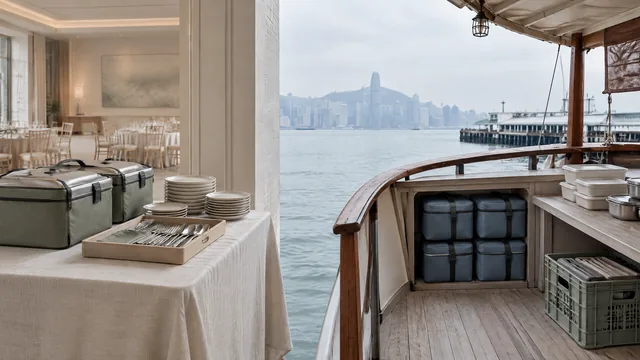
For a junk party, trace the entire route: vehicle unloading point, pier meeting point, boarding access and onboard storage. Ask the boat operator whether boxes can pass through entrances and where they can be secured. Food accepted beside the pier has not necessarily reached its intended place aboard. Agree who carries it and where the supplier's responsibility ends.
The supplier's boat page discusses portable food and pier delivery. Explore Junk Boat Party Catering with your vessel layout in mind, particularly usable serving surfaces and space for covered containers. Confirm the actual pier and loading arrangement directly; a general service description does not establish access to your boat. [S2]
Once the vessel leaves, a missing serving utensil becomes harder to replace. Nominate an onboard receiver to check containers against the manifest before the agreed boarding cutoff. Keep food loading separate from guest check-in so the person reconciling the order is not simultaneously looking for late passengers.
Compare the physical constraints before comparing menus
Use this checklist jointly with the caterer and venue or boat operator. Its purpose is to expose unanswered operational questions, not to prescribe a package. Record the answer and the person responsible before accepting a quotation.
| Decision | Wedding reception | Junk-boat party |
|---|---|---|
| Handover location | Confirm loading entrance, room and receiver | Confirm pier meeting point and who transfers boxes aboard |
| Meal timing | Align serving with ceremony and speeches | Align loading with boarding and the planned onboard meal |
| Holding facilities | Check permitted preparation space and equipment | Check usable storage, power and operator restrictions |
| Guest eating position | Match table settings or reception stations | Check stable surfaces before choosing boxes or platters |
| Clearing and returns | Assign clearing, washing and equipment collection | Assign waste storage, unloading and rental return after docking |
| Plan changes | Agree who approves changes to service order | Agree who confirms a changed pier or departure before dispatch |
Specify portions in units people can actually reconcile
A wedding quotation may describe a meal per guest; a boat proposal may describe sharing trays or individual packs. Do not compare them by dish names alone. Ask for the number of pieces, packs or trays and the intended serving role of each. Reception bites preceding dinner and a standalone lunch need different briefs, even when the headcount matches.
On a boat, individual containers still need somewhere to rest while open. Sharing platters need a stable distribution point and a person responsible for serving or replenishment. Request container dimensions if storage is tight. At a wedding, check whether food is allocated by table, offered through one buffet or divided between stations; the receiver should know which quantities belong where.
Record dietary requirements against the actual dishes and portions. Ask about ingredients and cross-contact separately from vegetarian, vegan, halal or gluten-free descriptions. Give any agreed special meals an identifiable recipient and a separate serving plan, rather than expecting guests to work out which shared tray is suitable.
Agree storage and delivery boundaries together
Safe handling requires more than attractive packaging. Hong Kong's Centre for Food Safety identifies clean hands and utensils, separation of raw and cooked foods, thorough cooking, safe raw materials and safe temperatures as its Five Keys. Apply these principles to both settings, while asking for handling instructions for the actual food supplied. [S4]
At a wedding, check access to suitable holding facilities instead of assuming that an event room includes a kitchen. Aboard, ask what chilled storage is genuinely usable and whether any cooking equipment is permitted. If raw barbecue ingredients are proposed, establish separate storage, equipment and a responsible cook before accepting that menu. Do not select food that depends on facilities nobody has confirmed.
When exploring Catering Delivery, ask for the agreed handover location and the transport and holding instructions that accompany your order. Specify whether you need unloading, carrying, unpacking or setup; these are separate tasks. A delivery arrangement should end at a named receiving point, not at the vague instruction 'the wedding' or 'the boat'.
Count equipment through to collection, not only service
A wedding may need table settings and multiple service stages; a boat needs equipment that fits its space and can be stored securely. Count dining items separately from serving tools, storage containers and waste bags. Confirm material restrictions with the operator rather than assuming glassware or particular warming equipment can go aboard.
Use Tableware Rental to compare dining and serving equipment categories, then request a specific inventory. YumYum's page describes plates, glasses, cutlery and serving equipment, but your booking still needs quantities, collection arrangements and responsibility for cleaning and packing. Renting plates does not, by itself, provide clearing staff. [S3]
For a wedding, establish where used items accumulate without obstructing guests. For a junk party, agree how used equipment and waste will be contained until docking, who unloads them and where rental collection occurs. Do not leave the return plan to whichever guest happens to stay behind.
Send one operational brief and settle the fallback
Use this enquiry as a starting point: 'We are organising [wedding reception/junk-boat party] on [date] for [guest breakdown]. Food will be [a full meal/reception bites]. The receiving point is [venue entrance and room/pier and boarding location], with handover requested within [window]. Our receiver is [name or role]. We have confirmed [storage, serving surfaces and permitted equipment]. Please quote food quantities, transport, setup, service support, tableware and collection separately. Please state what changes are possible if [the programme slips/the sailing changes], and who must approve them.'
Before the event, add the missing practical details: for a wedding, the release of the dining space; for a boat, the loading cutoff and return pier. Ask when changes must be communicated and whether already-prepared food can follow a revised plan. If essential storage or safe transfer cannot be arranged, change the menu or event plan rather than improvising after arrival.
Questions you may be asking
Can we use the same menu for a wedding and a junk party?
Possibly, but check the serving and storage requirements dish by dish. A menu that works with seated guests and venue equipment may need different packaging or portioning aboard. Confirm those changes rather than simply renaming the event.
Should the wedding couple receive the catering order?
Prefer a designated receiver who can stay available during setup. Give them the manifest, delivery location and escalation procedure. The couple should not have to leave photographs or the ceremony to reconcile boxes.
What if the food fits the boat but the packaging does not?
Request outer-container dimensions and check the boarding route and storage openings before dispatch. Ask the supplier about suitable alternative packaging. Do not plan an unapproved repacking operation at a busy pier.
Does a later departure automatically mean a later food delivery?
No. Ask the supplier to accept a revised handover explicitly, and reconfirm the receiver and storage plan with the boat operator. Preparation or transport may already be underway, so the revised sailing time alone does not settle the food arrangements.
Can leftover food be divided among guests after either event?
Do not promise takeaway portions before knowing how the food has been handled. Agree leftover instructions and suitable containers in advance, and establish who makes the final decision. An untouched appearance is not enough to establish that food is suitable to keep.