
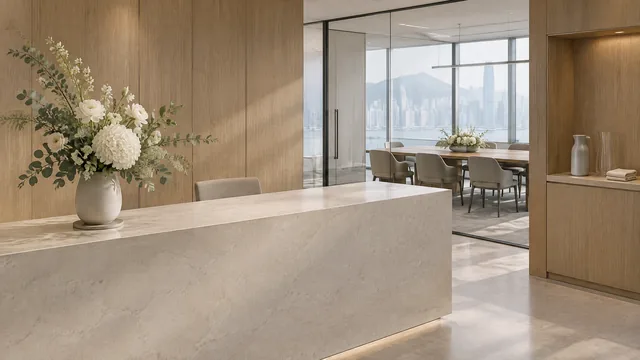
Map the space people actually use
Photograph the intended position from both the visitor's approach and the staff member's working side. Measure the clear surface rather than the whole reception counter: a vase cannot occupy the area needed for a visitor sign-in device, documents or an accessible interaction point. When exploring corporate flower arrangements, send this information alongside colour preferences. The provider's page discusses scale and placement, but its finished-product references are not a quotation for installation or an ongoing service. [S1]
Test the proposal with a simple cardboard outline before ordering. Sit at the meeting table and check the screen, neighbouring seats and camera view. Walk the reception route carrying a bag. Ask facilities staff to review circulation and required clearances; flowers should not become an informal barrier across a route that must stay open.
| Location | Design constraint | Care decision to settle |
|---|---|---|
| Reception counter | Preserve the visitor interaction area and staff sightline | Identify a reachable water-access point away from devices |
| Meeting table | Keep faces, screens and working surfaces visible | Choose a format staff can lift safely without spilling |
| Lobby side table | Keep the base fully supported and outside circulation | Agree who checks the display when reception is closed |
| Temporary event feature | Respect the approved footprint and venue restrictions | Name the installation, on-site care and removal leads |
Set a design envelope, not just a colour palette
Specify maximum overall width, height and depth, including projecting stems. A narrow vessel does not necessarily produce a narrow arrangement. Define the viewing direction too: a display against a wall may have a different balance from a centrepiece seen from every seat. For shared rooms, record fragrance objections or a no-flower requirement without describing any bloom as allergy-proof.
Use bespoke floral design as a resource for discussing how shape, texture and containers can respond to the room. The page describes a collaborative brief and asks clients to confirm current availability and project conditions. [S3] Give the florist a priority order: usable space first, silhouette second, palette third. Allow substitutions by agreed tone and form, while keeping any prohibited materials explicit.
Choose the vessel around the maintenance task
For fresh-cut stems in water, ask how staff will see the water level, top it up and change it without disturbing the design. A tall opaque container may conceal the level; a heavy vessel may require someone other than reception staff to move it. Ask for a suitable protective base and confirm how to prevent moisture reaching timber, stone or nearby electrical equipment.
RHS guidance recommends clean vases, removing foliage below the waterline, topping up water as needed and removing dying flowers. It also advises a cooler position away from heat sources. [S2] Turn that into an assigned inspection routine, with a daily visual check if appropriate for your workplace. Follow the florist's instructions for the specific arrangement. Ask before dismantling concealed mechanics; preserved flowers and potted plants need separate care instructions, not the cut-flower routine.
Separate everyday displays from event installations
An office vase and a stage feature can share a palette without sharing a service scope. For a temporary display, exploring an event florist service is a useful next step when you need to discuss venue access, setup and removal. Ask whether those tasks can be provided for the proposed date; do not treat a product image as evidence that they are included.
Mark the event placement on the approved floor plan and agree when it must be ready and when it must leave. Check loading access and lift dimensions with building management. Larger, suspended or fixed pieces need a venue-approved installation approach, not improvised office handling. Confirm who may move a feature if the room layout changes, and keep water-bearing displays separate from catering surfaces.
Give receiving, care and removal different owners
The person accepting delivery may not be the person maintaining the flowers. Name an authorised receiver, a care lead and a deputy for leave or office closures. Give cleaning staff clear instructions about whether they may move the vessel. Keep the agreed care note beside internal facilities information, rather than relying on a verbal message passed across shifts.
At handover, check the arrangement against the agreed location and dimensions, inspect the vessel for leaks and confirm that the base is stable. Ask the florist to demonstrate the refill point and explain which parts staff may handle. Record visible damage promptly with photographs. Establish who owns the container, whether it must be returned and who removes spent flowers; none of those duties should be inferred from delivery alone.
Agree recurring care separately from replacement
Regular replacement does not eliminate care between visits. Use corporate floral subscriptions to explore a recurring arrangement, then request written confirmation of availability and terms. The page describes recurring flowers adapted to office requirements, but that is not confirmation of a particular replacement schedule or staff-free upkeep. [S4]
Ask which tasks happen at each visit: exchanging the whole vase, refreshing stems, cleaning vessels or collecting old materials. Then identify the duties left with your team. Compare proposals by the same display positions and tasks, including any separately charged delivery, installation or collection. Agree what happens during holidays, office moves and unexpected deterioration. A replacement date should be a contractual arrangement, not a promised lifespan for every stem.
Send an enquiry that makes the responsibilities visible
Use this template, replacing the bracketed details: 'We are planning floral displays for [office or event] at [venue and date]. The positions are [locations], with maximum overall dimensions of [measurements]. Attached photographs show the working areas and views that must remain clear. Our preferred palette is [colours], with restrictions on [materials or fragrance]. Please propose suitable vessels and explain water access, routine care and any staff handling required. Our receiver is [role], and our care lead is [role]. Please confirm availability, substitutions, building-access requirements and an itemised scope covering placement, replacement and removal. State separately which services and containers are included, and which responsibilities remain with us.'
Questions you may be asking
What measurements should we give for a reception arrangement?
Give the clear surface footprint and maximum overall floral height, width and depth, not only the vase size. Include photographs from the visitor and staff sides, showing equipment and the counter area that must remain usable.
Can reception staff refill a concealed water reservoir?
Only if the florist explains an accessible refill method and the staff member can perform it safely. If refilling requires opening structural parts or lifting a heavy installation, agree another care arrangement before accepting the design.
Should office flowers be watered before a long weekend?
Follow the instructions for the specific floral format rather than adding extra water indiscriminately. Before closure, arrange a water-level check for fresh-cut stems and confirm whether anyone can inspect them during the break. Avoid leaving an unstable or leaking vessel unattended.
Can we move a reception display into a meeting room?
Recheck its dimensions, stability and sightlines in the second location. A reception design may occupy too much table space or block faces and screens. Confirm safe handling with the florist, particularly for heavy vessels or arrangements with concealed supports.
What should we do if vase water becomes cloudy?
For an ordinary fresh-cut arrangement, RHS advises more regular water changes and thorough vase cleaning. [S2] Follow the supplied care instructions. If the design cannot be safely removed from its vessel, contact the florist rather than dismantling it or adding improvised chemicals.