
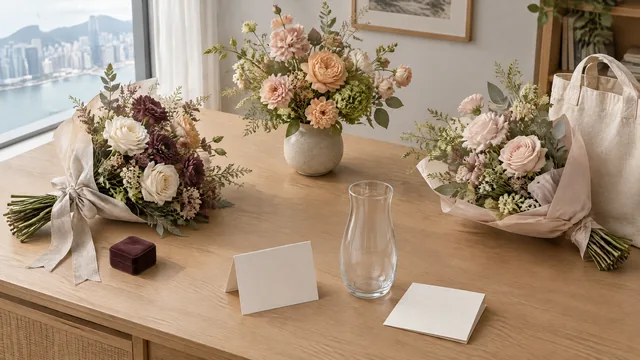
Find out preferences without spoiling the gift
Start with an ordinary conversation, not a flower-meaning chart. Ask whether they enjoy fresh flowers at home, prefer a particular colour or dislike strong fragrance. Notice preferences they have actually expressed rather than assuming their age, gender or clothing reveals their taste. Someone may love colourful arrangements yet dislike elaborate wrapping, or enjoy flowers but have no suitable vase.
Distinguish essentials from pleasant extras. A favourite colour can guide a flexible design; a request to avoid scented flowers needs explicit discussion. If pets share the home, obtain the proposed flower and foliage list and check suitability with the recipient and their veterinarian. Do not treat a mixed bouquet as safe simply because its main flower sounds familiar. Offering a non-floral alternative is better than insisting on flowers.
For a proposal, separate the flowers from the decision
A bouquet should accompany a proposal, not create pressure to accept it. Discuss your shared future beforehand and establish whether a private or public proposal would feel comfortable. Flowers, an audience and a photographer are separate decisions. Agreement about marriage does not automatically mean agreement to a restaurant-wide announcement or having photographs shared online.
Explore a proposal bouquet to compare colour, overall shape and presentation. The destination presents design references and flower specifications, with availability and arrangements subject to enquiry. [S1] Choose by what your partner can hold comfortably and where the bouquet will rest while you handle the ring, rather than treating a stem count as a measure of commitment.
Keep the ring box separate and accessible. Ask the venue whether flowers may be stored and who will hand them over; do not assume staff can hide a large arrangement. For an outdoor plan, decide how you will move indoors if weather changes. A manageable bouquet with a clear handover can serve the moment better than a dramatic design that needs constant attention.
For Mother’s Day, recognise the person and family context
Mother’s Day may be cheerful, sensitive or not celebrated at all. Ask how the recipient prefers to mark it, especially if family circumstances have changed. Use the name or title they welcome. A card can thank them for something specific without presenting motherhood as their only identity or assuming that every family relationship is uncomplicated.
A Mother's Day bouquet is a useful resource for exploring flower combinations, wrapping and presentation around her preferences. The provider page discusses style, scent and display space. [S2] Use these as enquiry topics, not a rule that mothers should receive pastel flowers. A preferred bright palette or restrained arrangement is an equally valid direction.
If siblings are buying together, agree on one design reference, one combined message and one person to approve changes. Check whether Mum wants flowers at home or at a family meal. Multiple large bouquets can mean multiple vases and extra carrying; a shared gift may be more practical, but only if it still reflects what she enjoys.
For Valentine’s Day, agree on visibility and expectations
Clarify whether your partner wants to exchange gifts before choosing a grand gesture. In a new relationship, an extravagant arrangement may communicate an expectation neither person intended. In an established one, repeating last year’s flowers can be thoughtful if they were enjoyed, but habit is not evidence that the same delivery location or display format still works.
Compare a Valentine's Day bouquet by colour, texture and format rather than assuming red roses are compulsory. The collection page contrasts rose-led and mixed designs and discusses scale for different settings. [S3] Use that range to find a style your partner likes, then ask what can actually be supplied for your chosen date.
An office delivery is not automatically romantic. Ask whether public attention is welcome and whether reception accepts personal parcels. A compact design still needs desk space and a journey home. If privacy matters, arrange a direct handover after work. For dinner, check storage with the restaurant and avoid leaving the recipient responsible for protecting flowers throughout the meal.
Use birthdays as a reminder to avoid occasion stereotypes
Exploring birthday flowers can help you compare celebratory palettes without assuming one colour belongs exclusively to one occasion. Look for qualities the recipient likes, such as a loose shape or simple wrapping. Then give the gift its meaning through your message, rather than expecting the catalogue category to explain your intention.
If a birthday falls near Valentine’s Day or Mother’s Day, ask whether the recipient would prefer separate gifts or one combined gesture. Do not quietly combine them to simplify your order. Separate cards can recognise each occasion, while different colours or presentation formats can distinguish two gifts without making either one larger.
Check the assumptions before approving a design
Use this checklist before asking for a quotation. Record the answer beside the design reference so a practical requirement is not lost when you become absorbed in the flowers.
| Occasion or issue | Assumption to avoid | Question to settle |
|---|---|---|
| Proposal | A public reveal is welcome | Private setting or audience, and who holds the flowers? |
| Mother’s Day | Several bouquets are better than one | Which gift format and display space does she prefer? |
| Valentine’s Day | Office delivery is romantic | Is public attention welcome, and can reception accept it? |
| Birthday near another occasion | One gift can silently cover both | Separate celebrations or an agreed combined gift? |
| Every occasion | Any replacement flower is acceptable | Which colours, scents and materials must not change? |
Send an enquiry that defines what matters
A useful enquiry gives the florist room to suggest options while protecting the recipient’s essentials. Ask for finished dimensions as well as flower specifications: a photograph alone may not show carrying size. Request a total quotation that identifies wrapping, any container and delivery charges. Confirm the receiving arrangement separately from the time of your celebration.
You could send: ‘I’m choosing flowers for [occasion] on [date], for handover in [district and setting]. The recipient likes [colour and shape] and wants [private or public presentation]. Please avoid [specified materials or fragrance]. My total budget is [amount]. Please suggest a design and confirm flower materials, approximate finished dimensions, included packaging, total charges and a feasible handover window. Obtain my approval before changing any stated restriction.’
Plan the first few minutes after receiving flowers
Decide who will receive the arrangement if the intended recipient is unavailable. At handover, check the card, agreed presentation and visible condition, then raise any mismatch promptly with the provider. Ask how to remove transport wrapping and whether a container needs water; do not assume decorative packaging is a permanent vase.
For fresh cut flowers, prepare a clean vase, remove foliage below the waterline, keep water topped up and place the arrangement in a cooler spot away from heat. These are RHS care recommendations. [S4] Follow flower-specific instructions for further preparation. Fresh-flower care does not automatically apply to dried or preserved arrangements. The most considerate gift leaves the recipient with enjoyment, not an unexpected care project.
Questions you may be asking
Can I keep a proposal bouquet secret while checking preferences?
Yes. Discuss general flower preferences and comfort with public attention beforehand, while keeping the final design private. Do not use the bouquet or reveal setting to bypass a conversation about marriage.
Are carnations necessary for a Mother’s Day gift?
No. Choose a flower or colour the recipient enjoys rather than treating a traditional option as compulsory. If relatives are contributing, agree on the recipient’s preferences before collecting competing design requests.
What if my partner dislikes receiving Valentine’s gifts at work?
Arrange a private handover somewhere they welcome. Do not route the gift through colleagues to preserve the surprise. Check the journey home and display needs even when the presentation is discreet.
How should I handle an unavailable favourite flower?
Tell the florist which quality matters most: the exact flower, colour, shape or scent. Request approval of a proposed replacement. If the flower itself is essential, consider a different design or gift instead of accepting an unsuitable substitution.
Is a ready-to-display arrangement always the easiest option?
Not necessarily. It may reduce vase preparation, but its container still needs space and may be awkward to carry. Confirm dimensions, water-care instructions and the recipient’s journey before choosing it over a hand-tied bouquet.