
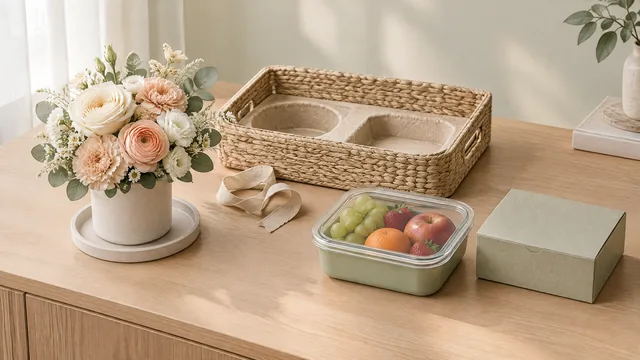
Choose a presentation that comes apart
Start with the recipient's next task, rather than the basket's appearance. Can they lift out the food without reaching through flowers? Can they remove the floral holder without tipping its water? Two coordinated packages may be easier than one intricate basket, especially for an office recipient taking food home and leaving flowers on a desk.
Y. Florist's floral hamper page describes flowers paired with complementary gifts and invites enquiries about customisation. Use it to explore presentation directions, then ask specifically whether the floral unit and food bundle can be packed separately. The page is not confirmation of the packaging for your particular request. [S1]
A shared outer carrier can still work if the components are independently supported and removable. Ask how each is secured during transport and which part to lift first. Ribbon or tissue can coordinate the appearance, but should not be the only thing preventing a wet floral holder from moving against food.
Specify food as food, not decorative filler
Name each edible component in the enquiry. For fruit, distinguish whole fruit from cut or prepared fruit; for treats, ask whether they arrive individually wrapped or in a closed food container. Record fruit quantities by count or net weight as appropriate, and packaged snacks by pack count and pack size. A large basket is not a useful measure of how much food someone receives.
When comparing a flower and fruit basket, consider the provider's emphasis on display location and receiving arrangements, then ask for a layout showing the fruit container separately from the floral holder. Specify fruit dislikes and handling needs before approving substitutions, rather than treating similar colours as equivalent contents. [S2]
Request ingredient and allergen information for packaged or prepared foods, including how any stated dietary requirement is handled and whether cross-contact can be addressed. Vegan, halal and gluten-free requests are different questions. Keep food labels and storage directions accessible after unwrapping; a greeting card should not cover the information the recipient needs.
Check each component before approving the gift
Compare proposals component by component. A photograph may show colour balance, but cannot establish food-contact suitability, removable packaging or storage needs. The following checklist helps turn an attractive concept into a gift that someone can receive and unpack without improvising. Ask for written answers, not assumptions based on a reference image.
| Component | Practical arrangement to request | Question before approval |
|---|---|---|
| Fresh flowers | A stable, removable holder independent of food | How is water contained, and where should the holder be lifted? |
| Whole fruit | A separate container suitable for food contact | Which varieties and quantities are included, and what storage advice applies? |
| Prepared food or treats | Closed packaging with readable product information | Are ingredients, allergens and storage directions supplied? |
| Outer basket or box | Secure supports with an obvious unpacking order | Can either component be removed without disturbing the other? |
| Potted plant alternative | A separate pot and protective transport container | How are soil and drainage kept away from the food package? |
| Handover | A named receiver who can route food and flowers | What happens if that receiver is unavailable? |
Coordinate colour without mixing care requirements
Separation need not make the gift look unrelated. Echo one muted colour in the flower wrapping and food box, or use matching container materials. A taller floral silhouette beside a lower food container creates contrast without burying edible items beneath leaves. Request the overall footprint and individual package dimensions so the design fits the recipient's surface and carrying route.
For an unusual shape or a narrow reception counter, explore bespoke floral design with a brief centred on two removable components. Describe the intended visual relationship and the unpacking sequence together. Ask whether the proposed design is feasible for your date; custom work should not be presumed to include food sourcing or particular packaging.
Plan separate display positions after the initial presentation. RHS advice for cut flowers recommends a cooler location away from heat and keeping arrangements away from ripe fruit. A shared gift is therefore not a reason to leave the vase beside the fruit bowl throughout its display life. [S4]
Consider a plant only when the recipient wants one
A potted plant is an alternative decorative component, not a care-free replacement for flowers. Before you buy indoor plants, check the recipient's available light, space and willingness to maintain it. Ask for the species, finished size and care instructions, and request a separate transport package that keeps soil and drainage away from edible items.
Do not apply vase instructions to a plant, or fresh-flower watering advice to dried or preserved arrangements. A plant-and-food gift still needs separate receiving decisions. If the recipient does not want either flowers or a plant, choose a food-only gift rather than making the decorative component an obligation.
Give the receiver a clear unpacking job
For a Hong Kong office, distinguish the person accepting the delivery from the person responsible for the contents. Reception may be able to acknowledge arrival without opening packages or arranging food storage. Confirm who will collect both components, and agree a fallback if that person is unavailable. Do not assume that a lobby desk can act as a storage area.
At home, prepare a clean surface for the food package and a different spot for the floral holder. Remove the edible bundle before working on flowers, and wash hands before handling food after touching stems or decorative materials. CFS's Five Keys emphasise clean hands and utensils, safe materials and appropriate food temperature; these general principles guide the receiving routine, not a supplier certification. [S3]
Check the food packaging for damage, moisture or leakage and read its storage directions. Keep questionable items out of sharing until the supplier has clarified the problem. For cut flowers intended for a vase, RHS recommends a clean vase, removal of foliage below water level and topping up water as needed. For another presentation, request its specific care instructions. [S4]
Send one brief that covers both components
Before ordering for a hospital, confirm that the recipient and ward permit both flowers and food. If either is unwelcome or restricted, change the gift rather than relying on a compact basket or mild fragrance to make it acceptable. Food should express thoughtfulness, not carry a promise of recovery or suitability for a patient's diet.
A ready-to-send enquiry is: ‘Please propose a flower-and-food gift for [occasion] at [location]. I would like a removable floral holder and separately protected food, with no contact between edible contents and floral materials. Please list the food quantities, relevant product information and care directions. The available surface is [dimensions], and [receiving role] will handle unpacking. Please confirm packaging, acceptable substitutions, current feasibility, handover arrangements and an itemised quotation before I approve.’
Review the reply for separate flower and food specifications, included containers and any additional charges. Approve substitutions for each component independently: permission to change flower colour is not permission to change food ingredients. Keep the final contents list with the receiving instructions so the recipient knows what to expect.
Questions you may be asking
Can flowers and food travel in the same outer basket?
They can be proposed as a coordinated gift, but request independently secured components with suitable food packaging and contained floral water. Check how both parts come out. A shared carrier should not require stems, loose decoration or moisture to contact edible contents.
Does wrapping fruit make it ready to eat?
No. Gift wrapping describes presentation, not preparation. Ask whether the fruit is whole or prepared and follow the supplied food-handling directions. Do not assume that a decorative liner or individual sleeve establishes that fruit has been washed or is ready for consumption.
Should the whole hamper go into a fridge?
Do not use one storage decision for every component. Remove the food and follow its particular storage instructions. Place flowers separately according to their presentation and care guidance. If directions are missing, ask before treating the entire basket as either room-temperature or refrigerated storage.
What if floral water has leaked onto the food package?
Set the affected food aside and assess whether the package is damaged or its contents may have been exposed. Ask the supplier how to proceed; do not share questionable food while waiting. Drying the outside does not establish that the contents are unaffected.
How can an office share the food while keeping the flowers?
Choose a removable food bundle and name a colleague to transfer it to the appropriate storage or sharing area. Keep its product information with it. Leave the floral holder in a separate display position and use separate tools for any flower care and food preparation.