
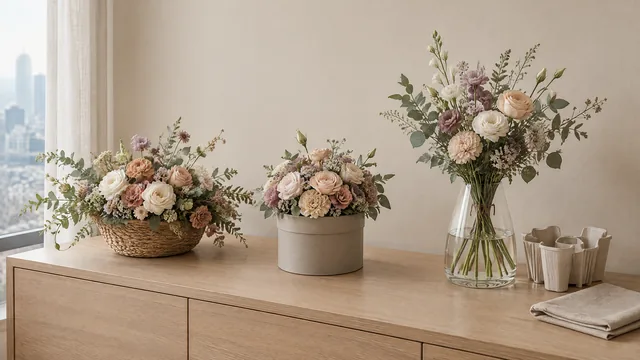
Start with the space, not the container name
Measure the usable surface rather than the whole desk or table. Leave room for the monitor, serving dishes or everyday objects that will stay there. Ask for both the container dimensions and the complete arrangement's width and height, including projecting foliage. A small base can support a surprisingly broad display.
Viewing direction is equally important. A piece against a wall can have an intentional front; a dining-table centrepiece needs to work from every seat without blocking conversation. Y. Florist's guide distinguishes these design approaches. Explore its flower arrangements resource to compare overall forms before narrowing the choice to one container. [S1]
For a shared office desk, prioritise a restrained footprint and easy access for watering. For a birthday gift on a sideboard, a fuller silhouette may work. The occasion sets the tone, but the receiving space should set the size.
Choose a basket when texture suits the setting
A woven basket can soften a room with hard surfaces or complement a relaxed home interior. Its texture remains part of the display, so judge the basket and blooms together. Compare flower baskets for shapes and proportions, then ask whether the proposed design is a tabletop piece and how far its flowers extend.
Do not assume the basket itself holds water. Ask what liner or inner vessel protects the weave and furniture, and whether the flowers are cut stems or living plants. The provider distinguishes cut-flower arrangements from potted-plant baskets; these require different care. This comparison concerns cut flowers unless you deliberately choose plants. [S2]
A decorative handle is not necessarily a carrying handle. Confirm the recommended lifting point and support the base when moving the display. For someone taking the gift home after work, consider the whole journey, not merely the initial presentation.
Choose a box for presentation, not presumed portability
A box can make the container feel like part of the gift rather than an accessory. Round hatboxes, square containers and shallow trays are described on the provider's box page. Browse flower boxes to compare those shapes, while checking the actual display footprint rather than judging size from a photograph. [S3]
A low box may suit a coffee table where flowers are viewed from above. A taller hatbox could suit a console instead. Check whether any lid is decorative, removed for display or usable during transport; never assume it can close over the finished blooms. Ask which protective packaging is supplied.
The outer box does not reveal its watering system. Request a clear description of the inner container and the point where water should be added. If the recipient will struggle to reach it without disturbing flowers, ask for a different structure. A neat exterior should not conceal an impractical care task.
Choose a vase when water access and reuse matter
A vase can be a useful longer-term gift if its size and style suit the recipient's home. Explore a vase arrangement by vessel shape as well as floral height. Ask whether the vase is included and whether the stems stand in open water or are secured by another support system; the general arrangement guide describes several possible structures. [S1]
Clear glass makes water visible, while an opaque vessel hides it. Neither removes the need for care. A narrow opening or fixed support may make water changes awkward, so confirm how to maintain the finished design without dismantling it. Choose accessibility over appearance if the recipient wants straightforward upkeep.
For a tall display, ask about the filled weight, base stability and transport packaging. A low vase may fit a dining table better, but width still matters. Keep any water-filled vessel away from vulnerable desk equipment and precarious edges.
Compare the practical trade-offs
Use this table to identify what needs checking, rather than to rank one format as universally best. The inner vessel, stem supports and finished dimensions can change the practical result within each category.
| Format | Useful reason to choose it | Key care question | Handling check |
|---|---|---|---|
| Basket | Visible woven texture suits the room | What inner vessel holds water? | Confirm base support and whether the handle bears weight |
| Box | Container contributes to the gift presentation | Where can water be added without wetting the exterior? | Check upright packaging and clearance above blooms |
| Vase | Recipient wants an accessible vessel to keep | Can water be changed without disrupting the design? | Check filled weight, stability and protection against breakage |
Make the care method part of the purchase decision
For cut flowers standing in water, the RHS advises clean vases, removing foliage below water level, topping up water and keeping the display in a cooler spot away from heat. It also recommends regular water changes and removing dead or dying flowers. These basics apply regardless of whether the water vessel is visible or concealed. [S4]
For a supported arrangement, obtain instructions specific to that construction. Ask where to check water and how to add it without overflow. Do not pull stems out simply to inspect the interior. A ready-to-display gift still needs an agreed care routine and someone willing to carry it out.
Avoid choosing by a promised universal lifespan. Species and care affect the result. If the recipient cannot manage water, discuss a genuinely different product rather than assuming a box solves the problem. Preserved flowers, dried materials and living plants need their own instructions, not this cut-flower routine.
Send a clear enquiry and plan the handover
A useful enquiry reads: ‘Please recommend a cut-flower basket, box or vase for [occasion]. It will sit on [surface], with usable space of [width × depth] and a maximum height of [height]. It will be viewed from [front/all sides]. We prefer [colours]. The recipient can manage [care tasks], and the gift will travel by [method]. Please confirm the finished size, water system, packaging, permitted substitutions and itemised total.’
Ask the quotation to distinguish flowers, container, presentation and any delivery or custom work. Confirm whether the vessel is kept by the recipient or subject to any agreed return arrangement. A simpler container may be the better fit even when the budget allows a more elaborate one.
At handover, check that the base is dry, the arrangement stands securely and the care instructions match its construction. Identify who receives it and where it can wait before reaching the recipient. For an office tower, confirm access and the agreed handover point; a container choice cannot resolve missing permission or unattended storage.
Questions you may be asking
Is a basket always bigger than a flower box?
No. Compare finished width, depth and height, not category names. A compact basket may occupy less space than a broad box with overhanging flowers.
Does a box mean I will not need to add water?
No. Fresh cut flowers still need a water source. Ask about the inner vessel, access point and care instructions before choosing a boxed arrangement.
Which format works best on a dining table?
Choose a low design that works from all sides and leaves room for place settings. A basket, shallow box or low vase can work if its full footprint fits.
Can I transfer the flowers into my own vase?
Ask first. Stems may be fixed into supports or cut for the original container. Moving them can alter the shape, and they may not suit your vase.
Which container should I choose for someone travelling home by MTR?
Prioritise manageable filled weight, upright protective packaging and a secure lifting point. Confirm how the specific design should travel; no format is automatically convenient on a crowded journey.