
Start with the recipient's day, not the biggest arrangement
Describe how the gift will be used. A colleague receiving flowers at work may need to carry them home; a friend receiving them at a flat may have little display space. Specify whether the arrangement should be easy to carry, fit a particular surface or arrive with a suitable container. These are clearer instructions than simply asking for something impressive.
To explore local planning considerations, the Hong Kong florist resource offers a starting point. In your own brief, state the relationship and tone without assuming that one colour suits every recipient. 'A cheerful thank-you for a colleague, with restrained wrapping' gives a designer more direction than an occasion label alone. Include known fragrance preferences or flower exclusions as separate requirements.
Translate a reference image into priorities
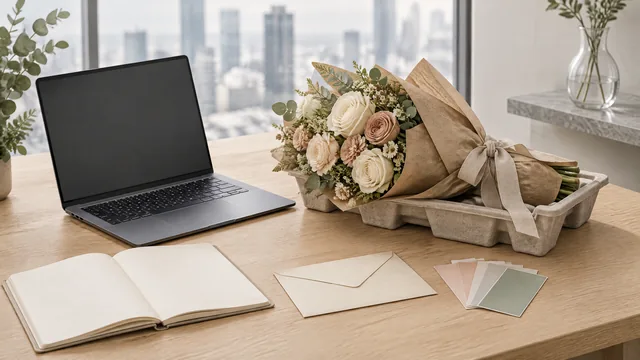
A picture can show colour balance, silhouette and wrapping, but it does not settle the contents of your order. The provider's bouquet page describes reference images as mood and presentation guides, with current flowers and substitutions to be confirmed. [S2] Tell the florist which feature matters most: the muted palette, a rounded shape, a particular flower or the paper finish. Avoid demanding every detail when only one is essential.
Compare flower bouquets to find a visual direction, then ask about the proposed finished height and width rather than relying on 'small' or 'large'. If a flower variety is essential, mark it as approval-required. If colour is the priority, allow alternatives within that palette, subject to agreed exclusions. Ask how the flowers will be supported during transport and what the recipient will need on arrival.
Separate preferences from details that must be confirmed
Before you order flowers online, organise your instructions into a short brief rather than scattered messages. The provider's ordering guidance asks buyers to prepare recipient and address details, flag access restrictions and check current availability. [S1] Use the table below to distinguish your choices from questions requiring a reply; the suggested entries are briefing examples, not supplier promises.
| Brief field | What to write | What to confirm |
|---|---|---|
| Design | Preferred palette and shape; identify the essential feature | Proposed flowers, finished dimensions and wrapping |
| Substitutions | Flexible on supporting flowers; approval required for the main variety | Who approves changes and how approval is recorded |
| Destination | District, street, building, block, floor and flat or company | Delivery feasibility and permitted entrance |
| Timing | Requested date, receiver's available window and latest useful arrival | Whether a compatible delivery window can be accepted |
| Handover | Named receiver, agreed contact method and authorised backup | Whether reception can accept and how receipt is confirmed |
| Total cost | Your spending limit, stating whether it includes delivery | Itemised total, container costs and any access-related charge |
Describe the handover, not just the address
An accurate destination still needs a receiving plan. Include the tower or estate name and the relevant block, floor and unit; add the Chinese building name if known and useful. For an office, distinguish building reception from company reception. Ask the receiver to check whether deliveries use a loading entrance, require registration or can reach their floor. The provider's delivery guide flags address and access details for confirmation. [S3]
Use the flower delivery Hong Kong resource to explore handover considerations, then confirm the actual rules with the destination. Give the primary receiver's available window and name a backup only after they agree to help. Ask what happens if neither is available; do not silently authorise a corridor drop. For an institution, check that flowers are accepted before requesting delivery there.
Resolve the quote and change rules before paying
Ask for an itemised total covering the floral arrangement, any container, delivery and additional handling. State whether your budget is for the flowers alone or the complete order. A comparison is meaningful only when the proposed form, size, packaging and delivery scope are clear. Do not infer today's price or availability from an attractive reference image.
Review substitution approval alongside timing. If the agreed flower cannot be supplied, should the florist propose an alternative or pause for your decision? If the receiver's window cannot be met, ask what rescheduling options and charges would apply. Clarify amendment, cancellation and unsuccessful-handover terms before committing. Keep the accepted version together so that a later change does not leave conflicting instructions in the conversation.
Adapt this ready-to-send enquiry
Replace the bracketed fields and remove anything irrelevant. This is an enquiry template, not a confirmed booking; its purpose is to invite a specific reply rather than an assumption that every preference can be fulfilled.
'Please advise whether you can prepare flowers for [occasion] on [date]. The recipient is [relationship], and the intended tone is [tone]. My reference is [image or design reference]. The priority is [colour, shape or essential flower]. Please propose the finished dimensions and wrapping. My complete-order budget is [amount], including delivery and any container. Please seek approval before changing [essential detail]; alternatives are acceptable for [flexible detail].'
'Delivery is to [full address, building, block, floor and unit or company]. The intended handover point is [location], with these checked access instructions: [details]. The receiver is [name], available during [window]. The latest useful arrival is [time]. A consenting backup is [name and availability]. Please confirm a compatible window and explain the procedure if handover cannot be completed.'
'The card wording is exactly: [message and signature]. Please keep operational notes off the card. Before I confirm, please reply with the proposed arrangement, substitutions, itemised total, accepted delivery plan and applicable change terms.'
Give the receiver a simple arrival checklist
Let the receiver know the agreed handover plan and where the flowers will be displayed. On arrival, they can check the card, arrangement and packaging against the agreed description. If something appears damaged or substantially different, record it promptly and raise it through the provider's order channel. A photograph can help explain the issue, but do not assume a particular remedy or refund policy.
For fresh cut stems, prepare a clean vase, remove foliage that would sit below the water, monitor and top up the water, and choose a cooler position away from heat. RHS guidance supports these basic steps. [S4] Ask for instructions suited to the supplied flowers and format; this vase-care checklist is not a watering guide for preserved arrangements or potted plants.
Questions you may be asking
Can I keep the delivery a surprise without leaving the receiving plan vague?
Yes, by arranging a consenting colleague or household member to receive it discreetly. Check their availability and the destination's acceptance rules. Keep the surprise in the greeting, not in the assumption that someone will be there.
Should I write a requested time or a delivery window?
Provide the receiver's available window and explain any genuine deadline separately. Ask which timing the provider can accept. A requested clock time is not an agreement unless it is explicitly confirmed for the destination and date.
How do I prevent a substitution from changing the whole look?
Rank the visual priorities and list exclusions. For example, allow supporting flowers to change while requiring approval for the dominant colour or main variety. Ask the florist to describe the alternative before you approve it.
What should I do if I spot an address error after confirmation?
Send one clear correction referencing the order, show the replacement address in full and ask for acknowledgement. Check whether the revised destination changes feasibility, timing or charges. Do not assume the correction has been accepted merely because it was sent.
How should I separate card wording from delivery instructions?
Label the card message and operational notes separately. Supply the exact spelling, punctuation and signature for the card; place access directions and backup-receiver details only in the delivery brief. Ask about message length before finalising a long greeting.