
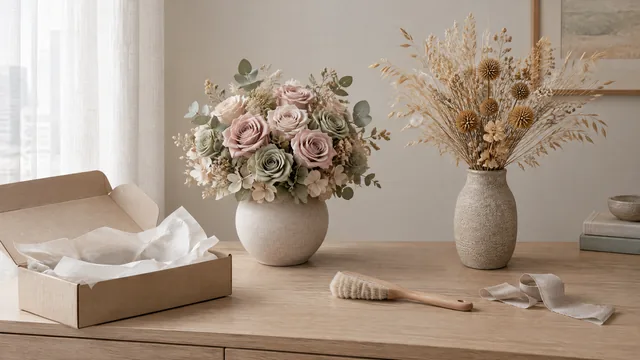
Ask for the material mix, not just a style name
Preserved flowers are natural botanical materials that have undergone a treatment to retain their form and flexibility without watering. SecondFlor describes a preservation solution typically containing glycerin, water and colourants; this is a general explanation, not a formula for every bouquet. Dried flowers lose moisture through drying, which can include air-drying or methods using a drying medium. Their finish is often papery and less flexible. [S3] [S4]
When exploring a preserved flower bouquet, use the photographs to discuss shape and colour, then request the actual flower and foliage list. Ask whether anything is dyed, bleached, scented or artificial, and whether the heads use wire supports. The provider describes a treated, water-free arrangement, but the composition of your chosen design still needs confirmation. [S1]
This matters for a gift displayed beside pale wallpaper or upholstery. Ask about possible colour transfer and the required clearance rather than assuming that a soft-looking petal is untreated. If substitutions are proposed, request the new material names and care implications, not merely a promise of a similar palette.
Compare texture with the recipient's display habits
A recipient who wants a decorative keepsake has different needs from someone who enjoys tending a plant. Choose the form around their habits: will they keep the bouquet in its wrap, rearrange it, or place it on a busy desk? Preserved petals are not robust simply because they look supple, while dried grasses can occupy more space than their slim stems suggest. [S1] [S2]
A dried flower bouquet is a useful resource for comparing airy outlines with compact bunches. Look beyond the front-facing image: ask for the finished width, depth and height, including wrapping, and whether a suitable dry vessel is included. For a narrow shelf, depth and nearby movement can matter more than height.
| Option or setting | Practical consideration | Question to ask |
|---|---|---|
| Preserved focal flowers | Treated petals need protection from water and handling. [S1] [S4] | Which blooms are preserved, and what instructions apply to them? |
| Dried flowers and grasses | Brittle elements need clearance from passing hands and curtains. [S2] | How much space does the finished outline need? |
| Mixed-material bouquet | Different components may need different care. | Does it contain fresh stems, artificial accents or glued elements? |
| Covered display | A cover may reduce dust but is not a humidity guarantee. | Is the piece designed for a cover, and how should it be stored? |
| Gift for a busy desk | A stable base and compact profile reduce accidental contact. | Can it stand securely without changing the original support? |
Choose a dry position before the bouquet arrives
Check the proposed spot during ordinary household use. A shelf may be dry in the morning but receive cooking steam later; a window ledge may collect condensation or strong afternoon sun. The RHS advises keeping dried displays out of direct sunlight and away from moist rooms because they could go mouldy. SecondFlor similarly recommends indoor use away from excessive humidity and direct sun for preserved materials. [S3] [S4]
In a Hong Kong flat, a shaded living-room cabinet may be more practical than a bathroom shelf or open kitchen corner. Avoid putting the bouquet directly beside an air-conditioning outlet, where delicate pieces face continuous airflow. If you use room dehumidification, manage the room rather than aiming a device at the flowers. Ask for any material-specific humidity guidance instead of applying one universal numerical target. [S1]
Keep the display clear of candles, hot appliances and food preparation. If children or pets can reach it, consider another position; preservation and drying do not establish household safety for an unspecified plant mix.
Unpack by the support, then inspect the arrangement
Prepare a clean, dry surface before opening the package. Lift by the container or supported stem bundle, not by the blooms. Remove loose transit packaging slowly, without dragging it across petals. If a tie appears to hold the bouquet together, leave it in place until you know whether it is decorative or structural. The preserved-bouquet guidance stresses supported lifting and protection from rain and crowded surfaces during travel. [S1]
Compare the received arrangement with the confirmed material list and presentation. Check for crushed heads, detached stems, damp wrapping or visible marks, and take clear photographs before attempting repairs. Ask the provider how to proceed if something seems wrong; do not reshape wired stems by force or wet a crease to flatten it. This records condition without assuming a particular returns policy.
Pass the care note to the person who will actually maintain the display. In a shared office, make sure it is not mistaken for a fresh bouquet during routine vase cleaning.
Dust gently and respond to changes without home treatments
For the preserved or dried materials described on the provider pages, a clean, very soft brush is suggested for light dust removal. Keep pressure minimal, start with an inconspicuous area and stop if petals loosen. Do not scrub intricate flower centres to chase every particle. Avoid damp cloths, cleaning sprays and perfume on the arrangement. [S1] [S2]
Both pages also mention gentle cool airflow, but a brush may be easier to control on a small piece. If using airflow, follow the specific instructions and stop if fine stems move vigorously. A hot hairdryer is not a way to rescue a damp bouquet. If treated petals change appearance or wrapping becomes wet, move the piece away from moisture and send photographs for material-specific advice. [S1]
Expect appearance to change rather than relying on a fixed lifespan. Light, humidity and handling affect preserved arrangements; dried stems can shed or fade. Separate ordinary ageing from sudden damage, and avoid spraying varnish or attempting a preservation recipe at home. [S1] [S2]
If learning to arrange, ask what the session actually teaches
Readers considering preserved flower workshops should ask whether the session uses ready-treated materials or teaches a preservation process. Those are different learning objectives. For caring for a keepsake, handling delicate heads, recognising supports and packing the finished piece may be more useful than learning a treatment method.
Request the proposed syllabus, tool arrangements and take-home care instructions. Ask whether participants learn to combine preserved blooms with dried foliage, and whether packaging protects those different textures. Confirm the session's current availability and inclusions directly; a page describing possible techniques does not establish what a particular booking includes.
Send an enquiry that includes the future display space
A concise enquiry could read: 'I am choosing a keepsake bouquet for a shaded living-room shelf. Please confirm the preserved and dried components, any fresh or artificial elements, and any dyes or added fragrance. I need the finished dimensions including wrapping, details of the support or vessel, and instructions for dusting and storage. Please explain proposed substitutions before confirmation and whether the piece is suitable for this setting.' Add your measured space and carrying plans rather than relying on a style photograph alone.
If the recipient would prefer a living plant, the resource to buy orchids online provides a different direction to explore. Treat a potted orchid as a separate care decision: request instructions for the identified plant, its growing medium and container. Never transfer the bouquet's no-water rule to a living orchid.
For either option, settle who receives the gift and where it will stand. The right choice is the one whose materials, dimensions and maintenance suit that space, not the one described with the strongest longevity language.
Questions you may be asking
What if my bouquet includes fresh stems as well as preserved flowers?
Ask for separate care instructions and how the components are kept apart. Do not put the entire bouquet in water or mist it: preserved materials should avoid water. The provider needs to explain the actual mixed construction. [S4]
Should I remove all the wrapping for display?
Not automatically. Wrapping or ties may help support the bouquet. Confirm what can be removed, and use a stable dry vessel that does not squeeze the stems. Keep original supports intact unless advised otherwise. [S1]
Does a glass cover solve humidity problems?
Do not assume so. A cover can limit dust exposure, but it does not establish that the air or materials inside are dry. Ask whether the arrangement is designed for that presentation, and keep it away from damp locations. [S3]
Can I assume pale preserved flowers have no dye?
No. Colour alone does not reveal treatment. Preservation solutions can contain colourants, so request information about the specific materials, including any dyeing or bleaching, and ask about contact with light-coloured surfaces. [S4]
How long should I expect the bouquet to look unchanged?
There is no universal unchanged period. Material type, sunlight, humidity and handling influence appearance. Ask for care expectations for your selected mix, and treat fading or shedding as something to assess rather than a guaranteed timetable. [S1] [S2]