
First, find out what ‘making’ means
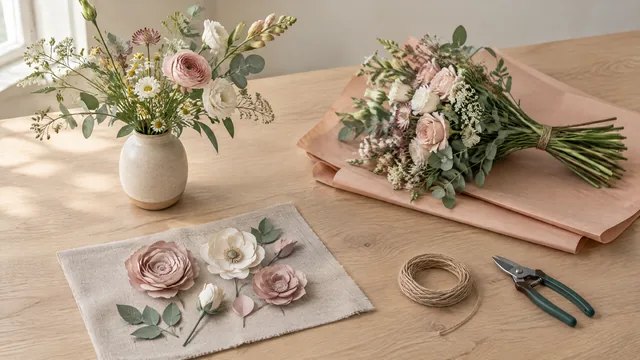
The words making and arranging are not cleanly separated course categories. A bouquet workshop may involve arranging fresh stems and then making them into a portable gift. A craft workshop may involve forming petals from paper or another material before composing the finished flowers. Ask for the material and project name: a fresh-stem bouquet, a vase arrangement or a constructed flower piece tells you more than a broad class title.
Use the Flower class page to explore floral learning directions, then narrow your enquiry to one task. Its navigation distinguishes vase-arranging and bouquet interests, but does not establish a particular lesson plan. [S1] Do not assume that a provider offers constructed-flower crafts simply because a listing uses the word ‘making’.
Match the first project to your real goal
Think about where you would repeat the skill. For a small dining table, learning how stems sit in your own vase may be more useful than elaborate wrapping. For a thank-you gift, holding and securing a bouquet may matter more. If you enjoy detailed craft work, ask about constructing individual flowers rather than assuming every floral lesson uses fresh material.
| Direction | Main task to ask about | Useful first goal | Key question |
|---|---|---|---|
| Vase arranging | Positioning existing stems in a container | Rearrange flowers for your own table | Will I choose heights and revise the composition? |
| Fresh bouquet making | Gathering, holding and securing stems | Make a portable floral gift | Will I practise the grip and binding myself? |
| Wrapping-focused bouquet work | Building a presentation around a bouquet | Finish a gift neatly | How much practice concerns flowers versus wrapping? |
| Constructed-flower craft | Forming petals and assembling flowers | Learn a repeatable craft technique | Which material and tools are used? |
| Preserved or dried arrangement | Placing prepared materials in a design | Make a display using those materials | How are fragile parts handled and protected? |
Choose arranging when you want to understand placement
For vase work, a useful beginner objective is to explain why a stem belongs where you put it. Ask whether the lesson lets you compare heights, change the angle of a stem and view the piece from its intended display position. A table centrepiece and an arrangement against a wall need different viewing decisions. Knowing which one you are practising helps you judge the result.
Explore the Flower arranging class resource when vase composition is your priority. The provider’s related descriptions identify vase composition and handling tools as enquiry themes, not a confirmed syllabus. [S2] Ask what supports the stems in the proposed project and whether you will learn to use it yourself. A beautiful sample alone does not show how much independent arranging you will do.
Choose bouquet making when the gift must be portable
Bouquet making adds a handling problem: the composition has to remain manageable while you hold and secure it. For a first lesson, ask to practise adjusting stems before the bouquet is tied, rather than only adding paper around a prepared bunch. Then check who completes the binding and whether you can try again if your first attempt loosens.
If airy placement and layered presentation appeal to you, explore the Korean bouquet class guide as a style reference to discuss with the provider. [S3] Specify whether your priority is flower placement, holding technique or wrapping. Do not treat a style name as proof of beginner suitability; the important distinction is which operations the lesson actually includes.
Look for a chance to correct your own work
A manageable first project should leave room to notice and fix something. Ask whether you will work on your own piece, pause for feedback and make a revision. A demonstration can introduce the method, but watching someone secure a bouquet is different from finding a comfortable grip yourself. If the instructor finishes difficult stages, ask which stages remain yours to practise.
The Beginner flower class page is a starting resource for an introductory enquiry. Explain that you have no experience with the proposed technique, even if you regularly buy flowers. Confirm the teaching language, tool guidance and any support you need for cutting or gripping. Describe the operation you want help with rather than relying only on the word ‘beginner’.
Check materials, aftercare and the journey home
Confirm whether the project uses fresh, dried, preserved or constructed flowers. These choices change what you need to learn and what you do afterwards. For fresh cut flowers, RHS guidance recommends a clean vase, removing foliage below the water, topping up water as needed and placing the arrangement in a cooler spot away from heat. [S4] Ask for instructions suited to the actual stems; do not apply fresh-flower watering advice to preserved or dried material.
Before booking, ask whether the container, wrapping and transport packaging are included. For an MTR journey, consider the complete packed shape and how you will carry it without crushing the flowers. A water-filled vase needs a different carrying plan from a wrapped bouquet. Confirm who prepares the take-home piece and whether you need to bring a bag or carrier.
Send an enquiry that gets a useful comparison
Ask for a written outline and an itemised quotation rather than comparing headline fees alone. Establish what materials and tools are included, which parts are demonstrations and which you practise, and whether the finished piece and its container go home with you. Confirm the actual venue, dates and booking-change terms before arranging your journey.
You can send: ‘I am choosing my first flower class and want to compare vase arranging with fresh bouquet making. My priority is learning a skill I can repeat, not only finishing a sample. Could you explain the hands-on stages, opportunities to revise, teaching language and materials? Please confirm the total fee, inclusions, take-home packaging, venue, available dates and booking-change terms. If flower making uses craft materials instead, please clarify the material and tools.’
Questions you may be asking
Is flower making easier than flower arranging?
Not automatically. Constructing petals, holding a bouquet and placing stems in a vase involve different tasks. Ask which technique is taught and how much help is available. Choose a project with a clear first goal and time to revise, rather than judging difficulty from the title.
Can I start with a Korean-style bouquet without previous experience?
Ask whether the particular lesson accepts complete beginners and introduces holding and binding before presentation. A style reference does not establish the starting level. If most practice concerns wrapping an already-prepared bouquet, decide whether that matches what you wanted to learn.
Should I buy floristry tools before my first class?
Check the supplied-tool list first. Ask whether tools are shared or provided individually, and whether any need to be brought along. Avoid buying a specialist kit before you know the project. Request an explanation of safe handling before using unfamiliar cutting or fastening tools.
Can I turn the class project into a gift that evening?
Possibly, but confirm the expected finish time, packed format and care needs before committing to a handover. Ask whether the piece is suitable for your journey and the recipient’s display space. Leave room for a beginner’s result to differ from the reference design.
How can I tell whether the class taught me a reusable skill?
Afterwards, check whether you can describe the main steps, identify one decision you made and explain one correction. For arranging, that might be changing stem height; for bouquet work, adjusting the grip before binding. Keep any permitted notes so you can practise the same task again.