
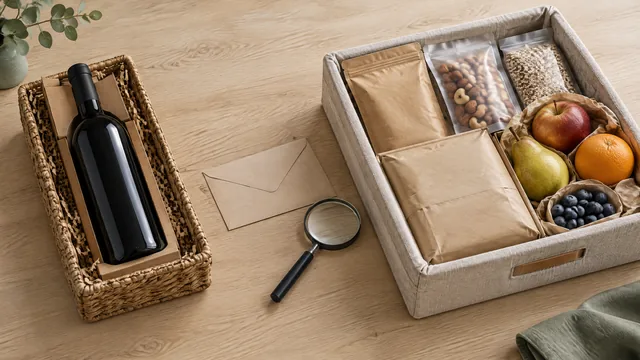
Ask about preferences without asking for a diagnosis
A discreet question is more useful than guessing from someone's age, job or recent absence. Try: ‘Would you enjoy food and drink as a gift, and would you prefer it without alcohol? Are there any ingredients you would like us to leave out?’ This lets the recipient set boundaries without explaining a medical history, religious practice or personal reason for not drinking.
For a household gift, check whose preferences the hamper should reflect. One person's enthusiasm for wine does not establish that everyone wants it. For a workplace thank-you, ask the nominated organiser whether food gifts and alcohol are permitted before choosing the contents. Request only the practical restrictions needed for the order, and avoid passing private health information to the merchant.
Treat wine as an optional preference, never a health feature
Do not describe wine as heart-friendly, restorative or a healthy reward. WHO states that no form of alcohol consumption is risk-free, and even low levels carry risks. Wine should therefore never be recommended for its health effects or included to encourage someone who does not drink to start. Do not offer alcohol to minors or pregnant recipients. [S4]
If an adult recipient has explicitly welcomed wine, explore the Wine hamper page as a starting point for presentation ideas. It identifies a wine-hamper category, but the actual bottle and accompanying contents still need confirmation. Ask for the proposed wine name, style, bottle volume and alcohol content rather than approving an unspecified ‘premium bottle’. [S1]
Ask whether the gift is intended for a meal or to be kept for later; do not prescribe a drinking amount. If the recipient is unsure whether alcohol fits their health circumstances or medicines, leave that decision to them and their clinician or pharmacist. Keep the alternative equally thoughtful so declining wine does not feel like declining your gesture.
Look past the wellness theme to the proposed items
A green ribbon, fruit motif or reassuring product name is not evidence that a hamper suits a particular diet. Start with the proposed item list. For packaged food, request photographs of the ingredient list, allergen information and nutrition panel. Establish which products the recipient already enjoys before adding unfamiliar herbal preparations or supplement-type products; do not select them as treatments.
The guide linked through Health hampers includes a wellness and health-hamper theme alongside other gifting directions. Use it to explore the concept, then assess the actual contents separately. The theme itself does not verify suitability for a patient, substantiate a health benefit or prove any supplier certification. [S2]
When checking a nutrient claim, keep the comparison basis consistent. A figure per serving cannot be compared directly with one per 100 grams without accounting for serving size. Ask what the proposed wording means on the actual label rather than treating ‘no added sugar’, ‘low sugar’ and ‘sugar-free’ as interchangeable. Never promise recovery, detox, immunity improvement or weight loss in the card.
Choose contents that are useful, not merely impressive
Think about how the recipient will open, store and use each item. A small household may prefer manageable sealed packs to large containers that need finishing after opening. Someone receiving the gift at work may have no refrigerator or serving utensils. Fresh and chilled items need a receiving plan based on their actual storage instructions, not an assumption that every basket can sit on a desk.
To compare a food-focused alternative, browse Gourmet hampers for the general hamper direction, then ask for a precise proposed composition. The destination introduces hamper gifting rather than establishing a fixed assortment. Check pack sizes and whether items require preparation so the recipient gets something convenient to enjoy, not an unexpected task. [S3]
| Recipient situation | Clarify first | Practical direction |
|---|---|---|
| Alcohol preference unknown | Whether alcohol is welcome | Do not include wine without agreement |
| Specific dietary requirement | Ingredients, relevant labels and cross-contact information | Hold uncertain items or agree on a non-food gift |
| Small household | Preferred pack sizes and storage space | Choose manageable units with clear opening instructions |
| Office reception | Gift policy and who will move the parcel | Confirm an authorised receiver and suitable storage |
| Hospital recipient | Recipient consent and ward permission | Do not send food before both are confirmed |
Set boundaries for substitutions and receiving
Allergen checks belong at product level. A nut-free request does not answer questions about milk, gluten or other ingredients, and vegan, halal and gluten-free requirements need separate confirmation. Ask what cross-contact information is available. If essential information cannot be established, do not describe the item as safe; choose an agreed alternative rather than relying on its appearance.
When preparing a Gift hamper enquiry, separate the contents approval from the receiving instructions. The page can help frame a general hamper request, but it does not confirm your chosen combination or delivery arrangement. Require approval before any substitution that changes an ingredient, alcohol status or dietary claim. [S3]
Name the person who will accept the parcel and agree on a realistic receiving window with the merchant. For hospital gifts, obtain both recipient and ward permission, especially for food; a reception desk is not automatic permission. At handover, check that the parcel matches the approved list, packaging is intact and storage instructions are available. Flag discrepancies before sharing or consuming the contents.
Send a brief that the merchant can actually answer
Use this enquiry: ‘I am considering a hamper for [recipient and occasion]. They have confirmed [alcohol welcome or excluded] and want to avoid [ingredients or products]. Please send the proposed item names, pack sizes and relevant label photographs. Please explain what cross-contact information is available and confirm any storage requirements. Do not substitute without approval. The receiving location is [address type], and [receiving role] can accept it during [proposed window]. Please confirm the arrangement and quote the total, including any delivery charge.’
Keep the card separate from that operational brief. ‘Thinking of you and hoping you enjoy these’ conveys care without commenting on someone's body or promising a health outcome. Before paying, resolve any essential suitability questions and check the confirmed contents against your brief. Where uncertainty remains, changing the gift is better than expecting the recipient to manage it.
Questions you may be asking
Is red wine a suitable addition to a health-themed gift?
Not because of a supposed health benefit. Include it only when an adult recipient explicitly welcomes alcohol and it is appropriate to their circumstances. WHO says alcohol consumption is not risk-free. A non-alcoholic or non-food alternative should remain a genuine choice. [S4]
Can I choose a hamper for someone with diabetes from its wellness description?
No. Ask which products the recipient wants and request the actual nutrition panels and ingredients. Do not label a hamper ‘diabetes-friendly’ yourself or infer suitability from the theme. The recipient can seek individual guidance from their healthcare professional if needed.
Does removing the wine make the whole hamper alcohol-free?
Do not assume so. Ask the merchant to check every proposed item, including filled chocolates, preserves and any other products where alcohol might be an ingredient. State whether your requirement covers the entire hamper and request approval before replacements.
What if a client does not want to disclose dietary restrictions?
Do not press for personal information. Offer a choice between food, an alcohol-excluded option and a non-food gift, subject to their organisation's policy. If the suitability of food remains unknown, let them choose a different gesture rather than sending a surprise hamper.
Should a get-well hamper be delivered straight to a hospital?
Only after the recipient and ward have agreed, particularly when it contains food. Confirm the permitted contents, authorised receiver and location before arranging delivery. If admission or discharge plans change, ask the merchant to confirm any new arrangement rather than assuming redirection is possible.