
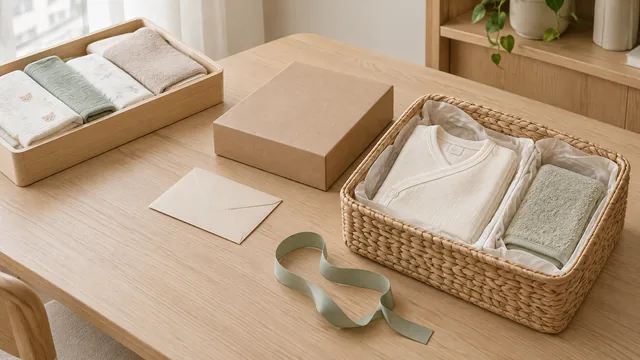
Ask for a small shortlist, not a complete household inventory
A broad question such as ‘What does the baby need?’ can create work for tired parents. Offer an easy choice instead: ‘Would you prefer something from your wish list, an adult treat, or a gift later?’ If they choose baby essentials, ask for two or three specific gaps. You need enough information to make one useful decision, not access to every purchase or a detailed account of their home.
Check three places: what is already available, what has been ordered, and what relatives or colleagues have promised. A present still in transit can be a duplicate even though nobody has unpacked it. Record the date of the answer, too. Needs may change between a newborn visit and a full-moon celebration, so an earlier conversation should not automatically govern a later purchase.
Compare the contents, not the size of the basket
Use the Baby gift basket page as a starting point for presentation ideas, then request an itemised list for the option you are considering. The page introduces baby basket gifting, but its appearance is not a specification for your order. [S1] Count usable products separately from ribbons, filler and the container; a large arrangement may still repeat items the family does not want.
Compare each proposed item with the parents’ answer. ‘Baby clothes’ is too vague: ask about garment type, size, fastening and care instructions. For nappies, establish the preferred brand, size and amount wanted before buying a bulk supply. For toys or care products, request the exact product details and age guidance for parental review. Leave unfamiliar feeding equipment off the list unless the family has specifically requested it.
Decide when a spare is genuinely useful
When comparing Baby gift hampers, separate a welcome repeat from an unwanted duplicate. YumYum’s baby destination presents newborn and full-moon gifting as options to explore; confirm the particular contents directly rather than assuming a fixed package. [S2] Ask whether the parents want another of the same item, not simply whether they already own one. A requested spare and an unneeded replacement are different purchases.
Use this checklist before committing. It is a decision aid, not a recommended shopping list. An unanswered question means pause the item, rather than guessing that a larger size or another colour will solve the problem.
| Proposed item | What to confirm | Keep it when | Pause or change it when |
|---|---|---|---|
| Clothing | Exact size, garment type and intended season | Parents request that particular gap | Matching clothes are already bought or promised |
| Nappies | Preferred brand, size and useful quantity | The family wants a top-up of that product | You would be guessing the fit or buying excess stock |
| Washcloths or towels | Existing supply and laundry routine | An additional set is specifically welcomed | Storage is full or enough sets are already coming |
| Toy or keepsake | Age guidance, parental preference and display space | The exact item is approved and wanted | A similar gift is reserved or details remain unclear |
| Food for adults | Ingredients, dietary needs and receiving arrangements | Parents welcome it and can store it as instructed | Suitability or the handover is unresolved |
Refresh the plan for the full-moon occasion
Treat the full-moon gift as a fresh decision, not a second newborn hamper by default. Ask whether the family still wants practical supplies or would now prefer a modest keepsake or something for the adults. The purpose here is a present going to the new family. If the parents are also arranging thank-you gifts for others, keep that outgoing order separate from your own choice.
Explore Full moon gift sets for presentation directions once the recipient and purpose are clear. [S2] If you have already given a newborn present, there is no need to repeat essentials merely to mark another occasion. A greeting card or a later requested contribution may suit the family better. Ask whether they want the parcel brought to a gathering or received quietly at home.
Remove duplicates before adding personal touches
The Bespoke gift hampers guide discusses recipient-led selection and approval of substitutions. [S3] Use it to frame an enquiry about removing or replacing unwanted items; it does not establish that every baby hamper can be altered. Get the revised contents and total quote in writing. Do not approve an order while an unsuitable item is still included ‘for presentation’.
If the hamper cannot be changed, compare a different format rather than trying to justify the duplicates. Personalisation also needs checking: confirm spelling and ask permission before adding the baby’s name or birth details. Keep those details off the outer parcel where possible. A restrained card can make a practical gift feel personal without introducing another object the parents must store.
Coordinate the purchase and the handover
For a group gift, nominate one organiser to hold a short list of reserved items. Record the exact product, who is buying it and whether it is merely proposed or actually ordered. Release a reservation if plans change. Share only the information needed to coordinate, with the parents’ agreement. The organiser should check the final basket against the latest list before payment, particularly if several relatives are shopping independently.
Agree on a receiving person and delivery window before ordering, and ask about building reception arrangements. A hospital parcel needs recipient and ward permission first. If adult food is included, confirm ingredients, allergens, cross-contact questions and storage instructions separately. The CFS Five Keys cover cleanliness, separation and safe temperatures among other food-handling principles. [S4] Arrange prompt handover according to the product instructions; celebratory food is not infant food.
Send an enquiry that prevents silent substitutions
Adapt this message: ‘We are choosing a gift for a new family who already has several essentials. Please send the exact contents, product sizes and quantities. We want to exclude [items already owned] and are interested in [confirmed need]. Can you offer that combination? Please quote the total, including any packaging and delivery charges, and confirm the receiving arrangements. Do not replace an item without our written approval.’
Before dispatch, compare the confirmed list with the reservation record and verify the card spelling. On receipt, the nominated adult should check that the contents match, retain product instructions and identify anything needing particular storage. Tell the organiser what has arrived so another buyer does not purchase it again. This closes the gap between ‘ordered’ and ‘received’ without asking the parents to manage every parcel.
Questions you may be asking
How can I avoid duplicates without spoiling the surprise?
Ask a parent-approved coordinator to confirm one category or wish-list item, then reserve it. You can keep the card and presentation a surprise. Do not ask someone to guess the parents’ preferences on your behalf.
Should I automatically buy clothing in a larger size?
No. A larger size can still duplicate future purchases or miss the intended season. Confirm the exact size and garment type the parents want. If they are unsure, choose another confirmed gap or offer to buy later.
What if the parents say they already have everything?
Accept that answer rather than searching for more essentials to add. Ask whether they would welcome an adult treat or a later gift when needs become clearer. A warm card is also a valid choice; more products are not compulsory.
Can several colleagues contribute without buying overlapping gifts?
Yes: agree on one organiser, one approved contents list and one purchase. Decide how contributions and the card will be handled internally. Avoid separate last-minute additions unless the organiser checks that the family actually wants them.
What should I do if the seller proposes a replacement?
Request the replacement’s exact details and check them against the family’s current needs before agreeing. For food, revisit ingredients and dietary questions. If the replacement is unwanted, ask about removal or another available option; do not assume changes or refunds are guaranteed.