
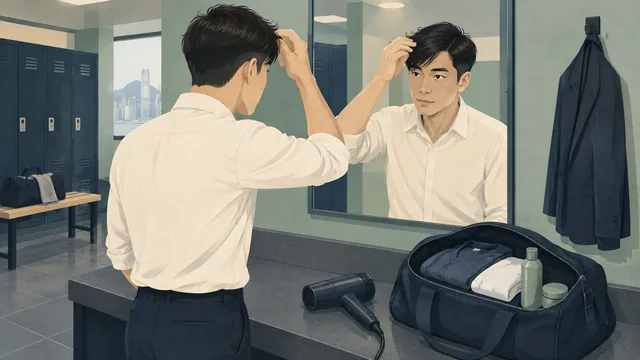
Start with your actual post-workout wash
An early workout can leave you choosing between the changing-room mirror and catching the MTR. Before changing your haircut, record what you do on a gym morning: whether you shampoo, how wet your hair is when you leave, and whether last night's styling product is still there. Compare that with a non-gym morning. The difference often reveals the step you need to plan around.
There is no single shampoo schedule for everyone who exercises. The American Academy of Dermatology recommends washing according to how dirty or oily the hair becomes, with shampoo applied to the scalp rather than rubbed through the whole length. Use that as a starting point instead of automatically adding another wash because it is a training day. [S3]
Make the changing-room routine specific
Note whether you use the gym's shampoo or bring your own, and which steps you skip when the shower area is busy. The same AAD guidance recommends conditioner after washing: on the ends for fine or straight hair, and through the length for dry or curly hair. Choose products appropriate to your hair type and follow their instructions, rather than treating every short cut alike. [S3]
Separate drying the hair from arranging the front
Write down two different tasks: removing moisture and creating the office shape. You might manage the first with a towel and dryer but spend most of your mirror time lifting the fringe. Or you might arrange the front quickly while leaving the back damp. Tell a stylist which task you want to simplify; asking only for shorter hair leaves that distinction hidden.
For gentler drying, the AAD advises using a towel to absorb water instead of rubbing the hair, air-drying where possible and using the lowest heat setting when using heated tools. A rushed morning is a reason to simplify the desired finish, not to rely on hotter settings. [S4]
Practise with the tools you can actually access
If your gym dryer has different settings or attachments from the one at home, say so during the consultation. Ask for a demonstration using your normal parting and finger styling if that is your usual method. A finish created with a brush you never carry is useful inspiration, but it should not become an unspoken requirement of the cut.
Give each product in your gym bag a job
Lay out the styling products you use and identify what each one is meant to do. Are you trying to direct the front, keep a parting visible or create a particular surface finish? Bring the product names or photographs of their labels to the appointment. Ask which step the proposed haircut would still need, rather than buying another product before you understand the problem.
Follow the product's directions on application to damp or dry hair. For a repeatable trial, keep the product and drying method consistent and change only one part of the routine at a time. Note how much you apply and where. If you dislike the result, that record is more useful than saying the product does not work.
Include your evening routine in the discussion. Product applied before an after-work dinner belongs in the same inventory as what you use after training. Decide what you are willing to carry, use and wash out regularly. A streamlined bag should support the agreed routine, not contain a substitute for every possible haircut.
Choose the cut around the steps you will repeat
Once the routine is clear, discuss a haircut for a busy lifestyle in terms of the one task you most want to reduce and the length you want to retain. Vit So's guide makes this trade-off explicit: natural texture, drying habits and upkeep all belong in the consultation. [S1]
A shorter top is not automatically the best answer if you rely on pushing the front back. Equally, retaining length for a lifted finish makes little sense if you dislike arranging it each morning. Take a current photograph after your usual gym routine alongside a reference image, and point to the part of the reference you want rather than requesting the whole look.
Include upkeep beyond the gym mirror
Consider how often you can return as well as what you can do every morning. If crisp edges are important, planning the cost of keeping edges sharp helps you weigh that preference separately from daily styling. Do not let a quick morning routine become a return-visit commitment you cannot sustain.
| What you notice | What to discuss | What to test in your routine |
|---|---|---|
| The front falls forward after drying | Dry fringe position and enough length for your preferred direction | Can you arrange it with your normal tools? |
| The sides need repeated attention | Retained side length, coverage and natural fall | How do they sit without extra product? |
| The back remains damp when you leave | Length and weight in the area you struggle to dry | Can your available drying method reach that area? |
| The office finish looks too elaborate | A softer shape rather than a deliberately lifted finish | Do you like it after your ordinary drying routine? |
Check the appointment scope before booking
Vit So lists men's wash cut and blow dry as washing, cutting and blow-drying; use those three parts to clarify the work you want rather than treating a reference photograph as an all-inclusive order. Colour, perming and other additional work need their own discussion. [S2]
Build your enquiry around the following checks. Name your current length and any previous colouring, perming or straightening. Describe which areas may be shortened and which must stay. Ask whether the quoted work includes the finish you want to discuss, and whether any additional service or length-related charge applies. Beard trimming should be a separate question, not assumed from a men's haircut label. [S2]
Finally, give possible appointment dates and any fixed commitment afterwards. Ask about available timing and the expected duration for the agreed work before arranging travel. If your workday leaves little flexibility, consider another slot rather than relying on an assumed completion time.
Bring a gym-day brief, then test it at home
For a local appointment, Vit So's men's haircut sheung wan page identifies its address as 252 Hollywood Road, Sheung Wan; use the hair-service details there for your enquiry and wait for booking confirmation before travelling. [S2]
A useful brief might read: 'I train before work and use the changing-room dryer with my fingers. I want the front away from my eyes without a brush-shaped finish. Please help me decide what top length to keep, and confirm the wash, cut and finish scope.' Replace those details with your own habits and attach a current gym-day photograph.
Before leaving, ask to see the front in your usual direction. Assessing a cut beyond the blow-dry can help you distinguish retained shape from the salon finish. Then try the agreed routine on ordinary training days and record where it needs adjustment. If your exercise commute involves curls under a helmet, the more specific cycle-helmet routine guide is a useful next read.
Questions you may be asking
Should I automatically shampoo both before and after an early workout?
Do not add a second shampoo simply to make the routine feel complete. Review when your hair becomes dirty or oily and what products you have used. The AAD bases washing advice on those needs rather than a universal timetable. Plan the wash alongside your workout so you are not repeating it by habit. [S3]
What if the gym has no dryer when I need one?
Tell the stylist that air-drying is your fallback, not just an occasional preference. Bring a photograph of your hair after it has dried that way and discuss an acceptable front direction. Avoid choosing a reference whose appeal depends entirely on lift created with a dryer.
Is a matte product necessarily better for the office?
Matte describes a finish, not whether a product suits your hair or workplace. Decide how much shine and hold you like, then discuss the actual product and application instructions. A product label cannot tell you how much arranging your chosen haircut will need.
Should I cut the top very short to make the routine simpler?
First check what the current length lets you do. If you normally push the front back or part it, removing length may change that option. Ask which area can be shortened without losing the direction you like, and compare the result with your normal drying method.
Can I fit the salon appointment between the gym and a meeting?
Ask the salon about availability and expected duration for the work you have described, and explain the meeting deadline. An enquiry is not a confirmed slot or completion time. Choose a less constrained appointment if the timing cannot be established before you travel.