
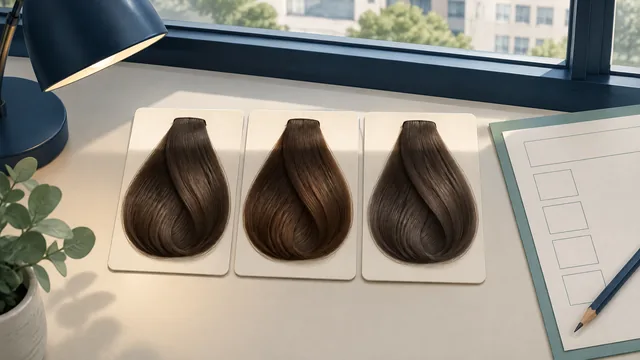
Define your office-light target before naming a shade
Start with the moment when you most want the change to be noticeable. Perhaps you want your hair to read clearly as brown in the office lift mirror, rather than showing colour only beside a window. Or perhaps you prefer a deep outline during the working day, with a warmer sheen visible outdoors. Those are different priorities, even if both inspiration pictures carry the same brunette label.
Depth means how light or dark the overall hair looks. Reflection is the warm, cool or more balanced cast you notice within it. Describe these separately: ‘deep brown, with a little golden warmth’ is clearer than ‘not too dark but natural’. The distinction also lets you reject an unwanted reflection without accidentally asking for a lighter base. [S1]
Look at more than the brightest strip along a wave. Check the broad body of the hair, the parting and an area turned away from the light. Then ask whether you like that darker impression. If the shaded hair looks too deep for you, more shine alone would not answer your request. If you like its depth, the reflection may be the part worth changing.
Build a small lighting set, not a bigger mood board
Give each reference a job. Keep one to show your preferred everyday depth, another to show the reflection you enjoy, and a third to mark a limit. Ten unrelated glossy pictures can make the brief less clear if some appeal because of their lighting, others because of their styling and others because of their colour.
Where possible, choose several views of the same head of hair. If you cannot find them, use references with similar texture and visible shadows, and explain that they illustrate separate preferences. Do not treat an outdoor photograph of one person and a dim indoor photograph of another as proof that their actual shades differ.
Photograph the places where you actually judge your hair
Take a current-hair photograph under your usual office lighting, one beside a window in soft daylight and, if evening appearance matters, one under your normal home lighting. Use dry hair, the same parting and a similar angle. Turn off beauty filters and keep the whole head in view before adding a close-up. The aim is a useful comparison, not a studio-quality portrait. [S1]
Note the setting beneath each photograph in your own consultation notes. Include ‘near a window with ceiling lights on’ if that is what happened. Look at the hair directly as well as on your screen; you do not need to make every image agree. A short observation such as ‘the ends look more golden here’ is more useful than trying to edit away the difference.
Compare brown, chocolate and ash at a similar depth
Use the brown hair colour comparison to decide whether the shaded hair should stay deep or appear more clearly brown indoors, before choosing its reflection. Point to a substantial area rather than a bright edge, and say whether that depth should extend through the whole head. [S1]
When a chocolate brown hair reference appeals, identify whether you like its rich depth, gentle golden sheen or redder warmth. Chocolate is not one fixed shade, so keep a contrasting image that shows where the warmth becomes too obvious for your taste. You might like warm lengths but dislike a strong red-looking area beside your face. [S2]
For an ash brown hair colour discussion, say whether you want a deep brunette with less warm-looking reflection or a much lighter, smoky appearance. The second request changes the brightness target as well as the tone. Compare an ash reference with a chocolate reference at similar visible depth, rather than choosing between a pale ash photograph and a dark warm one. [S3]
Try covering the caption while you compare. Write down what remains appealing: brown indoors, soft warmth outdoors, or a muted reflection in both views. If neither a strongly golden nor a distinctly grey-looking image feels right, ask about a more balanced direction. Your preferred work jacket or everyday makeup can help you judge the overall impression; they do not have to dictate a colour category.
Fill in a shade-discussion sheet you can actually use
Copy this sheet into your phone and attach the reference each answer describes. Avoid writing only ‘natural’, ‘soft’ or ‘subtle’: add the visible feature that gives the word meaning. An acceptable alternative is useful too. It tells the colourist which preference matters most if the original combination needs reconsidering.
Keep depth and reflection in separate rows even when you think you have already chosen chocolate or ash. This helps prevent a conversation about reducing warmth from drifting into a request for much lighter hair. Fill in the final row after discussing the existing base, not from the image caption.
| Decision | Your note | Question to take to the consultation |
|---|---|---|
| Office-light depth | Deep outline / visibly brown / noticeably lighter | Which shaded area in my reference best represents this depth? |
| Daylight reflection | Gentle golden warmth / less red / muted coolness | Can we discuss this reflection separately from lightness? |
| Brown reference | The image that shows my preferred overall depth | Is the brightness spread throughout or only in selected areas? |
| Chocolate reference | The warmth I like, plus the point that feels too warm | Am I choosing the brown base or the warmer sheen? |
| Ash reference | The cool effect I like, plus any pale areas I do not need | Would a deeper cool-looking option meet my main goal? |
| Acceptable alternative | The feature I would keep if other details change | What fits my roots, coloured lengths and current condition? |
Bring your existing hair base into the decision
Your lighting set explains the appearance you want; it does not establish the route to it. Show the colourist your current roots, middle lengths and ends. Note which areas have been coloured or lightened, including older work that remains on the hair. A brunette shade chosen from an image still depends on those starting sections and their condition. [S1] [S3]
Keep this history factual and brief. Record previous salon colour or home dye, any old red or copper colour, and chemical texture work still present in the lengths. Bring product names or packaging photographs if available. You do not need to diagnose what is underneath; the point is to avoid presenting differently treated sections as one uniform base.
Rank your boundaries before discussing the exact shade. If avoiding bleach matters more than reproducing pale smoky areas, say that. If preserving your current length comes first, put that first. Ask which parts of your preferred depth-and-reflection combination can be discussed on the existing hair, and what would need further assessment. A deeper alternative can remain worth considering even when it does not reproduce every detail of the original photograph. [S3]
Read back a brief that works in both lighting settings
Finish with one short statement that joins the two views. For example: ‘I want it to remain a deep brunette under office lights, with gentle warmth in daylight. I like this shaded area, but this red-looking reflection is too strong. Keeping the depth matters more to me than copying the brightest part.’ Adapt the words to your sheet rather than borrowing someone else's shade name.
Ask the colourist to explain the proposed direction against your current hair and the photographs. Confirm what areas would be treated and whether any separate lightening or colour-finishing work is being proposed before reviewing the quote. Record the agreed priority and alternative beside the images so that the final decision remains easy to recall.
Keep your current lighting photographs for a later comparison. If something then looks different, describe the setting and the area: ‘the ends look warmer beside the window’ is more informative than ‘it is no longer brown’. Your next conversation can start with the same depth and reflection preferences, rather than a fresh search for a completely different label.
Questions you may be asking
What if I love a brunette in daylight but dislike it under office lights?
Keep both views and identify the problem in the office image. Is the overall hair too deep, or is the reflection too warm or cool? Decide which setting matters more for everyday wear, then ask whether a different balance of depth and reflection would suit that priority.
Can I combine the depth of a chocolate reference with the reflection of an ash one?
You can use the two images to describe that preference. Point to the shaded brown depth in the first and the muted reflection in the second. Whether that combination can be approached on your hair depends on your current base and processing history; the images help frame the assessment.
Is an office selfie enough if I cannot photograph my hair outdoors?
It is a useful starting point because it shows a setting you care about. Add a photograph beside a window when convenient, using dry hair and the same parting without a beauty filter. Tell the colourist which view best matches what you see directly rather than treating either photograph as definitive.
Should I take a pale ash reference if I only want less red-looking brown?
Yes, if you explain which part you like and which part you do not need. Mark the cool reflection as the preference and the pale brightness as optional. Also bring a deeper reference so that less warmth is not mistaken for a request to make the whole head much lighter.
How should I describe a colour change after the appointment?
Compare photographs taken in similar settings and note where the difference appears. Say whether the whole hair looks lighter, the ends look warmer or the root boundary is more visible. Include any home colour products used since the visit so the follow-up discussion has useful context.