
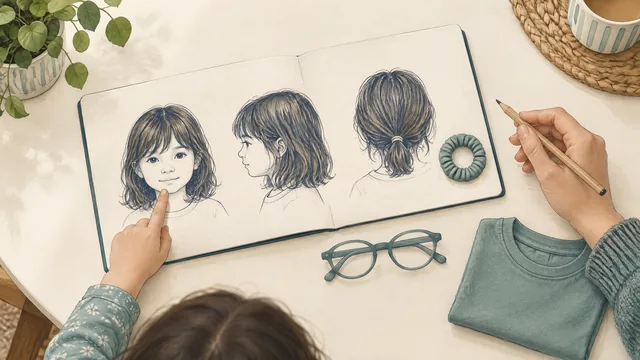
Start with one change your child understands
Choose a practical reason for the visit before choosing a style. Perhaps the front falls across the eyes during drawing, the ends catch in a school collar, or the family wants to tidy the outline without losing a favourite ponytail. Make that the first request. A first appointment does not need to become a complete transformation simply because everyone has made the journey.
Where your child can express a preference, ask what they like about their hair now. ‘Keep it long at the back’ or ‘I want to see my ears’ gives the conversation something concrete to work with. Explain what a trim means using the actual area you want changed, rather than calling the whole visit a surprise.
Vit So’s kids haircut information asks parents to share age, retained length and comfort needs, so use those details to check whether the proposed visit can be arranged for your child.[S1] Agree on a modest first priority together; keep optional changes for discussion rather than treating them as settled.
Turn comfort preferences into useful observations
Replace ‘might not cooperate’ with what you actually know. Does your child dislike water near their face during home washing? Do they prefer an adult within sight? Have they objected to a fastening at the neck? If there has been no previous haircut, say that plainly. You do not need to predict every reaction to give the salon a useful starting point.
Discuss these observations when enquiring, not after the cape is on. Ask about washing, accompaniment and any familiar object you hope to bring. A child-sized chair, lap seating, headphones or entertainment should not be assumed from a children’s service listing. Each proposed arrangement needs the hairdresser’s agreement.[S1]
Give the child a small, real choice
Offer choices you can honour: which current-hair photo to show, which small familiar item to bring if agreed, or whether you explain the request or they point to the fringe. Avoid promising choices that depend on equipment or an appointment arrangement you have not checked. Keep the explanation ordinary: someone will look at the hair, discuss the cut and explain the next step.
Pack for the journey as well as the chair
Bring the usual hair tie or glasses if they matter to the shape. Choose comfortable clothing and keep a spare top available if loose cut hair would bother your child afterwards. Arrange food and rest around your child’s normal day, while checking with the salon before planning snacks or extra belongings inside the appointment.
Set length boundaries before saying ‘just tidy it’
Take a current photograph with the hair worn as it usually is. Use visible points such as the brows, ears or shoulders to explain the finished length. For waves or curls, show their usual dry position rather than pulling a strand straight as your only guide. Bring a reference for a particular feature, not as an instruction to copy another child’s entire haircut.
Write down the smallest change that would solve the problem, then the limit you do not want crossed. A request to clear the front does not automatically mean shortening the back. Likewise, keeping overall length does not explain whether the sections around the face must remain inside the usual tie.
| Everyday situation | What to show or describe | Boundary to agree |
|---|---|---|
| Hair falls forward when drawing | The front in its normal parting, without holding it back | Which front sections may be shortened and which should stay |
| A ponytail is part of the school routine | The actual tie, including any pieces that escape | Which sections must still reach the tie |
| Hair sits against spectacle arms | Glasses worn with the usual ear-area hair | How much ear coverage the child wants to retain |
| The family wants a neater back outline | The current neckline and any collar preference | An agreed end point rather than simply ‘much shorter’ |
Send the booking questions in one message
Before you book a hair appointment, include your child’s exact age at the visit, current length, first-visit status and the main change requested, then ask for the service and appointment arrangements to be confirmed.[S2] Offer possible dates and explain any firm departure limit. Keep that limit separate from your preference for a convenient afternoon.
You could adapt this message: ‘I’m enquiring about a first salon haircut for my child, aged [age]. Their hair currently reaches [point]. We would like [main change], while keeping [length or feature]. They prefer [relevant comfort detail]. Could you confirm whether you can arrange this visit, who may accompany them, and whether washing and drying are included? We could attend on [dates]. Please also confirm the charge, how much time to allow and any arrival preparation.’
Add questions about pushchair access or space for another accompanying family member if those affect the journey. Ask about cancellation or rescheduling conditions before committing, and clarify the language arrangement if needed. Keep the salon’s reply with your length note so the adult attending has the same information. Sending an enquiry is not an appointment confirmation.[S2]
Build a flexible Sheung Wan outing around the visit
Vit So’s published appointment address is 252 Hollywood Road, Sheung Wan.[S2] Plan from your own starting point and check the route before setting off. If you are bringing a pushchair, confirm the relevant arrival arrangements rather than assuming that a neighbourhood address tells you everything about access.
When looking up haircut sheung wan, distinguish the adult wash, cut and finishing information from your child’s agreed service; washing or a particular finish still needs confirmation for the child’s visit.[S3] That distinction matters when deciding what to prepare and what the family expects to happen.
Keep the appointment as the main stop. An optional browse along Hollywood Road or a meal afterwards can make a family outing, but choose something you can shorten or skip. Avoid a prepaid activity or tightly timed collection immediately after the salon. Ask how much time to allow for the proposed visit, then leave room for the journey and your child’s pace. If a firm later commitment cannot move, discuss it before accepting the slot.
Agree on a pause and a simple finish check
Before cutting begins, ask how your child can signal that they need a pause. A simple word may be easier to remember than an elaborate instruction. If they need to turn or move, alert the hairdresser first and wait for tools to be clear.[S1] Discuss what happens if the planned work cannot comfortably continue, rather than insisting that every optional change must be completed.
At the end, return to the original priority. Check the front with the usual parting, put glasses back on if relevant and discuss whether the retained sections can still tie as intended. Ask the child about comfort as well as looking in the mirror yourself. A finished photograph can be a keepsake, but it need not become another task they have to sit through.
After the next ordinary wash, note whether the main practical problem has changed. Keep the first-visit note and add one observation for the future: what felt comfortable, what needs a different arrangement or which length you want to retain. Your next conversation can begin with that specific information, rather than a fresh set of hairstyle pictures.
Questions you may be asking
Can I arrange a first salon visit for a baby or toddler?
Ask about your child’s exact age before making travel plans. A published children’s haircut category does not establish a minimum accepted age or arrangements for very young children. Describe the intended trim and any uncertainty about sitting for the work, then wait for an individual reply.[S1]
Should I wash my child’s hair at home first?
Ask what arrival preparation the salon wants for the agreed service. Explain any concern about washing at the basin and confirm whether washing or drying forms part of the visit. Do not infer those items from the fact that adult wash-and-cut services appear on the website.[S1] [S3]
What if my child wants to keep more length than I do?
Separate the practical issue from your preferred look. Identify a shared aim, such as keeping hair clear for reading, and ask about changing that area while retaining a familiar length elsewhere. Show the agreed boundary to the hairdresser; avoid giving contradictory instructions once the cut has started.
Can we keep a small lock from the first haircut?
Ask before the appointment whether this can be accommodated, and how the salon would prefer to handle it. Bring a suitable envelope if the arrangement is agreed. Keep the keepsake request separate from the cutting instructions so it does not distract from your child’s comfort or the length decision.
Can a sibling or parent have a haircut during the same outing?
Enquire about each person separately and ask whether the requested appointments can be coordinated. One child’s confirmation does not reserve another service or establish space for everyone. If one adult needs to stay with the child, make that part of the planning conversation before adding another haircut.[S2]