
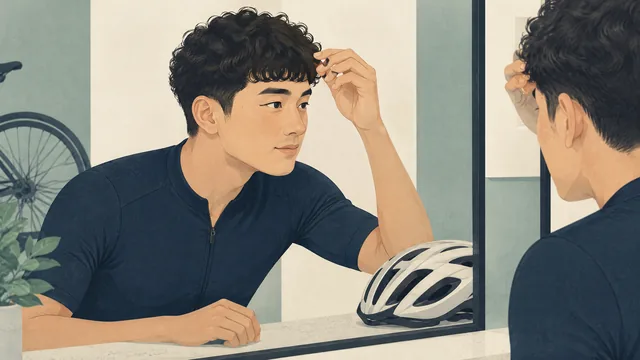
1. Choose the arrival routine before the haircut
Picture the destination on an ordinary day. At the office, can you use a basin and mirror, or will you only have your hands? After a weekend ride, might you shower before meeting friends? These are different hair briefs. A style that relies on washing and deliberate drying at the destination is not a practical reference for a morning when neither is available.
Set an acceptable arrival finish: a soft outline with less height, a fringe clear of your eyes, or curls that you deliberately reshape before going inside. Be specific about what can change. You may accept a flatter crown but dislike one long front curl falling across your glasses. That tells the stylist where convenience matters most.
On a normal ride, photograph your hair before setting off, after removing the helmet once parked, and after your usual touch-up. This is a record of your routine, not a haircut test during cycling. Keep helmet use unchanged; the decisions here concern hair length and the finish after the ride. Note the one area you spend most effort restoring.
2. Set a dry fringe boundary, not just a length
A short curly fringe can mean a few curls close to the hairline or a fuller front covering part of the forehead. Decide which you want when your hair is dry and resting naturally. Use a visible landmark, such as a clear space above the eyebrows. Include the corners: you might want the centre short while retaining some coverage at the temples.
Show the front both in its usual dry position and as it looks after a ride. Do not pull a curl down and use that as the only measure. If the front is usually pushed aside at the destination, demonstrate that movement too. Ask which length preserves the curl you enjoy without leaving a piece you constantly need to move out of the way.
The discussion of dry shape in Vit So's guide to curly haircuts for men can help you describe the resting fringe position and fullness you want to preserve. [S1] Choose the coverage first; asking for the front to be made much lighter does not explain where you want its shortest curls to sit.
3. Give the crown an acceptable relaxed shape
If your favourite reference depends on a high top, consider whether you also like it with less height. Look at your ride-arrival photograph from the side and back. Is the problem reduced lift, a broad band above the ears, or one crown section pointing differently? Those observations suggest different questions; 'make it shorter everywhere' leaves the important distinction unresolved.
Ask about the crown's connection to the front and upper sides. A compact, gently rounded outline may suit your preference for a relaxed finish, while a longer top gives you more curls to arrange. Neither is automatically right for cycling. The useful choice is the shape you are willing to wear when it is not at its most deliberately styled.
Protect the fullness you value. If you like the top but dislike width at the temples, identify that area rather than requesting thinning across the head. Also show any crown section that stands up after your normal wash. Let the stylist assess whether retaining or reducing length serves that particular area, instead of assuming a closer cut will make every curl settle.
4. Compare a crop with other short outlines
A forward crop is a useful candidate when you enjoy a short front and do not need a tall, swept-up finish. Vit So's textured crop haircut guide separates fringe length, retained weight and side coverage, which are helpful choices to settle before selecting a reference. [S2] With your natural curl, describe the intended outline rather than requesting a straight row of pieces from a differently textured model.
A very close top suits a different priority: having little front length to reposition. It also removes much of the visible curl you might want to keep. A short rounded top retains more surrounding movement. A longer, side-directed front provides another wearing option, but only if you are prepared to re-establish that direction when needed.
| Outline to discuss | What you keep | Arrival decision |
|---|---|---|
| Forward curly crop | Short forehead coverage and movement behind the fringe | Can you accept the front falling softly rather than as a precise edge? |
| Very close buzz-style top | Little movable front length; more exposed head outline | Are you comfortable losing most of the visible curl? |
| Short rounded curly top | Fullness through the crown and some upper-side connection | Do you like its relaxed silhouette with less lift? |
| Short sides with a longer, side-directed front | Length for a sweep and more visible front curl | Will you reset the direction, or is its loose fall also acceptable? |
5. Practise the reset you can actually repeat
Start with the touch-up you already use, on a day when you have no important meeting immediately afterwards. Once parked and the helmet is off, look before rearranging anything. Attend to the area that matters most: the fringe boundary, crown outline or side width. You do not need to reproduce every curl from the departure photograph to achieve a finish you like.
If your normal refresh involves slightly damp hands or a familiar styling product, demonstrate that routine at the consultation. Ask the stylist to show the smallest useful intervention with those tools. If the suggested finish requires a dryer, comb or full rewetting, decide whether that belongs to an office arrival or only a shower-and-change day. Avoid adopting a complicated routine simply because it completes the reference look.
Keep the trial consistent. Changing the product, drying method and haircut at once makes it harder to explain what worked. Record whether the front stays out of your way, whether the crown looks acceptable and what you still have to correct. If you dislike the untouched arrival shape, say so: that is valuable information for a cut consultation, not a reason to change helmet fit.
6. Take a three-zone brief to the appointment
When browsing short hairstyles for men, use the differences in retained top length and styling direction to narrow your choices, rather than treating every short example as equally easy to restore. [S3] Save one main reference and label its useful feature. Your own arrival photographs should explain the parts that an inspiration image cannot: what gets displaced and which changes you can live with.
A practical brief could read: 'I cycle before work and have natural curls. I want the dry front clear of my eyebrows, a crown I like without much lift, and some softness above the ears. I can use my hands at arrival but not a dryer. Please help me compare a forward crop with a short rounded top while keeping visible curl.' Adapt the boundaries to your preference.
Before booking hair services with Vit So, ask what preparation is preferred for the consultation and what the quoted cut includes. Before leaving, ask to see the front and crown in a relaxed finish as well as styled. Keep those photographs. At the next visit, explain which zone became inconvenient first so a tidy-up addresses the actual change, rather than automatically shortening every area.
Questions you may be asking
Is a curly crop always the easiest cut after cycling?
No. A softly forward crop may suit someone who accepts a relaxed fringe, while a precisely arranged crop may involve a touch-up they do not want. Compare its dry front and relaxed crown with your actual arrival tools. A closer top removes more movable length but also more of the curl you may enjoy.
Should I take the crown much shorter because it looks flat after a ride?
First show the difference between your usual dry crown and your arrival photograph. Decide whether you need height restored or would prefer an outline you like with less lift. Ask about that zone's length and connection to the upper sides; a blanket shortening request does not explain the desired shape.
What if I like a longer fringe but cannot reset it at work?
Show where it falls after the ride and which dry boundary is comfortable for you. Compare keeping that length with a shorter front before deciding. If its relaxed fall repeatedly gets in your way and you cannot rearrange it, that is a concrete reason to revisit the fringe length, not necessarily the whole haircut.
Do I need a perm to make a crop look textured?
The starting point here is your existing natural curl. Discuss how the cut can retain and shape that movement. A photographed crop may also involve styling. If you want to change the curl pattern itself, raise that as a separate consultation question rather than assuming chemical texture work belongs to the cut.
Should I bring my cycle helmet to the haircut consultation?
Your ordinary before-ride, arrival and post-touch-up photographs can communicate the hair issue without changing how you wear the helmet. If you think bringing it would help explain your routine, ask the salon beforehand. Keep the discussion focused on hair shape and resetting after removal, rather than asking for adjustments to helmet fit.