
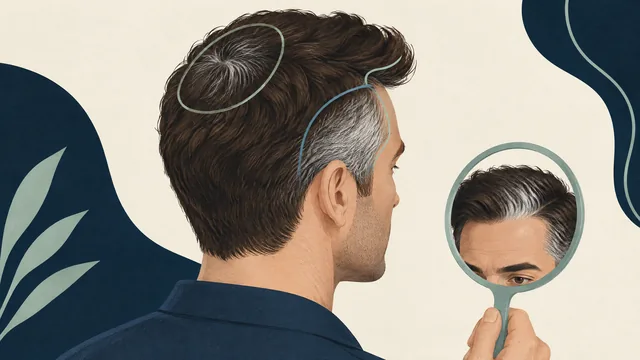
1. Decide what you want to recognise in the mirror
Before collecting colour references, write down one feature you want to preserve: the pale edges above your ears, a silver streak in the fringe, or scattered lighter strands across the top. Then identify the part you would change. Perhaps a concentrated front patch draws your eye more than the rest, while the sides already feel right. These are separate preferences, not a contradiction.
Use two plain statements: ‘I want to keep…’ and ‘I would like less contrast at…’. Follow them with what would feel too different, such as a completely dark hairline or a much lighter top. Avoid using ‘younger’ as your only instruction; it does not tell a stylist which colour balance you actually like.
When reviewing Vit So’s men's hair colour information, bring a photograph of the haircut you intend to keep, because its guidance treats the top-and-side relationship as part of the colour discussion. [S1] Your starting brief should describe your own silver pattern, not somebody else’s age or appearance.
2. Photograph five zones, not just your best angle
Take the photographs with dry hair worn normally. Use soft daylight, turn off filters and keep the camera far enough away to show the outline as well as individual strands. A sharp close-up can record a patch, but it needs a wider view beside it. Ask someone to photograph the crown and back if those views are difficult to capture.
Make a separate note for each temple rather than assuming they match. Include your normal parting and a second view with the front lifted if you sometimes push it back. For every zone, choose ‘retain’, ‘soften’ or ‘cover’, then add a short explanation. ‘Retain the pale band above my right ear’ is clearer than ‘natural at the sides’.
The table is a conversation sheet, not a treatment plan. You can put a question mark beside a zone you cannot judge. Take both unmarked photographs and annotated copies so the stylist can see the actual hair without arrows obscuring it.
| Zone to photograph | What to record | A preference you could write |
|---|---|---|
| Front hairline and fringe | Normal position, then lifted away from the face | Soften this bright cluster; keep a few visible silver strands |
| Left temple | Silver above the ear and how the top overlaps it | Retain the light edge that I recognise |
| Right temple | Its own distribution, even if it differs from the left | Leave this side unchanged unless we discuss it |
| Top, parting and crown | A wider overhead view plus any concentrated patch | Reduce contrast here without making the whole top solidly dark |
| Back and neckline | The outline at your usual haircut length | Help me judge whether this needs colour at all |
3. Give ‘soften’ an observable meaning
Retain means that you want visible silver to remain part of the look. Cover means that you want the chosen area to appear more consistently coloured. Soften needs another sentence: do you want fewer bright strands catching your attention, a gentler difference beside darker hair, or a less concentrated-looking front patch? Describe the effect before asking for a product or technique.
For a men's grey hair coverage enquiry, specify both the areas you want darker and the silver you would miss if it disappeared, rather than leaving the stylist to interpret ‘not too much’. The linked service page distinguishes a more consistent appearance from keeping visible white strands. [S1]
Also set an overall depth limit. You might accept a softer mix but reject a near-black finish or a noticeably lighter surrounding colour. Ask the stylist to explain how the proposed work would connect the zones. A wish to soften one patch does not, by itself, settle whether the rest of the head should be treated.
4. Ask about the proposed work, not only its name
A service label cannot capture all the decisions on your map. Vit So’s grey coverage page is useful for framing the difference between making selected strands darker and keeping a varied finish, with the actual method discussed individually. [S2] Take that distinction into the consultation rather than assuming every coverage request uses the same approach.
Ask: ‘Which areas would you colour, which would you leave, and what change would you expect between them?’ Follow with: ‘Would this proposal also change the surrounding darker hair?’ If a reference shows an entirely silver head, explain whether you like its overall lightness or just the visible silver near the face. Retaining your own grey and asking to create a silver shade are different briefs.
For the quote, confirm the colour work, any additional processing, the finish and whether cutting is separate. A small-looking target is not enough to establish the service category or cost. If a proposal exceeds your budget, ask which goal can be prioritised while preserving the features you want to keep.
5. Check the map against your normal haircut
Bring one photograph from shortly after your usual haircut and one from its grown-out stage. These show the lengths you actually live with. Tell the stylist if you refresh the sides while leaving the top longer, or if you are planning a change in shape. Vit So notes that cutting and new growth can change the visible colour balance, especially where short sides sit beneath retained top length. [S1]
This matters when silver at the temples is part of your identity. Show the edge you like at its usual length, not only underneath a temporarily longer top. Ask how the proposed colour placement relates to the next cut, and whether a planned shorter fringe would expose a patch that currently stays hidden.
Keep the colour target separate from styling. If you normally wear a matte, forward-directed finish, include that view even when your inspiration photograph has a glossy swept-back top. You are trying to explain where silver should remain visible in your routine, not asking colour alone to reproduce a different haircut.
6. Leave with a shared brief you can refer back to
List previous salon and home colour, lightening and other chemical services on the hair still present, including approximate dates and areas. Bring product photographs where available and label uncertain details as uncertain. A short haircut does not make retained top lengths a blank slate; Vit So asks for this history when discussing men’s colour. [S1]
Before agreeing to the work, read your map back together. Confirm the silver to preserve, the areas to change, the depth you would find too dark and any accepted variation. Ask what preparation applies to the proposed service and what follow-up work the design may involve. Keep a copy of the agreed priorities beside your photographs.
Your enquiry could read: ‘I want to keep the silver at both temples, soften the concentrated patch at the front and discuss whether the crown needs work. I prefer to retain a dark overall appearance, but not a solid dark hairline. Attached are my usual haircut, five-zone photographs and colour history. Please explain the proposed areas, method and quote before we arrange the service.’
Questions you may be asking
Can I ask to keep one silver temple even if the other side has less grey?
Yes—include separate left and right photographs and state whether the difference is something you like. Do not describe the sides as one zone if preserving that asymmetry matters to you. Ask how the proposed work would respect it.
How can I describe ‘half covered’ without choosing a percentage?
Describe what you want to notice in the finished appearance: a visible pale edge, scattered silver across the top or a quieter front cluster. A percentage alone does not explain placement. Use your marked photographs to show which variation matters most.
What if my reference has silver sides but my own grey is mostly at the front?
Identify the feature you like in the reference, then keep your current photographs beside it. Say whether you want to work with your existing distribution or discuss a different colour design. The reference is an appearance preference, not evidence that the same method fits your hair.
Should I include beard grey in the brief?
A full-face photograph can show how your head-hair colour sits beside your beard, but keep the requested service clear. A head-hair colour enquiry does not establish that beard colouring is offered or appropriate. Ask separately rather than including it in the assumed scope.
What if I still cannot decide whether to cover the crown?
Mark it ‘discuss’ and prioritise the zones you are sure about. Ask to review the wider crown photograph alongside your normal hairstyle. You can clarify that uncertainty before agreeing to work rather than turning it into a default all-over request.