
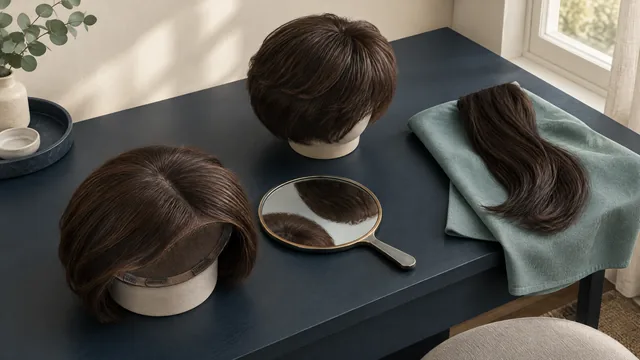
1. Identify what your own hair will still do
A topper covers a selected area, while some of your own hair remains part of the finished hairstyle. A full wig provides full-head coverage. OWNSTRAND's hair topper vs wig guide makes this distinction a useful starting point: compare the coverage needed before considering a favourite photograph or haircut. [S1]
Look at your hair in its usual part, from above and from the side and back. You are not trying to assign a hair-loss category. Identify the area whose appearance you want to change, then note which surrounding sections you would like to keep visible. A top-view photograph can help communicate this, but it cannot establish attachment suitability.
There are two different jobs for retained hair: contributing to the blend and, for some designs, supporting the fastening. When exploring hair toppers, ask about both. Plenty of length at the ends does not establish that hair is available where the particular attachment sits. OWNSTRAND advises checking the exact footprint and attachment; Jon Renau also puts coverage and sufficient hair for clips before fibre and colour in its selection guide. [S2] [S4]
If either job is uncertain, keep both formats open for inspection. The useful result is a question about how the candidate would work with your hair, not a decision that every local concern needs a topper.
2. Separate more coverage from more change
Write down what should remain familiar and what you want to change. Keeping your own side lengths while adding coverage at the crown is different from wanting a new colour and outline across the whole head. Both are legitimate goals, but they create different blending demands.
For a broader change, women's wigs provide a full-head format to compare. The reason to inspect one may be the desired overall hairstyle, rather than the size of a sparse area. Conversely, a full wig can reproduce a restrained, familiar shape; full coverage does not require conspicuously greater length or volume. [S3]
A topper leaves a meeting point between the piece and visible natural hair. If you want the top to have a distinctly different texture or shade, consider whether you also want to arrange your own hair to suit that change. A full wig reduces reliance on a local blend, but replaces it with questions about overall cap fit and the front edge. Neither format removes the need to inspect the specific design. [S1]
3. Put removal into the decision before buying
Describe your routine plainly: 'I want to remove it when I get home', 'I only need it for meetings', or 'I need to manage it myself each evening'. These details are more informative than assuming a smaller piece must be easier. A topper and a full wig can involve different preparation, fastening and re-styling tasks. [S1]
For a topper, find out how the exact attachment is released and how much arranging your own hair needs after the piece goes on. For a full wig, ask how retained hair is accommodated under the cap, how the piece is secured and what must be readjusted on the next wear. Do not infer nightly removal suitability from the category name.
If a suitable sample can be shown, ask for a model-specific demonstration of putting it on and taking it off. Consider whether you can reach the fastenings and follow the sequence independently. Include storage and the next morning's preparation in the conversation. If scalp discomfort or a treatment-related concern affects wearing or removal, discuss that aspect with your healthcare team rather than settling it through a product label.
4. Choose an inspection route, not an automatic winner
Use the following table to decide what to inspect first. It is not a scoring system: one unresolved practical issue can matter more than several preferences. Where coverage, blending and removal point in different directions, request a comparison rather than forcing a purchase decision.
| Your priority or uncertainty | Start by inspecting | Question to resolve |
|---|---|---|
| One local area; you want surrounding hair visible | A topper | Can this footprint cover the area and leave a workable blend? |
| Coverage across several areas or the whole head | A full wig | What does this cap cover, and how does it fit? |
| A new overall colour or silhouette | A full wig alongside any plausible topper | How much work would blending with my own hair require? |
| Unsure whether retained hair supports attachment | An item-specific fitting assessment | Can this fastening work with the hair available? |
| Removal after short outings is essential | Either format with a demonstrated routine | Can I manage removal and preparation for the next wear? |
| You simply prefer longer hair | Coverage first, then length options | Is the base appropriate before we compare the ends? |
5. Now choose length—and leave with specific answers
The base footprint and the length of hair attached to it are separate specifications. Hair hanging below a topper's edge does not turn that edge into a larger coverage area. Jon Renau's base guide assesses front-to-back and side-to-side coverage separately; it does not select the base by the desired hair length. [S5]
Once a format looks workable, compare the ends with your intended hairstyle. For a topper, inspect where its lengths meet your own hair at the sides and back. For a full wig, consider the complete outline. Extra length may be exactly what you enjoy, but it cannot compensate for a misplaced edge, unsuitable fastening or cap-fit problem.
There is no need to choose the longest candidate as a precaution. Ask to compare relevant options at a similar intended length or shape where possible, so the photograph's styling does not distract from coverage. Then assess whether the selected length suits your clothing and the amount of arranging you want to do.
A short enquiry worth sending
Bring a coverage sketch and one hairstyle reference. Ask OWNSTRAND: 'Which area would this exact piece cover? What retained hair does it need? How would I remove it? What preparation remains before the next wear?' Its only showroom is in Kwun Tong; confirm relevant samples and visit arrangements before travelling. Catalogue images do not confirm supply. [S2]
Finish with the unresolved choice: 'Can we compare local and full coverage before deciding the length, and confirm which cutting or fitting work is included?' Those answers should tell you what to inspect next—and whether a candidate deserves a quotation.
Questions you may be asking
Does shoulder-length natural hair mean a topper will work?
Not by itself. Length can help with the visual blend, but the exact attachment also needs to work with the retained hair at its intended positions. Ask about those positions rather than judging only the ends.
Can I choose a full wig even if I still have plenty of hair?
Yes, full coverage can be an appearance preference. If you want a different overall style, inspect how your retained hair would be accommodated and how the specific cap fits before deciding.
Should I buy a longer topper to hide a coverage mismatch?
No. Longer strands do not change the base footprint. First clarify whether the mismatch concerns the coverage area, placement or blending; then compare appropriate lengths for the intended shape.
Is a topper always faster to take off than a wig?
The format alone does not establish that. Fastening, access to it and preparation for the next wear all matter. Request the routine for the particular piece and decide whether you can manage it.
What if I cannot decide from online photographs?
Send your coverage goal and removal preference first. Ask for the candidate's footprint or cap measurements and fastening details, then confirm whether relevant samples can be inspected. Do not treat an attractive image as evidence of fit.