
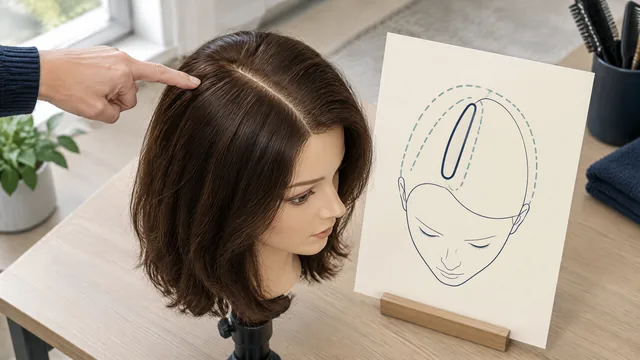
Map the visible zone, not just its widest point
Style your hair as you normally wear it before recording the area. Notice where the visible line starts, where it finishes and whether it opens into a broader patch towards the crown. A single width cannot describe all three. Use a top-view photograph alongside a simple head outline, marking the front so there is no confusion about direction.
When considering a hair topper for widening part, include the ends of the part in your enquiry, not only its most noticeable section. OWNSTRAND's coverage guide highlights that a base covering only the centre can leave the ends outside its footprint. It also distinguishes a part-focused concern from wanting more fullness across the crown. [S1]
Keep the sketch specific to your appearance goal. Mark the area you would like softened rather than shading the entire top because it seems easier. If the boundary is unclear, show that uncertainty with a dotted line; it is a useful question for the fitting discussion, not a reason to guess a larger size.
Draw the part you intend to wear
Your usual part and your intended topper part may not be in the same position. If you hope to retain a centre part, draw it clearly. If you prefer a side part, add a second line and label it as your preference. The sketch should show both the visible area needing coverage and the line you want the finished style to present.
Moving a part is not the same as moving the whole base. The exact piece may limit where a part can be made, while shifting its base changes where the perimeter and attachment points sit. Ask to see the permitted parting area and the front of that model before treating an online hairstyle as a placement plan. [S2] [S3]
If preserving your own front hairline matters, add that preference to the sketch. Someone assessing the piece then has a concrete task: compare the proposed front edge with the visible zone while keeping the intended hairstyle in view.
Give surrounding hair a separate role on the sketch
Hair beside the part has two different jobs to discuss: contributing to the transition around the edge and, for a design that attaches to retained hair, supporting its fastening. Those requirements need checking separately. A long strand that can sweep over an edge does not establish that an attachment position is suitable.
Mark the surrounding hair you want to retain, including areas that are short, fine or difficult to arrange. Do not assign clip positions yourself. Jon Renau's guidance for its clip-in toppers emphasises having sufficient hair at the intended attachment areas. That supports asking about the hair available around a proposed base; it does not establish a fitting rule for every topper. [S4]
OWNSTRAND's hair toppers guide treats attachment as an exact-model detail, rather than assuming every piece uses clips. Bring your sketch to that enquiry and ask which surrounding areas need inspection. Keep any uncertain supporting hair marked as uncertain instead of drawing an apparently confirmed fastening plan. [S3]
Turn the sketch into a base-size comparison
The coverage margin is the space being considered beyond the visible zone so that the proposed edge and attachment arrangement can be assessed against surrounding hair. It is not a fixed allowance to add on every side. Different ends of a part can present different placement questions, and the model's outline matters alongside its overall dimensions. [S1] [S2]
Use OWNSTRAND's hair topper base size guidance to frame the comparison: ask for the exact base length, width and outline, then establish what those measurements include. Similar headline dimensions can describe different shapes. A narrow, elongated footprint and a broader outline should not be treated as interchangeable simply because their size labels match. [S2]
Record how you measured, not only the result
If you take preliminary measurements, note the units, start and finish points and whether the tape followed your head's curve. Keep front-to-back and side-to-side readings distinct. A curved reading is not automatically equivalent to a flat base measurement; ask how the manufacturer measures that specific piece before comparing figures. [S2]
| Sketch detail | Question to ask | What it prevents |
|---|---|---|
| Visible zone and its ends | Does this outline reach the full area I want covered? | Choosing by the widest point alone |
| Preferred part line | Can this model present my chosen part at this position? | Confusing hair styling with base placement |
| Retained surrounding hair | Which areas need checking for blending and support? | Assuming nearby hair suits every attachment |
| Proposed perimeter | Where would each edge sit, rather than only the centre? | Rounding up without checking the outline |
Compare two outlines before adding more coverage
If two sizes appear plausible, ask what each changes on your sketch. Does the longer option reach the back of the visible part? Does the wider option move a side edge into hair you prefer to leave uncovered? Ask whether the extra footprint solves a stated problem, rather than treating it as reassurance on its own.
Do not reject a larger outline simply because you want modest volume, either. Base footprint and hair density describe different features. A coverage requirement may need more reach without your wanting a fuller silhouette. Keep those preferences separate so the enquiry can address both. [S2] [S3]
Where a relevant sample can be assessed, return to the sketch while checking the front, sides and rear of the proposed placement. Ask which concern remains unresolved: an exposed end, an edge transition or the intended part. This keeps the conversation on coverage instead of asking colour matching to solve a positioning problem. Confirm sample arrangements before travelling.
Leave the enquiry with a placement explanation
Your useful outcome is not merely a recommendation marked small or large. Ask for an explanation of how the proposed outline covers your marked zone, where its edges would sit and what surrounding hair it relies on. Record the exact model and any specification still needing confirmation alongside the sketch.
If enquiring with OWNSTRAND, its only showroom is in Kwun Tong; confirm whether a relevant sample and coverage discussion can be arranged before making the journey. A catalogue image is a starting reference, not confirmation that the piece is available to inspect. [S3]
Finish with three practical questions: can you show why this outline suits the whole marked part; can the intended part and attachment arrangement work at that placement; and what measurement or fitting detail remains to be checked before ordering? Those answers are more useful than an unexplained instruction to choose the next size up.
Questions you may be asking
Should I draw every area where I can see scalp?
Draw the area you want the topper to address with your everyday hairstyle in place. You can mark other uncertain areas separately. The sketch communicates a coverage goal; it is not a diagnosis or a requirement to cover every visible bit of scalp.
Can I send a photograph instead of a sketch?
A clear photograph is useful, but an annotated outline adds your intentions: the part you want, the area to cover and hair you prefer to retain. Send both if comfortable. Neither establishes the fit or measurement convention of a particular model.
Does a longer topper give a longer coverage margin?
Not necessarily. Hair length describes the strands, while base length describes the foundation's footprint. Longer strands do not prove that the base reaches the back of your visible part. Request both specifications separately.
What if my measurements fall between two base sizes?
Compare the outlines and proposed edge positions rather than automatically rounding up. Ask what the additional area would cover and how it changes the placement relative to surrounding hair. An unclear measurement needs clarification before a size decision.
Can I reuse the same sketch when changing my usual part?
Keep the original as a reference, but add the new part and reassess the visible zone. Check whether the current model permits that part position and whether its proposed placement still addresses the area. Do not assume the same dimensions settle a different hairstyle.