
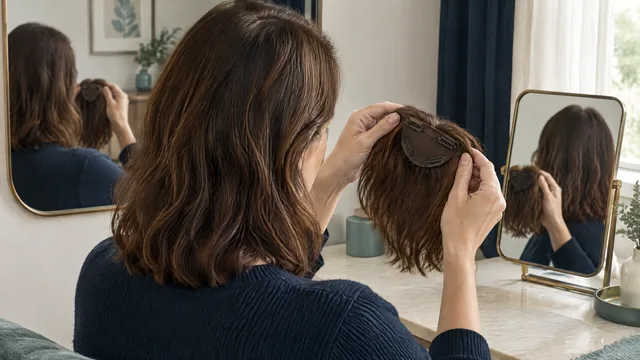
Start with the fastening, not the finished hairstyle
When investigating a clip-in hair topper, ask which clips the exact model uses and where they sit on its underside. OWNSTRAND describes clips as generally fastening to existing hair, but their number, design and placement are product-specific. A photograph of the finished hairstyle cannot establish how those attachment points relate to your head. [S1]
Keep the fibre question separate. A human hair topper describes the hair material, not the fastening. Confirm both descriptions for the same piece rather than assuming every human-hair option uses clips. That lets you evaluate attachment before becoming committed to a particular colour or length. [S2]
Look at the hair where each clip would land
Ask the fitter to show the underside beside your intended wearing position. Identify where each clip would meet your own hair, including points you cannot see in a front mirror. Hair left at the sides or back does not automatically mean there is enough at every proposed attachment point. Specialist retailer HairWeavon likewise explains that clips grip natural hair and need enough surrounding hair to support them. [S3]
Describe what is present at those positions: shorter new strands, fine hair, longer layers or an area with little hair to engage. Ask whether the model can fasten there without pulling nearby strands across to compensate. There is no useful universal minimum length to apply to every clip design; request an assessment against the actual piece rather than a yes-or-no answer based on total hair length.
Bring your usual part and hairstyle into the discussion. A layout demonstrated on tightly gathered hair may not answer whether the piece works with the loose style you normally wear. Photographs from above and behind can help an initial enquiry, but they cannot establish grip or diagnose the condition of your hair or skin.
Use a trial fit to check ordinary movement
If a trial can be arranged, have the fitter explain the model's opening, closing and positioning instructions before fastening it. Say whether you expect to wear it for a short lunch, a working day or several separate outings. Sit in your normal posture, gently turn your head and look down as you would at a phone. This is a fitting check, not a strenuous tug test.
Notice location as well as intensity. Saying that one side pulls when you turn left is more useful than saying the whole topper feels odd. Ask for a reassessment if a clip tugs or the base shifts. OWNSTRAND advises removing an uncomfortable piece rather than assuming a tighter fit is better. A short successful trial is useful evidence about that fitting, not a promise of comfort throughout a full day. [S1]
| What you notice | What to ask |
|---|---|
| A clip cannot engage the hair at its proposed position | Does this layout suit the hair available here? |
| One point pulls during a gentle turn | Can you reassess that attachment before continuing? |
| The base moves despite closed clips | Is the position or fastening unsuitable for me? |
| The rear clips are difficult to reach | Can I practise handling this model myself? |
| The hair looks right but removal catches strands | Can you demonstrate complete release before lifting? |
Rehearse removal while help is available
Removal deserves its own demonstration. Ask how to support the piece, open its clips and release your hair in the order specified for that model. HairWeavon's clip-removal guidance stresses opening the clips and freeing hair from their teeth before lifting the topper away. The important principle is release before lifting, rather than pulling a still-engaged piece upwards. [S3]
Then practise with the agreed guidance. Can you locate every fastening without seeing the back of your head? Can you tell whether each clip is open? If something catches, stop and ask for help instead of using extra force. Ask whether a second mirror would help at home, especially if rear attachments are hard to locate.
Match handling to the routine you actually want
If you want to remove the topper each evening, include that task in the purchase decision. Consider your reach, hand dexterity and whether you want anyone else's assistance. A piece that can technically be removed may still have a fiddly fastening for you. Ask for the care and storage instructions too, so the whole routine is clear.
Recognise when the clip layout needs another answer
If one attachment repeatedly misses usable hair, do not solve the problem by accepting more pulling. Ask whether a different confirmed layout or piece warrants assessment. Moving clips is not a casual home alteration: establish whether the particular model permits it and who would carry out the work. A larger base is not automatically the answer, because its proposed attachment positions still need checking.
Pain is not a sign of reassuring security. The American Academy of Dermatology explains that repeated pulling can cause traction alopecia, a form of hair loss, and identifies pain, stinging and crusting as reasons to change a pulling hairstyle. Stop the trial if it hurts. If skin is sore, inflamed or otherwise symptomatic, do not trial clips on that area; seek advice from your healthcare team about individual suitability. A clip-in piece is an appearance option, not a way to prevent hair loss. [S4]
Take precise attachment questions to your enquiry
For an OWNSTRAND enquiry, identify the piece you are considering and explain your retained hair and removal preference. Its only showroom is in Kwun Tong; confirm arrangements before travelling. Ask whether the visit can include viewing the underside, assessing the proposed clip positions, checking gentle movement and practising removal. A category page does not establish which samples can be seen or what fitting support is available. [S1]
Leave with answers to three practical questions: where would this model attach to my own hair, can it do so without tugging, and can I release every clip myself? If any answer remains unresolved, ask what different option or further assessment would address it. Those details are more useful than being told that a piece simply has clips.
Questions you may be asking
Does long hair mean I have enough hair for topper clips?
Not necessarily. Length elsewhere does not establish how much hair is available where each clip would sit. Ask for the proposed attachment positions to be assessed with the actual model and your usual hairstyle.
Can I leave one awkward clip open?
Do not assume that a partly fastened piece will work as intended. Ask whether the model permits that arrangement. An awkward attachment is a reason to reassess the fit, not improvise with the remaining clips.
Should I backcomb my hair if a clip slips?
Do not treat backcombing as the automatic fix. First establish why the attachment slips and whether the model suits the hair available. Ask for its intended fitting method rather than adding preparation steps to compensate for an unresolved mismatch.
Can I sew the clips somewhere else myself?
Ask whether alteration is permitted for that base and whether suitable support is available. Relocating a clip changes where the piece attaches; it should not be treated as a substitute for checking fit first.
What if removal is harder than putting the topper on?
Ask for another demonstration and supervised practice before deciding. Check that you can reach each fastening and release trapped hair before lifting. If you cannot manage that comfortably, discuss a different design or the assistance you would need.