
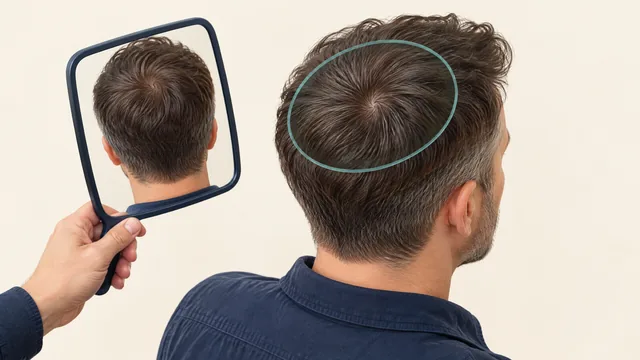
Start with an overhead outline and a rear view
Use an overhead photograph to describe the sparse area, then add a rear view and an angled view from each side. Keep your usual part and brushing direction rather than arranging the hair solely to hide the crown. The overhead view helps explain coverage; the rear view shows the relationship between the crown and the hair beneath it. These photographs are discussion aids, not a substitute for checking the actual piece against your hair.
When exploring a men's hairpiece for thinning crown, mark both the area you want covered and the surrounding hair you want to keep. OWNSTRAND's crown guide highlights the whorl, where hair changes direction, as well as the boundary with retained hair. Ask how the proposed piece would accommodate that direction rather than assuming everything can be brushed into the same pattern. [S1]
Agree the base margin before the final haircut
The base is the foundation that carries the piece's hair. Its footprint is not the same as the area reached by the hair hanging beyond it. Ask to see the base dimensions and shape separately from the styled hair: a generous-looking hairstyle in a photograph does not establish the coverage underneath.
A coverage margin means discussing where the base ends relative to the visible sparse area. There is no useful universal allowance for every crown. The proposed boundary also needs checking against surrounding hair and the intended way of securing the piece. Larger is not automatically better, just as the smallest possible base is not automatically easier to blend. Ask the fitter to explain the boundary at the back as carefully as at the sides. [S1]
For a men's hairpiece, make base size and the surrounding cut part of the same enquiry. The partial-coverage guide identifies dimensions, edge position and existing hair as separate checks. Agree those points before committing to a much shorter haircut, so the proposed fit can be assessed with the length you currently have. [S2]
Separate a tidy nape from a short blending zone
“Short at the back” can mean a neat neckline, a close lower-back taper or short hair right up to the crown boundary. Those are different requests. Show the stylist where you want the haircut close and where you are willing to retain more length. The hair immediately outside the base deserves particular attention; shortening that area changes what the piece's perimeter hair has to meet.
Specialist cut-in guidance from Hair Hub advises against cutting the wearer's sides and back too short and recommends retaining some initial piece length for blending. That supports a cautious planning principle, not a fixed haircut: first establish the transition, then decide how much can be shortened. The right arrangement depends on the piece and your existing hair. [S3]
If you prefer a fade, bring a rear-view reference rather than only a front-facing photograph. Ask whether the fade can sit below the proposed transition or whether another shape needs consideration. You are not required to abandon a short style, but its relationship to the base should be resolved before the cut, not disguised afterwards with added volume.
Identify what creates the visible edge
An obvious join is a reason to inspect, not an automatic request for more hair. Density describes the amount of hair in the system; specialist supplier guidance treats it as something to match with existing hair, alongside colour and base dimensions. Adding density may increase the contrast if the surrounding hair is lighter or finer. [S4]
At a fitting, ask to see the crown from above, directly behind and at rear-quarter angles. Compare the everyday finish with the hair gently moved in its usual direction. If an edge appears, ask which element needs attention. The observations below help frame the question; they do not diagnose the cause from a photograph.
| What you notice | What to examine together | Question to ask |
|---|---|---|
| Sparse hair remains beyond the piece | Base footprint and coverage outline | Does this base cover the agreed area, or is the boundary misplaced? |
| A heavy band above the rear hair | Perimeter length, cut shape and visual density | Is this excess weight in the cut, a length mismatch or a specification issue? |
| The base edge becomes visible when hair moves | Fit, edge position and surrounding length | What changes when the hair falls in my normal direction? |
| The join looks darker despite similar lengths | Colour, grey distribution, texture and volume | Can we compare the hair under the same lighting before changing density? |
Make the cut work beyond the fitting day
Your retained hair keeps growing; the cut hair in the piece does not. A transition agreed immediately after a haircut therefore needs an upkeep plan. Hair Hub's guidance makes both points clear: preserve room for adjustment initially and account for growth around the system. It does not establish a haircut interval for everyone. [S3]
Tell the stylist how you normally schedule haircuts and whether you can return for professional adjustments. Ask what a later trim should preserve around the crown boundary. If a different barber will maintain your surrounding hair, request a simple record of the agreed shape and lengths, with photographs if permitted. Do not assume that every provider will cut or adjust another supplier's piece.
Leave with one base-and-cut brief, not two separate plans
Bring the coverage sketch, rear-view style reference and haircut preferences to the same discussion. Separate what you want to preserve from what you want to change. A brief can prioritise the crown while keeping the familiar side profile; it need not request a fuller overall hairstyle.
A brief you can adapt
“I want coverage over the marked crown area while retaining my surrounding hair. Please assess the rear and side base boundaries with my usual brushing direction. I prefer a tidy lower back, but want to know what length must remain near the edge. Please explain whether the transition needs a different base, a different cut or a change in hair specification.”
OWNSTRAND's only confirmed shop is in Kwun Tong. Its public information describes custom enquiries and fitting-related cutting, but you still need to confirm what applies to the crown option being discussed. [S2] Before deciding, ask: Which base shape are we assessing? Where will its rear edge sit? What hair should my next haircut preserve? Is cutting this piece and my surrounding hair included? Who can maintain that transition later?
Questions you may be asking
Should I get my usual haircut before a crown-piece consultation?
Ask first, particularly if your usual cut is close around the crown. Arriving with the current length lets the fitter assess what can be retained. Share how long it has been since your last haircut.
Can longer piece hair compensate for a base that misses part of the crown?
Do not treat that as reliable coverage. Hair falling over a sparse area and a base covering it are different things. Ask to compare the footprint with your marked area before relying on the finished style.
Does keeping more surrounding length mean I need a long hairstyle?
Not necessarily. The transition zone and the lower sides or neckline can have different lengths. Ask the stylist to show how a short overall shape would meet the proposed base rather than specifying one length everywhere.
Can a heavy rear edge always be corrected by thinning the piece?
No. Fit, placement, length and hair specification all need consideration. Cutting is irreversible because the piece's hair does not grow back. Ask whether that exact item can be adjusted before authorising a change.
What should I record once the blend is agreed?
Keep the confirmed base dimensions, intended position and rear-view cut reference. Add any guidance on retaining surrounding length and who handles later trims. This is more useful for the next haircut than remembering only the piece's product name.