
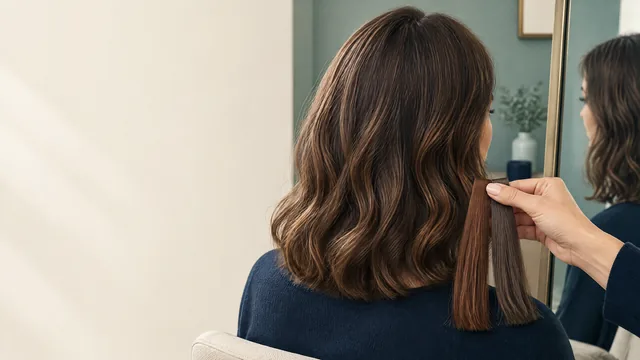
Describe the separation before changing the size
Replace ‘it looks like a hairpiece’ with something you can point to: a gap beside the part, an edge that lifts, a warmer colour near the temples or a heavy line above the shoulders. These observations describe different problems. A broader base may address an uncovered area, but it does not change the colour of the hair falling over it.
Notice when the difference becomes obvious. Is it visible while you sit still, only when you turn your head, or after your usual styling? Bring front, side and back photographs in consistent light, if helpful. They are references for discussion, not a substitute for seeing how the piece sits.
When exploring a human hair topper, check more than the fibre label. Base dimensions, attachment, hair length and texture all affect how it meets the hair you retain. Human hair alone does not establish a suitable match or permission to colour and heat-style the piece. [S2]
Check coverage and fit before styling
Coverage means whether the intended area is concealed at the placement you want. Fit concerns how the base sits and how the piece is supported. Ask the fitter to assess both before proposing a colour treatment or cut. Otherwise, attractive styling can distract from an unresolved footprint or attachment problem.
A visible base edge is not automatically evidence that the base is too small. Its position or shape may need assessment; surrounding hair may also fall away from it. Likewise, a full-looking crown can still leave the intended area uncovered. Separate the amount of hair from the area beneath it. OWNSTRAND's topper guidance treats coverage, base fit and surrounding-hair blending as connected but distinct questions. [S1]
Use the observations below to direct the consultation, rather than to diagnose fit at home.
| What you notice | First question | Why upsizing is not the default |
|---|---|---|
| An intended area remains visible | Does the footprint cover this area at my preferred placement? | A different shape or position may matter as well as size. |
| The base lifts or the piece shifts | Is this base and attachment appropriate for the hair I retain? | More base area does not establish a secure fit. |
| A warm or dark band appears at the sides | Can we compare the shade against these exposed lengths? | A larger base leaves the shade difference unresolved. |
| Smooth topper hair sits above wavy lengths | Which texture fits my normal styling routine? | More coverage does not reconcile the patterns. |
| The topper ends form a separate shelf | Is the transition a cutting issue or unsuitable starting length? | A larger piece may add more of the same outline. |
Compare colour where your own hair stays visible
Compare the topper with the hair it will actually meet, not only a swatch held against your roots. Face-framing hair, sides and back lengths may differ from the crown, especially with highlights, grey or grown-out colour. Jon Renau recommends using exposed face-framing hair and natural light as colour references. [S4]
Ask what differs: depth, warmth, coolness or the distribution of lighter strands. Two pieces described as brown may still read differently together. Check a relevant sample in daylight where practical, then in ordinary indoor light; a single flattering photograph should not settle the choice.
Decide which colour you want to maintain. If you intend to let grey roots grow, matching only today's freshly coloured lengths may not reflect your plan. Discuss that transition before ordering. Choosing a more suitable shade can be preferable to buying a mismatch on the assumption that it can be dyed later. [S2]
Look at texture and the cut as a pair
Texture includes more than straight versus curly. Look at strand thickness, surface sheen and where the wave begins. A smooth, glossy top can appear separate from softer, irregular lengths even when the colour is close. Specialist guidance identifies similar texture and professional cutting as useful blending considerations. [S5]
Describe your ordinary routine, not just your occasion hairstyle. If your own hair usually air-dries with a wave, ask how the proposed topper would be maintained alongside it. A finish that depends on styling both sections each morning is a different purchase from one that works with your usual outline. Confirm permitted methods for the exact piece rather than assuming every human-hair topper tolerates the same tools. [S2]
Matching length is not always matching shape
Equal overall length can still produce two visible layers if the topper has blunt ends and your hair is tapered. Ask a stylist familiar with hairpieces whether a planned cut could soften that transition. Establish whether the topper, your own hair or both would be cut. Your retained hairstyle should not change by default.
Cutting cannot add missing length, and removing fullness is an irreversible decision. Ask to see the proposed outline before agreeing. If the starting length or density is unsuitable, comparing another specification may be more sensible than extensive thinning or trimming.
Give customisation a specific job
Custom makes sense when it addresses a requirement you can name. That might be a base footprint not met by the options assessed, a particular colour blend or a length-and-density combination that needs separate discussion. ‘More natural’ is a useful goal, but too broad to define an order.
OWNSTRAND's custom hair topper Hong Kong service describes sample viewing and measurements followed by handmade production and a return fitting with washing, cutting and blow-drying. Ask which design details can be arranged for your request and included in its quotation. This new-order process does not establish that an existing piece can be rebuilt, recoloured or resized. [S1]
If you already own the topper, disclose its model, previous cuts and any known colour treatments. Ask whether it can be assessed before any work is agreed, and whether the shop handles pieces bought elsewhere. An alteration should have a defined scope; ‘human hair’ is not enough information to approve it.
Leave the consultation with two clear options
Take the current piece if the appointment allows, together with its care information and a reference for the look you want to keep. Mark what already works: perhaps coverage is sufficient and the density feels familiar. This helps avoid changing a successful feature while solving another problem.
For a custom wig consultation Hong Kong enquiry, explain that your concern is a topper transition and ask what relevant samples or assessment can be arranged. OWNSTRAND's only showroom is in Kwun Tong, at Unit 2103, 50 Hoi Yuen Road, 利寶時中心. Confirm the visit scope before travelling. [S3]
Ask for a comparison between the least extensive suitable change and a new specification or custom order. What would each option change, what would remain, and how much styling would you undertake afterwards? Request confirmation of any cutting or fitting included, without assuming that later alterations are unlimited.
Finish with concrete questions: ‘What makes you recommend a larger base here? Could the same coverage work with another shade or texture? Which change is irreversible? Can we agree the intended outline before cutting?’ These answers give upsizing a reason—or show why better blending deserves attention first.
Questions you may be asking
If the topper looks too thick, should I choose a smaller base?
Not automatically. Base footprint and visual fullness are different specifications. Confirm the coverage you need, then compare density and outline. A smaller base could leave the intended area exposed.
Can I dye an existing human-hair topper to match?
Do not assume so. Its processing history, construction and care directions matter. Ask a hairpiece specialist to assess the exact piece; another shade may be the more suitable option. [S2]
Must my own hair be cut to blend with a topper?
No haircut should be assumed. Discuss whether the proposed transition involves cutting the topper, your own hair or both, and approve the outline before work starts.
What if the shade matches indoors but not in daylight?
Compare it again against the exposed hair in both settings. Ask whether the difference is undertone or depth rather than deciding from a shade name or one photograph. [S4]
Does ordering custom mean every mismatch can be solved?
No. Custom is a route for discussing defined requirements, not a guarantee that every construction or colour can be supplied. Confirm feasible specifications and fitting arrangements before agreeing an order. [S1]