
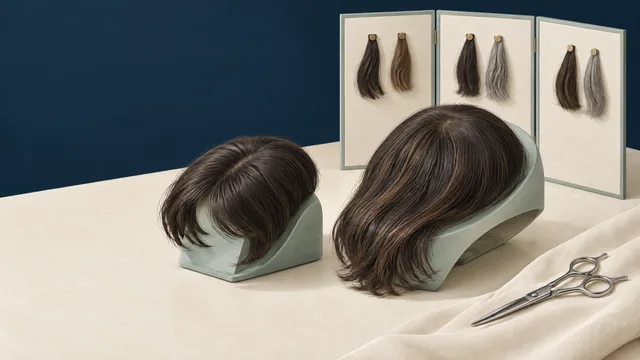
Give both quotes the same coverage job
Before asking for prices, describe the area you want covered and the hair you intend to leave visible. A narrow parting concern and a broader crown concern are different jobs. OWNSTRAND's guide to hair toppers explains partial coverage and the importance of the transition into surrounding hair. Use that distinction to keep your shortlist relevant, rather than comparing every piece labelled a topper. [S2]
Give each retailer the same reference photographs, preferred part position and coverage notes. Ask them to identify the proposed model and explain how its footprint relates to your brief. Record front-to-back and side-to-side dimensions, the outline and the measurement convention. A size label or an attractive front-view photograph cannot settle those details. [S1]
Coverage and attachment belong together in the quote discussion. For a proposed clip-in piece, ask whether its attachment arrangement can work with the retained hair around your target area. A lower-priced piece that cannot meet the intended coverage or fitting requirements belongs outside the shortlist, not at the top of it.
Lock down the hair specification before judging the price
Two human-hair pieces can still be very different purchases. When assessing a human hair topper, ask for the exact model's hair description, length, colour and texture. The material label alone does not confirm Remy status, processing, colouring permissions or permitted heat styling. Those details need their own evidence. [S3]
Separate supplied hair length from the finished cut you want. Ask how the listed length is measured and whether the proposed option has the length needed for your intended blend. If one quote includes longer hair you do not need, ask about a shorter option rather than assuming the extra length justifies the difference. Also describe your preferred fullness; ask how any density figure is defined instead of treating numbers from different ranges as identical.
Record the exact shade or colour code, including any rooted or grey-blended effect that matters to you. A similar colour name is not enough to make quotes equivalent. If matching depends on seeing a sample, make that an outstanding decision rather than assuming a later dye service will correct it. The manufacturer's care restrictions may rule out the change you had in mind. [S3]
Compare what the base does, not a price per unit of area
Base dimensions describe the foundation, not a complete specification. Shape, perimeter and attachment positions affect placement; construction details are a separate comparison. A bigger footprint is useful only where the additional coverage serves your brief. Dividing the price by base area would ignore those differences and reward size even when it adds nothing you need. [S1]
A manufacturer's specification shows why separate fields matter. Jon Renau lists its Top Form HH 12-inch model with 12-inch hair, a 6.5 × 6.5-inch base, clip-in application and double monofilament with a PU perimeter. The hair length is not the base length, and the base name is not the attachment method. This is a specification example, not confirmation of a local quote or stock. [S4]
Ask which part of the base carries the feature you are paying for and whether it matters at your intended part or visible edge. Keep the maker's actual terminology in your notes. A construction label does not establish a universal quality ranking, and two similarly sized pieces should not be treated as equivalent without their details.
| Field | Record for each quote | How to use the answer |
|---|---|---|
| Coverage | Target area, proposed placement and model | Exclude options that do not meet the job |
| Base | Dimensions, units, outline and construction | Explain what differs beyond size |
| Hair | Material claim, supplied length, shade, texture and fullness | Request an equivalent option where possible |
| Attachment | Exact method and any unresolved fitting question | Resolve suitability before counting a saving |
| Services | Cutting, fitting and adjustment scope; included or separate | Compare the same agreed starting package |
| Quote status | Currency, date, supply and outstanding charges | Keep missing costs marked as unknown |
Make cutting and fitting inclusions explicit
OWNSTRAND's hair topper prices guidance says fitting, adjustment or styling may be included, separately quoted or unavailable for the particular item. Ask for a current quote with those distinctions written down. A product-only amount and a piece supplied with an agreed blending cut are different starting packages. [S1]
Ask what 'cutting included' means: trimming the topper, shaping it while worn, or also cutting surrounding hair. For 'fitting included', clarify whether the appointment covers positioning and attachment checks, and what happens if an adjustment is requested afterwards. Record any confirmed additional charge rather than treating an unspecified service as free.
Keep later, optional styling separate from work needed to reach the agreed initial look. The initial comparison can include the piece and confirmed necessary services; your ongoing routine is a different budget decision. Do not borrow full-wig custom prices as a topper benchmark. OWNSTRAND's price guide explicitly separates its named custom human-hair reference options from topper pricing. [S1]
Choose between suitable options, not complete and incomplete quotes
Consider two hypothetical offers. The cheaper one has a larger base but leaves the shade and blending cut unresolved. The other identifies an appropriate footprint, a confirmed hair specification and a defined fitting appointment. The first is not yet a comparable saving. Ask for its missing answers before deciding whether the difference reflects scope, specification or simply price.
Equally, a smaller, lower-cost piece may be the sensible choice if it meets the same coverage brief and has the hair and service scope you need. Additional base area or a feature outside your visible styling priorities is not automatically worth paying for. Where both offers are suitable, compare their confirmed initial totals in the same currency. Where a necessary cost is unknown, leave the total open.
Questions worth leaving the enquiry with
Ask: Which exact model and shade does this quote cover? Why does its footprint suit my brief? What will the supplied hair require to reach the agreed cut? Which fitting or adjustment tasks are included, and which cannot be provided? What remains to be confirmed before payment?
If seeing the option matters, confirm whether relevant samples and the requested appointment can be arranged. OWNSTRAND's only showroom is in Kwun Tong; a catalogue listing does not establish supply. Keep the dated quotation with its specification, so any later change to size, hair or services can be quoted clearly. [S1] [S2]
Questions you may be asking
Is a smaller base always cheaper?
Do not assume so. Hair specification, construction and included services can differ. Request current quotes for suitable options; base dimensions alone do not explain the price.
Can I compare toppers using a full-wig price list?
Not as a topper estimate. A full-wig offer describes a different purchase. Request the exact topper's price and inclusions rather than transferring a custom-wig figure.
What if one quote gives a density percentage and the other does not?
Ask each supplier how fullness is specified for that model and how the proposed look matches your brief. An unexplained percentage should not substitute for a comparable description.
Should I choose a longer topper and have it cut down?
Ask whether a suitable shorter option exists first. If cutting down is proposed, confirm that the piece can achieve the intended shape, who will cut it and the charge.
Does a quotation reserve the topper?
An enquiry or quotation is not automatically a reservation. Confirm supply, quote validity, payment terms and any reservation arrangement for the exact model and shade before relying on it.