
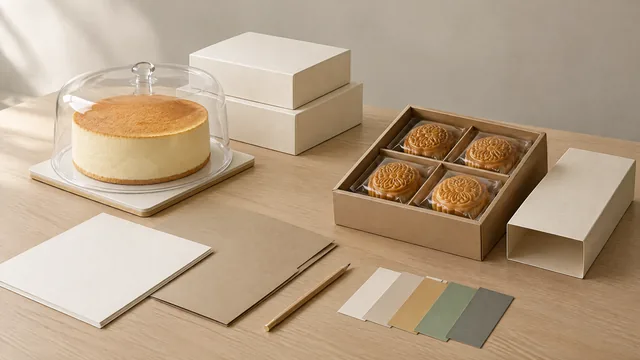
Define the batch before comparing quotations
For purchasing purposes, treat a batch as the group of items covered by an agreed order specification. Do not assume this means everything comes from one production run. Ask how the supplier will identify any separate production lots within your order, so a later query can be tied to the relevant products rather than the entire purchase.
YumYum presents corporate cakes as a service category. Its Corporate Cake page is a starting point for an enquiry, not a substitute for a written specification. [S1] Decide whether you need whole cakes for a shared celebration or counted portions for distribution. State the size or portion basis you want confirmed; neither a cake's appearance nor its diameter alone settles how many colleagues it will serve.
Make every quotation use the same units
Create a line for each distinct product and packaging combination. Record the ordered unit, contents per unit and total required. If the same mooncake assortment appears in two different presentation boxes, give each combination its own line. Keep any optional reserve quantity separate until someone authorises it; an informal request for 'a few extra' should not silently become a chargeable addition.
Use the Cake Wholesale resource to explore a batch enquiry, then request a breakdown against your own specification. Ask whether the quotation includes individual wrapping, presentation boxes, artwork work and transport. Compare equivalent deliverables rather than headline unit prices. An apparently cheaper offer cannot be assessed fairly while its packaging or handling scope remains unclear.
| Decision | Ambiguity to remove | Written agreement to request |
|---|---|---|
| Whole cakes | Cake count is mistaken for a serving commitment | Cake dimensions or weight, agreed portion basis and number of cakes |
| Mooncake assortment | A gift-box quantity leaves the filling mix unspecified | Contents per box and quantity of each approved assortment |
| Presentation | The sample sleeve is assumed to include a different box | Exact box, insert and wrapping specification linked to the sample |
| Acceptable variation | A design reference is treated as an exact reproduction | Which appearance details may vary and which require further approval |
| Handover | Receipt of cartons is treated as confirmation of all contents | Who checks quantities, condition and product identification, and how issues are recorded |
Approve the product separately from the artwork
A packaging proof answers a different question from a product sample. Record the approved filling, size and finish separately from the sleeve design and printed card. Request a physical fit check where a new insert or box is proposed. Agree which characteristics the sample represents and any acceptable variation in advance, rather than judging handmade decoration against an unstated expectation after receipt.
The Custom Mooncake Manufacturing page describes a service spanning recipe development, packaging design and production. [S2] Use those as separate enquiry headings, not an assumption that every change is included. Ask which sample and proof stages apply to your proposed batch, what each costs, and when a change would require another quotation or approval.
Keep ingredient requirements attached to the product record. Ask for ingredient and allergen information for the proposed items, including the supplier's response to any cross-contact concern. Vegan, halal and gluten-free requests should each be assessed explicitly; satisfying one does not establish the others. Do not approve a replacement filling solely because it looks similar.
Freeze one version that everyone can order against
Give the agreed specification a revision identifier and name the person authorised to approve it. Marketing can approve brand artwork while procurement approves commercial terms, but one order owner should assemble the accepted versions. Ask the supplier to acknowledge the complete record. A purchase order referring to an old attachment can undermine an otherwise careful approval process.
For staff and client gifting, the Corporate Mooncake page provides a relevant service enquiry route. It describes both uses. [S3] Separate the quantities for each recipient group when presentation differs, and make sure those lines reconcile to the order total. A later change in allocation must not accidentally change the approved assortment.
For every amendment, record what changed and what did not. Request confirmation of the revised price, feasibility and timing before treating it as accepted. If a supplier proposes a substitution, compare it with the agreed product and packaging record and obtain approval before it becomes part of the batch. Silence is not a clear purchasing instruction.
Set receiving checks without delaying safe storage
Name a receiving lead who has the accepted specification and delivery paperwork. Agree access arrangements and a handover window with the supplier rather than assuming reception can take any food order. Before arrival, confirm that the office can provide the storage required for the actual products. Where refrigeration is required, plan prompt transfer instead of leaving every box out while completing an extended count.
The Centre for Food Safety's Five Keys include clean hands and utensils, separation of raw and cooked food, and keeping food at safe temperatures. [S4] Apply these principles to the receiving area and shared office storage. Obtain product-specific storage and consumption instructions; do not assign all cakes and mooncakes the same shelf life.
At handover, record quantities received against the order lines, visible packaging condition and the product identifiers available. Separate a confirmed shortage from contents not yet checked. Photograph an apparent mismatch and keep the relevant packaging information. For damaged packaging or uncertain storage conditions, hold the affected items back from distribution and seek guidance rather than assuming appearance proves they are suitable.
Agree what happens when the batch differs
Ask before ordering how to report shortages, damaged items or specification differences, and who is authorised to agree a remedy. Clarify the notification procedure and any applicable reporting window in writing. These are matters for the accepted commercial terms, not promises that should be inferred from a promotional page.
Keep the receiving record distinct from invoice approval. Document the portion checked, any unresolved items and the supplier's response. Finance can then reconcile the invoice with the agreed scope and recorded receipt, without treating a reception signature as proof that every product met the specification.
Send an enquiry that can become the batch agreement
A useful first enquiry invites a precise reply. Replace the bracketed fields below with your requirements, attach the product schedule and request answers against each line. Leave unconfirmed items marked as questions instead of presenting desired arrangements as already agreed.
Please quote for our corporate cake and mooncake order for [occasion and intended date]. Our attached schedule specifies [product variants], [ordered units and quantities] and [packaging requirements]. Please confirm the portion basis where relevant, ingredient and allergen information, sample and artwork approval steps, acceptable product variation, storage instructions and available handover arrangements for [destination]. Please separate product, packaging, development and transport charges, state quotation validity and applicable payment terms, and explain how changes or receiving discrepancies are handled. We will nominate [order owner] to approve the final dated specification before proceeding.
Questions you may be asking
Can one purchase order cover cakes and mooncakes?
Yes, if the supplier accepts that structure. Keep separate product lines and approval references, and confirm whether their production and handover arrangements differ. One purchase order should not blur distinct storage instructions or commercial terms.
What if the supplier cannot offer a sample?
Ask what product specification, design proof or existing reference can be provided instead. Record the limits of that evidence and decide whether it is sufficient for your order. Do not describe an untested new product as sample-approved.
Should the whole order be labelled with one batch reference?
Your purchasing reference can cover the order, but it should not replace the supplier's product or production-lot identification. Ask how those identifiers will be shown or mapped to the supplied items so that a query can be traced accurately.
How should we handle colleagues with food allergies?
Gather their requirements privately and request specific ingredient and cross-contact information. If suitability cannot be established, do not promise a safe substitute from the same batch. Consider a separately agreed non-food option rather than improvising at distribution.
Can a verbal change be added after approval?
Send it as a written amendment and obtain the supplier's acceptance, including any effect on cost or timing. Update the shared specification and tell receiving staff which revision applies. An internal conversation alone does not change the supplier's accepted order.