
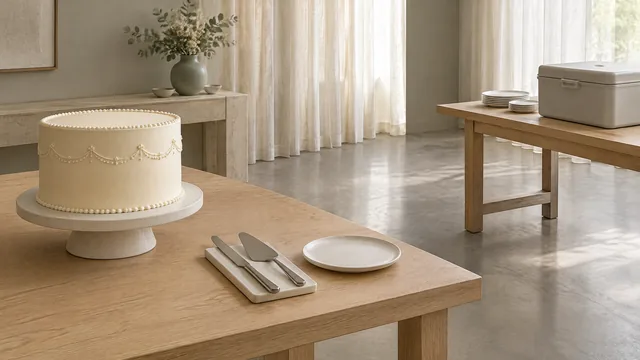
Decide what happens after the photograph
A wedding cake may appear in a formal cutting ceremony; an anniversary cake may stay on the dining table for a quieter shared moment. In either case, decide whether guests receive cake immediately, later with dessert, or only if they request it. Record cake servings separately from attendance, and specify whether each serving is a tasting piece or a full dessert portion.
Use the Wedding Cake page as a starting resource when discussing the centrepiece. The provider has a dedicated wedding-cake page, but its description is not a technical cutting plan. [S1] Ask for the proposed cake and board dimensions, edible serving yield, and whether any tiers or decorations are display-only. Height alone cannot tell the venue how much cake it can plate.
Choose a table that works from both sides
Walk through the display position with the venue rather than relying only on a room photograph. The couple need comfortable access to the cutting side; the photographer needs an unobstructed view; staff need a clear route to remove or serve the cake. Avoid placing it where guests queue, doors swing open or chairs must be moved during the ceremony. Confirm a stable table and a stand suitable for the cake's actual base and weight.
For a dinner celebration, explore the Anniversary Cake resource alongside your table plan. Decide whether a side table offers easier access than the dining table. Leave room for plates and serving utensils, not just the cake board. Keep floral arrangements separate from food and away from the knife's path; an attractive backdrop should not prevent someone reaching the cake safely.
Give shaped cakes a viewing and cutting plan
Initials can be meaningful at either celebration. The Custom Letter Cake page describes personalised letter designs, including wedding initials. [S2] Ask which direction the design should face and where the first piece can be removed without disturbing neighbouring decorations. Request a serving diagram: narrow strokes and broad curves may need different cuts, rather than a uniform grid imposed on the shape.
A milestone may invite a Number Cake design, which has its own provider resource. [S3] Check the complete board footprint, especially if separate shaped components are proposed. Agree which component the couple will cut and whether the remaining portions are prepared out of sight. Do not assume that equal-looking shapes produce equal servings; have the bakery explain how its portion estimate relates to the actual design.
Match the display format to the serving workflow
Choose the arrangement by what your venue can manage, not by visual impact alone. A separate serving area can protect the photograph space from clutter, but it creates another handover. The following checks help distinguish a workable plan from one that merely fits on the table.
| Arrangement | Useful when | Confirm before booking |
|---|---|---|
| Cake stays on its display table | A small gathering will share it there | Space for clean plates, controlled cutting and staff access |
| Ceremonial cut, then move to service area | The venue will plate guest portions | Who moves it, clear route and receiving work surface |
| Tiered centrepiece | Height is important to the room composition | Stand suitability, internal supports and who separates tiers |
| Letter or number layout | The shape carries the celebration's meaning | Full board dimensions, first-cut position and serving diagram |
Name a receiver and protect the waiting stage
Appoint a venue receiver who knows the order, rather than making the couple handle an arrival during photographs. Give that person the cake description and the agreed access route, including any lift or doorway constraints. On receipt, check packaging condition, visible damage and the supplied handling instructions before moving anything. Retain packaging if it is needed for an agreed later transfer; report concerns before attempting repairs.
The Centre for Food Safety's Five Keys include keeping hands and utensils clean, separating raw and cooked food, and keeping food at a safe temperature. [S4] Apply these principles to the waiting and serving stages. Ask the bakery for instructions specific to the filling and finish, then confirm that the venue can follow them. An air-conditioned room is not a substitute for required chilled storage. If speeches run late, nominate someone to revise the display timing rather than leaving the cake out by default.
Collect guest dietary requests before finalising the order. Ask about ingredients and cross-contact separately: a decorative style or cake name does not establish allergen suitability. Give the serving team the confirmed information, and do not present a separate plate as proof that a portion is safe for someone with an allergy.
Rehearse the ceremonial cut and staff handover
Agree on the cutting side and first-cut location with the bakery, then tell the photographer and venue coordinator. Place a clean knife, cake server and first plate within easy reach without crowding the cake. The coordinator can cue the couple once staff and photographer are ready. Avoid asking them to discover a suitable cutting point while everyone waits.
For a tiered design, ask for a diagram showing boards, supports and non-edible components. Leave tier separation to the person assigned and briefed for it; do not attempt to cut through hidden structures. Confirm who removes decorative picks or toppers and checks that none enter guest portions. The photographic slice should be planned as carefully as the rest of the cake.
After the photographs, make the handover explicit. The coordinator signals the serving team, the assigned handler moves or portions the cake, and servers follow the agreed portion guide. Ask the venue about any outside-cake handling charge and whether knives, plates, napkins, cutting and clearing are included. Resolve this before the event rather than assuming a cake order covers venue service.
Send one enquiry that bakery and venue can both use
A useful enquiry combines the occasion with the practical route. Send the bakery the cake details and ask the venue to confirm its responsibilities against the same plan. Use placeholders until answers are agreed, rather than turning a hoped-for arrival or display time into a promise.
Suggested message: ‘We are planning a [wedding/anniversary] at [venue] on [date]. We need [number] cake servings of [tasting/full dessert] size. Our proposed display location is [location], with cutting during [programme point]. Please confirm cake and board dimensions, serving yield, storage instructions and a first-cut diagram identifying non-edible parts. Please state whether transport, set-up and any equipment are included. The venue receiver is [role/name]; please confirm who moves, cuts, plates and clears the cake, and any separate charges.’
Keep the agreed plan with the venue's event notes. Include a fallback position if the original table is unavailable and identify who decides whether delayed service requires continued storage. One shared version prevents the bakery, coordinator and serving team from working to different assumptions.
Questions you may be asking
Should the cake face the guests or the photographer?
Agree on its main viewing direction, then test where the couple stand for cutting. The camera should see the intended design without making the couple reach awkwardly. If repositioning is needed, assign it to a briefed handler before the ceremony.
Can we use a decorative stand supplied by the venue?
Only after checking its usable surface, stability and suitability for the proposed cake's base and weight. Share the stand details with the bakery; a visually matching stand may still be unsuitable for handling or cutting.
Must every tier be cut during the ceremony?
No. Agree on one suitable ceremonial cutting point. The remaining edible tiers can be handled by the assigned serving team afterwards, using the bakery's instructions for boards, supports and portioning.
What if the venue will not cut an outside cake?
Find out before ordering. Ask whether an approved alternative handler or a different serving format is possible, and confirm space and utensils. Do not assume delivery staff will remain to provide service.
Can we keep a top tier for a later anniversary?
Ask the bakery whether that specific cake is suitable for saving and request its storage and later-use instructions. Decide before service which part is reserved, but do not assume every filling or finish can be kept until another celebration.