
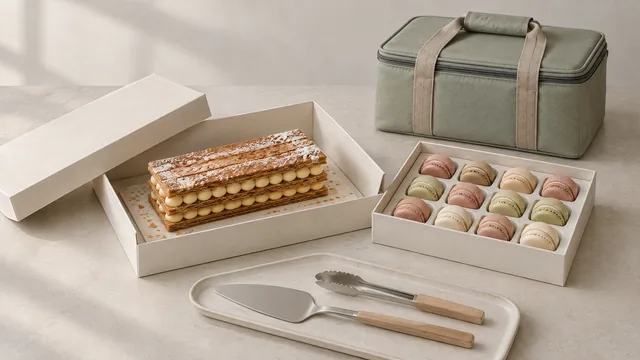
Choose the serving format before discussing transport
Decide whether the mille-feuille will arrive as a whole dessert or separate portions, and whether macarons will stay in their boxes until offered. These choices change the work at the venue. A whole layered cake needs someone to portion it, a suitable utensil and plates. Separate portions reduce cutting at the event but still need a supported transfer. Ask what formats can actually be supplied rather than assuming a photograph represents the packing you will receive.
Use Buy Mille-Feuille Online to explore the ordering information, then ask for confirmation of the chosen format, dimensions and serving yield. The provider’s page discusses flavour and size choices, but your enquiry should settle the actual order specification. [S1] State servings for the layered dessert separately from individual macaron pieces; they are not interchangeable portion units.
Support the mille-feuille without pressing its layers
For a layered pastry, ask how the base is supported and how the box prevents sideways movement. Lid clearance matters too: packing that is stable underneath should not bear down on the top. Obtain the outside box dimensions before delivery so that the receiving surface and intended storage space can accommodate it. Do not plan to solve a tight fit by removing protective packaging on arrival.
The Napoleon Cake Delivery page describes transport handling intended to protect crisp layers. Treat that as the starting point for questions about your cake’s support and handling, not a promise that every journey will be damage-free. [S2] For the final move inside the building, carry the box from its supported base as instructed, keep it level and avoid putting bags or other dessert boxes on top.
Keep macarons restrained until their next destination
Macarons can move inside a box even when the outside looks undamaged. Ask whether the chosen packing holds each piece in place and whether the lid closes without pressure on the shells. If some boxes are gifts and others are for serving, request distinct packing groups so the receiver does not need to sort loose pieces at the doorway.
Explore Macaron Delivery when comparing those arrangements. The provider describes cooling and shock protection as considerations in its logistics planning. [S3] Confirm what applies to your filling and package, including any instructions for opening after storage. Avoid repeated opening simply to check colours; make the agreed inspection once, then protect the remaining stock until needed.
Give every internal transfer a named owner
Write the destination as an actual receiving point, not just a building name. In Hong Kong, delivery may reach a lobby while the dessert is intended for another floor. Check whether the receiver can meet there, whether access needs arranging, and whether a trolley or helper is needed for the onward move. Ask the provider to confirm the feasible handover point and arrival window before fixing the event plan.
The person accepting the boxes should know where they go next. If another person takes over, pass on the product instructions and arrival record with the desserts. Prepare the storage area before the receiver leaves to meet the delivery. This avoids a fragile box waiting on an unsuitable surface while someone searches for space. A backup receiver should have the same instructions, not merely know that desserts are coming.
Use a receiving check that leads to a clear action
Inspect on a clean, level surface without turning the box sideways or removing its supports. Follow the agreed inspection method; if packaging is not intended to be opened at this stage, do not dismantle it. A visual check can identify damage, but cannot establish food safety.
For food handling, the Centre for Food Safety advises clean hands and utensils, separation of raw and cooked food, and keeping food at safe temperatures. [S4] Apply those principles alongside product-specific instructions; do not give all fillings one assumed storage duration.
| Check | What to establish | Next action |
|---|---|---|
| Packing condition | Look for crushing, leakage or loss of base support. | Record any concern and contact the provider before further handling. |
| Contents | Match the agreed portions, pieces and packing groups. | Keep gift stock separate from serving stock; clarify discrepancies. |
| Storage instructions | Locate guidance for the actual pastry and macaron fillings. | Move to the prepared suitable storage area; ask if guidance is missing. |
| Internal journey | Check that the route and landing surface are ready. | Assign the onward carrier and avoid stacking boxes. |
| Serving responsibility | Identify who opens, portions and sets out each dessert. | Pass on instructions before the receiver leaves. |
Separate the visual choice from ingredient approval
A coordinated colour palette is useful for presentation, but it does not tell you what is in a shell or filling. When browsing French Macarons, use the appearance to narrow your preferred presentation, then request ingredient and allergen information for the selected flavours. Do not infer a flavour or dietary suitability from colour alone.
Communicate allergy requirements before the order is confirmed, including questions about cross-contact during preparation and packing. Vegan, gluten-free and halal requests need separate answers. At the venue, retain the supplied product information and use clean serving utensils. If suitability remains unconfirmed, do not present that dessert as a safe option for the affected guest.
Send one enquiry that covers arrival through serving
A useful enquiry connects the product to the venue’s practical limits. Include the intended serving time as well as the preferred arrival window, because arrival, storage and serving are different stages. Request an itemised quotation covering the desserts, agreed packing and delivery arrangement, without assuming any service or charge is included.
Ready-to-send enquiry: ‘We are planning mille-feuille in {whole or portioned format}, serving {required servings}, plus {macaron pieces} in {serving or gift packing}. Our date is {date}; serving is planned for {time}. The receiving point is {entrance and floor}, with {receiver’s name or role} available during {preferred window}. Access involves {lift, stairs or other restriction}, and our storage space is {description}. Please confirm feasibility, box dimensions, protective packing, storage and opening instructions, ingredients and allergens, delivery charges, and the process for reporting damage or discrepancies.’
Questions you may be asking
Can the mille-feuille and macaron boxes be stacked for the lift journey?
Do not stack them unless the provider confirms that the particular packaging is designed for it. A rigid-looking lid is not proof of load-bearing strength. Arrange a suitable carrier or separate trips while keeping each box supported and level.
Should I transfer desserts onto serving plates immediately?
Only if that matches the product instructions and serving plan. Early transfer adds handling and removes protective packing. Prepare clean plates and utensils beforehand, but keep the desserts protected in appropriate storage until the planned serving stage.
What if the venue fridge cannot fit the mille-feuille box?
Resolve the fit before ordering by checking outside box dimensions and usable storage space. Ask whether another supplied format would work. Do not rely on stripping away supports or holding the dessert somewhere unsuitable as an improvised solution.
What should the receiver do if a shell is cracked or layers have shifted?
Record the affected packaging and visible condition using the agreed inspection method, and contact the provider promptly for instructions. Avoid rearranging everything first. Keep the dessert in appropriate storage while the issue is clarified; do not assume a replacement or refund is guaranteed.
Can unopened gift boxes be handed to guests later in the evening?
Confirm that plan against the specific filling’s storage and consumption instructions. Sealed presentation does not remove storage requirements. Pass the relevant guidance to each recipient, especially when their onward journey means the desserts will not be eaten at the venue.