
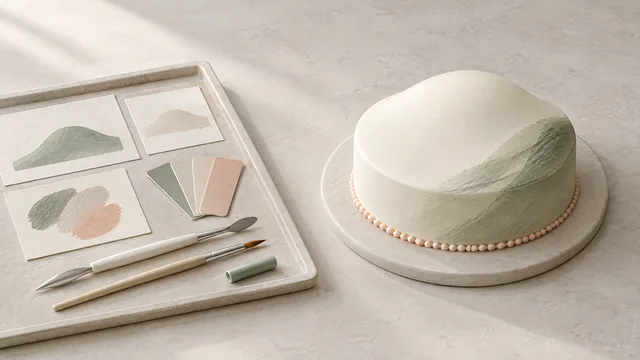
Edit the reference board before you send it
Select a small set of references with different jobs. One image can explain the silhouette, another the colour palette, and another the decoration placement. Under each, write a short instruction such as 'rounded outline only', 'sage and ivory, not the flowers' or 'leave the top mostly undecorated'. Sending a large album without these notes leaves conflicting details unresolved.
Use three labels: keep, adapt and avoid. Keep might be a distinctive curved profile; adapt might be a simpler border; avoid might be metallic decoration. Mark which image wins if references disagree. Request an original interpretation of a theme or object rather than a copy of another maker's artwork or a copyrighted character. Your own simple sketch can show placement without pretending to be a construction drawing.
Decide whether the cake itself must be sculpted
Explore 3D Cake to frame a discussion about sculpted silhouettes and decorative themes. The provider's page points readers towards those visual comparisons. [S1] Specify whether the entire cake should resemble an object or whether a conventional cake with a modelled accent would satisfy the idea. Those are different briefs, even when both look three-dimensional in a photograph.
State the important viewing angle: front, overhead or all around. A low rounded hill shape for a landscape theme might prioritise its profile, while a small gathering photographed from above might prioritise the top. Ask the baker to assess structural feasibility, identify any non-edible supports and explain how the design will be cut. Do not infer edible portions from the apparent volume of a modelled feature.
Describe the surface and decorative mood separately
The Fondant Cake resource introduces comparisons involving smooth finishes and sculpted decorative details. [S2] Say whether your reference calls for a full covering, a small modelled element or simply a clean-looking surface. Ask which proposed finish suits the shape and filling. A photograph cannot tell you the covering's thickness, texture or how much guests will enjoy eating it.
Use Korean Cake as a starting point for a Korean-inspired design enquiry. [S3] Replace 'make it Korean' with observable preferences: muted pastel colour, restrained piping, a rounded outline and open space around the central motif. These are instructions for your chosen look, not a fixed recipe. Confirm the actual coating and filling separately rather than assuming the style name identifies either.
Explore Hand Painted Cake if brushwork is the feature you want to retain. YumYum describes painted decoration on several possible surfaces, and also mentions complementary techniques. [S4] Specify whether visible hand-painted marks matter or whether another edible decorative method is acceptable. For an abstract landscape, identify the horizon placement and colour balance, then ask what detail can remain readable at the proposed size.
Choose a dominant idea rather than combining every detail
A coherent brief can combine techniques, but rank them. For example, make the rounded landscape silhouette essential, the pale green finish preferred, and the painted shading optional. If every reference feature is mandatory, the baker has little room to simplify. Use this table to decide what the enquiry needs to resolve; it is not a promise that any particular combination is available.
| Your priority | Describe in the brief | Ask before approval |
|---|---|---|
| Recognisable sculpted shape | Outline and main viewing angle | Whole cake or accent; supports and cutting plan? |
| Smooth fondant appearance | Covered areas and modelled details | Which finish and filling suit this construction? |
| Restrained pastel mood | Palette, piping density and open space | What coating is proposed, and what can be simplified? |
| Painted artwork | Motif placement and brushwork preference | Which edible method and surface will be used? |
| Several combined references | One essential feature; optional accents | Which combination is feasible within the budget? |
Set portions and ingredient requirements before decoration
Tell the baker how many guests will eat cake and whether it follows a full meal or is the main dessert. Request a serving estimate with the intended slice size explained. Specify usable cake portions separately from decorative volume. If the visual centrepiece and the serving requirement conflict, ask whether a simpler shape or separate serving cake is an option, without assuming either is offered.
List the desired flavour and filling independently of the exterior. For allergies or dietary requirements, ask about the sponge, filling, covering, painted colours and decorations, as well as cross-contact during preparation. Vegan, halal and gluten-free requirements are separate enquiries. Obtain a clear response before confirming; the appearance or name of a design does not establish ingredient suitability.
Approve a written specification, not a mood alone
Ask for a written summary or sketch showing the chosen silhouette, colour direction and decoration placement. If adding a message, supply the exact spelling, punctuation and preferred position. Explain which colours are essential and discuss how they will be interpreted, since screen images are not reliable physical colour matches. Agree what changes require your approval and when the final design details must be settled.
Request an itemised quotation that distinguishes the cake specification from separately charged decoration, packaging or transport, where applicable. Give a budget range and ask which simplifications would preserve your essential feature. Confirm the finished cake, board and box dimensions, then check the venue's access route and display space. Ask about current arrangements for your date rather than reading a category page as a delivery commitment.
Send an enquiry the baker can answer
Adapt this message: 'I am planning [occasion] on [date] at [venue or collection location], with [number] guests eating cake as [dessert context]. Reference A shows the outline to keep; B shows the preferred palette; C shows optional decoration. Please propose an original interpretation, not an exact copy. My essential feature is [feature], and I can simplify [details]. Preferred flavour and filling are [choices]; dietary requirements are [requirements]. Budget range is [range].'
Continue: 'Please confirm feasible shape and finish, estimated servings and slice basis, edible versus non-edible elements, dimensions including board and box, ingredient and cross-contact answers, quotation inclusions, design approval process and collection or delivery options. Please provide storage and serving instructions for the proposed cake.' Keep this together with the annotated references so instructions do not become scattered across separate messages.
Give the receiver and cake cutter the final instructions
Nominate a receiver who has the approved specification and can check the box, visible condition and message at handover. They should know where the cake will be stored and displayed, and have the baker's cake-specific handling instructions. Report a discrepancy before attempting a repair. Do not lift a sculpted decoration to test whether it is secure.
Give the person cutting the cake the agreed serving plan and instructions for removing non-edible parts. Confirm which decorations should be set aside rather than distributed with slices. A reference brief is successful when the chosen look, workable construction and serving plan agree—not simply when the cake resembles a cropped photograph.
Questions you may be asking
Can a sculpted cake still have a Korean-inspired appearance?
You can propose a sculpted outline with a restrained pastel palette, but ask the baker to assess the combination. Treat shape as one decision and decorative mood as another. Identify which matters most so the design can be adapted if the preferred construction and finish do not work together.
How many reference photographs should I send?
Send only enough to explain separate decisions clearly. A main shape reference plus supporting colour and decoration references is a useful starting point. Caption each image with what to retain and what to ignore; adding more photographs is unhelpful if they introduce unresolved contradictions.
Does choosing fondant determine the sponge or filling?
No. Your covering preference should not replace a flavour and filling enquiry. Ask the baker which combinations are suitable for the proposed construction, and confirm the ingredients of both the interior and decorative components. Do not assume that a smooth surface establishes a particular recipe.
How do I avoid receiving an edible print when I wanted brushwork?
State explicitly that visible hand-painted work is essential, if that is your priority. Ask which parts will be painted and whether printing, transfers or other techniques are proposed. Include the agreed method in the written design summary rather than relying only on an artwork reference.
What should I simplify if the design exceeds my budget?
Ask for alternatives that preserve the dominant feature. Possible discussions include fewer modelled accents, less repeated piping or a simpler painted motif. Have the baker explain the effect of each change on the quotation and appearance; do not assume reducing cake size alone will reduce decorative work.