
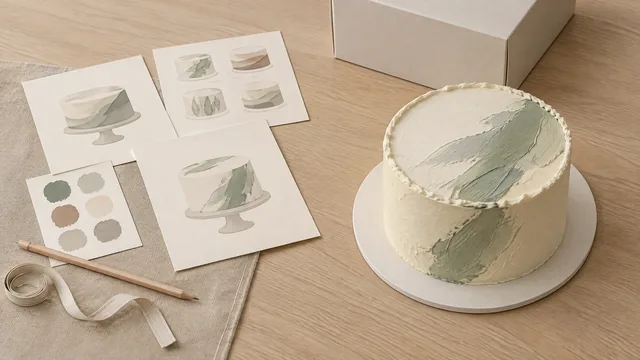
Start with the birthday person, not a collection of pictures
Describe the recipient’s taste in one sentence: for example, ‘an understated cake for someone who likes ceramics and muted green’. Then name the dominant feature, such as a rounded silhouette or an abstract painted motif. This gives the baker a direction without demanding several competing themes on one surface.
Make two short categories: must keep and may change. The first might contain the recipient’s name and a restrained palette; the second might allow changes to the border or motif placement. Include dislikes, such as metallic finishes or elaborate toppers, so an otherwise attractive suggestion does not miss the point.
The Custom Cake resource is a place to explore shapes, palettes and decorative finishes before describing your preferences. Its design references are starting points for discussion, not confirmation that a pictured design is available for your date. [S1]
Annotate references so the baker knows what to borrow
Choose a main reference and explain precisely what you like: ‘the off-centre composition and textured border, not the lettering’. If you add another picture for colour, mark it as colour only. Otherwise the baker has to guess whether you want its shape, decoration or complete appearance.
Describe colour relationships as well as names. ‘Warm ivory background, muted sage accents, no bright green’ is more informative than ‘green cake’. A swatch can help communicate intent, but ask how it will be interpreted in the proposed finish; do not assume a screen photograph establishes an exact colour match.
Request an original interpretation of a hobby or interest rather than replication of a copyrighted cartoon character. For a music enthusiast, an abstract rhythm of edible shapes can express the theme without copying a branded image. Keep the concept recognisable through one clear motif instead of filling every space.
Specify portions before choosing the silhouette
Count the people who will actually eat cake, including any portions you want reserved. Tell the baker whether guests expect a small slice after dinner or cake as the main dessert. Ask for a recommended size with the assumed portion dimensions; diameter alone does not settle how many usable servings the design provides.
Explore the Birthday Cake resource to compare celebration styles, then judge your preferred silhouette against the serving plan. A design that looks impressive in a photograph still needs enough edible cake and someone able to portion it at the venue.
Use the following checklist to turn visual preferences into decisions the baker can answer.
| Decision | Include in your brief | Ask the baker to confirm |
|---|---|---|
| Serving plan | Actual cake eaters and desired slice style | Recommended size and portion assumptions |
| Surface layout | Main motif, message position and clear space | How these fit on the proposed cake |
| Finish | Preferred texture and colour relationships | Feasible finish and any suggested changes |
| Decorations | Edible accents preferred; identify exclusions | Removable parts and cutting instructions |
| Handover | Venue access and available storage space | Box dimensions and handling guidance |
Give a compact cake a simpler design brief
For a personal gift or intimate celebration, explore the Bento Cake resource as a possible format, then ask about its actual dimensions and servings. Do not treat a compact cake as guest dessert unless the baker’s portion guidance supports that plan.
A smaller surface benefits from a clear hierarchy: short wording first, one decorative idea second. If your concept needs a long greeting and a detailed illustration, ask which should move to a separate card. Specify whether the cake will be presented in its box or transferred to a plate, because that changes which surfaces guests will see.
Proof the inscription as a separate part of the design
Send the wording in a clearly marked sentence and copy names exactly. State the language, capitalisation and punctuation you want. If you propose two lines, show the intended break rather than leaving it to an image reference. For bilingual wording, indicate which line should receive visual emphasis.
Ask for the proposed message position alongside the decoration layout. A name placed beneath a large motif may become the least visible part of the cake. Confirm whether a layout preview is available and what it represents; a rough arrangement is not necessarily a detailed artwork proof. Keep longer birthday wishes on a card rather than shrinking every word to fit.
Brief the edible components as carefully as the appearance
State flavour preferences separately from dietary requirements. Ask about the sponge, filling, covering and every edible decoration rather than assuming the outside reveals the recipe. If an allergy is relevant, identify the ingredient concerned and ask about shared equipment and cross-contact. Vegan, gluten-free and individual allergy requirements need separate answers.
Ask the baker to identify non-edible supports or decorative parts and explain their removal before slicing. Arrange clean hands and utensils for serving, and keep the cake separate from raw food during storage. These are consistent with the Centre for Food Safety’s general handling principles; they do not establish any supplier’s certification or allergy suitability. [S2]
Make handover constraints part of the design approval
Review the Cake Delivery resource when considering packaging and transport, but ask for arrangements specific to your venue and date. Give the address, access restrictions, proposed receiving window and the role of the person accepting the cake. A reception desk is not automatically a suitable storage location.
Check usable storage space against the complete box, not just the cake. Ask whether decorations travel attached or require professional assembly, and who provides that service. Obtain product-specific storage and display instructions, then share them with the receiving person. At handover, check the inscription and visible condition without dismantling the protective packaging unnecessarily.
Send one consolidated enquiry and approve one final version
Bring scattered messages into a single brief. Request a quotation that identifies the cake size, finish, decoration scope and any separately charged services. State your own total budget ceiling and ask what could be simplified if the proposal exceeds it. Confirm the amendment deadline and whether design revisions affect the quotation before agreeing to changes.
Use this enquiry template: ‘Please propose an original birthday cake for [date], serving [actual eaters] with [slice style]. The concept is [one-sentence direction]. Must keep: [essential features]. Flexible: [optional details]. Please use the attached main reference for [specific features] and the colour reference only for [palette]. Exact inscription: [wording and line breaks]. Preferred flavours: [preferences]. Dietary requirements: [requirements and cross-contact questions]. Proposed handover: [venue, access, window and receiving role]. Storage space: [usable dimensions]. My total budget ceiling is [amount]. Please confirm size, portions, finish, ingredients, removable parts, box dimensions, handling instructions, total cost and revision terms.’
Once agreed, retain one final confirmation with the approved wording and layout. Send later changes as explicit replacements, not extra inspiration that could be mistaken for a new instruction.
Questions you may be asking
Should I send a mood board or one cake photograph?
Send a small, labelled selection with one main reference. Explain what each image contributes and what should be ignored. A colour reference should not silently become an instruction to copy its entire design.
What if my requested colours cannot be matched exactly?
Ask for the closest feasible interpretation and decide whether the overall colour relationship matters more than a precise shade. Identify colours you do not want. Approve the proposed alternative rather than leaving the baker to choose without direction.
Can I request a long birthday message on a small cake?
Ask the baker to assess the available writing area first. Prioritise the name and short greeting, then move the longer wish to a card if necessary. Confirm line breaks and placement before approving the layout.
How do I compare quotations for the same design idea?
Use the same brief and compare confirmed portions, finish, decoration scope, packaging and services. Check any exclusions. A lower total is not a like-for-like comparison if essential design elements or handover arrangements are missing.
What should I do if guest numbers change after approval?
Tell the baker the revised number of cake eaters and ask whether the approved size remains suitable. Request written confirmation of any size, layout, cost or timing changes before treating the revised plan as agreed.