
Start with what repeats, not what is delivered
A recurring arrangement answers what happens on each agreed lunch date. Who submits the order? Does the office send fresh quantities each time, or does a standing quantity remain active until changed? What happens on public holidays or when the office closes? These questions matter more than the appearance of the meal. Ordering lunch repeatedly does not, by itself, establish a subscription or contract.
YumYum describes its Office Lunch Delivery page as daily workplace lunch ordering and mentions long-term corporate arrangements. That makes it a resource for exploring repeat service, not evidence that a particular schedule or contract is available for your office. Ask for the proposed ordering mechanism and commitment in writing. [S1]
Match the service model to the occasion
A training lunch has an attendance list and a break in the programme. Regular staff lunches may involve different diners each day. A weekly team lunch sits between the two: it repeats, but could still be booked as separate orders. State which arrangement you want before comparing quotations; otherwise a meal price can conceal very different administrative responsibilities.
For an isolated meeting or staff gathering, explore Office Lunch Catering. The provider presents this resource around meetings, training sessions and team lunches, with individual and shared serving formats. Compare those formats against your room and programme, then confirm the actual scope of the event order. [S2]
| Office need | Model to discuss | Quantity basis | Key point to confirm |
|---|---|---|---|
| Lunch on agreed working days | Recurring workplace ordering | Meals by date and selection | Fresh daily order or standing quantity? |
| A single training day | One-off event meal | Confirmed diners for the lunch break | Final count deadline and serving scope |
| A regular team lunch | Separate bookings or a recurring agreement | Attendance for each occurrence | Does cancelling one date affect later dates? |
| Client lunch alongside staff orders | Separate event and routine order lines | Guest meals and staff meals separately | Different budgets, recipients and handovers |
| Afternoon meeting refreshments | A separately specified snack order | Refreshment recipients | Contents, drinks and serving time |
Treat the lunch box as a format, not a contract
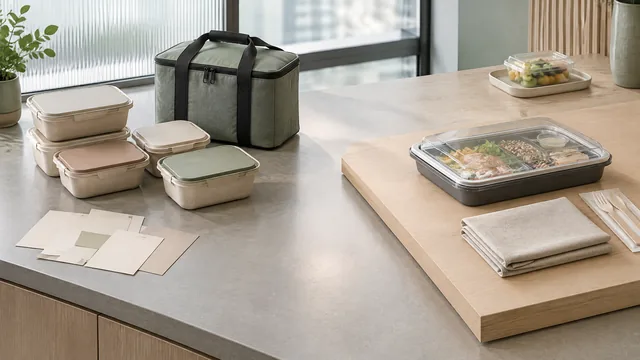
An individual box can serve a daily staff meal or a one-off conference lunch. A platter can serve a single team gathering or a repeated shared lunch. Packaging does not settle frequency, payment responsibility or cancellation terms. For boxes, ask what constitutes one complete meal. For shared dishes, request the portions and components behind the suggested diner count.
The Bento Box Catering resource describes individually packed lunches for corporate meetings and events. Use it to compare layouts and distribution needs, rather than assuming every bento order belongs to daily delivery. Check opening space, cutlery and how the correct meal reaches each diner. [S3]
Separate attendance, meal allocation and payment
For routine lunches, record each lunch date against the meals actually requested. An employee attending the office may bring their own food; a visitor may need lunch without appearing on the staff roster. Keep expected attendance separate from the submitted meal total. After submission, an absence is a change request, not an automatic reduction in the supplier's confirmed order.
For a one-off meal, identify staff and guests eating during that event, then allocate the agreed meal types. Keep event expenses distinct from any staff lunch subsidy or employee contribution. Ask who receives the invoice and whether packaging, delivery, setup or collection are separate charges. Compare complete scopes rather than assuming an advertised per-person figure covers every task.
Build a receiving process for each arrangement
Routine delivery needs a receiver and backup who can check the date, quantities and meal identifiers against the confirmed order. An event lunch also needs someone to coordinate with the meeting host and prepare the serving area. In a Hong Kong office building, establish the permitted handover point, access requirements and who carries food onwards. Arrival at ground level is not the same as setup in a meeting room.
Before ordering, agree where food will wait and who follows the applicable handling instructions. The Centre for Food Safety's Five Keys include clean hands and utensils, separation of raw and cooked food, thorough cooking and safe temperatures. These principles inform the office's receiving arrangements; they do not establish any supplier's certification. Do not use a reception desk as an indefinite holding area. [S4]
At receipt, reconcile the confirmed order, check packaging condition and dietary meal identification, and record any discrepancy before distribution. Ask the supplier how unresolved items should be handled. Dietary requests need ingredient and cross-contact answers, not just a vegetarian, vegan or gluten-free menu label. Restrict sensitive dietary details to colleagues who need them.
Keep afternoon refreshments outside the lunch count
If an afternoon session needs food, explore Afternoon Tea Box Catering as a separate refreshment resource. Specify whether the box is intended as a snack or a meal replacement, and request the actual contents and portions. The name alone does not tell you whether drinks or a substantial lunch are included.
Count afternoon recipients separately from lunch diners. Some colleagues may attend only one session, and others may receive both meals and refreshments. Keep each serving time and budget distinct, even if the supplier proposes combined transport. Confirm how food for the later session will be held safely rather than treating an early arrival as permission to leave everything out.
Send an enquiry that distinguishes both orders
Use this wording, replacing the bracketed details: ‘We need routine lunches on [dates or proposed frequency] for [expected meals by date], plus a separate one-off lunch on [event date] for [confirmed or provisional diners]. Please quote these separately. For routine orders, explain standing quantities, submission deadlines, changes, office closures and billing. For the event, specify portion units, individual or shared presentation, included equipment and setup. Our building permits handover at [location]; [office role] will receive the food. Please confirm feasible arrival windows, dietary requirements and cross-contact responses, handling instructions, additional charges and cancellation terms.’
Before approving either quotation, make sure it states the order dates, quantities, menu scope and receiving responsibilities. Establish how later changes become confirmed. Keep a recurring order record and an event confirmation separately, then reconcile each delivery against the relevant document. This preserves a clear distinction between ongoing workplace lunches and the office's occasional hospitality.
Questions you may be asking
Does placing orders every day automatically create a recurring agreement?
No. Repeated individual orders and a standing arrangement can have different terms. Ask whether each date requires a new confirmation or whether a default order remains active, and clarify how the arrangement can end.
Can employees pay individually while the company books the service?
Ask whether that payment structure is supported. Decide who collects selections, approves the order and reconciles contributions. Do not assume the supplier will split invoices or collect payments from each employee.
Can one event combine individual boxes and sharing platters?
Request a quotation with separate quantities and a clear allocation. Identify which diners receive boxes and which use shared dishes, and confirm whether any components overlap. Do not count the same lunch requirement twice.
What if the office has no predictable lunch attendance?
Discuss date-specific ordering rather than committing to an unsupported standing quantity. Ask about submission deadlines and adjustment rules. The office still needs a named person to consolidate requests and approve the final order.
What should we do if delivery can only be received at ground level?
Assign an office receiver to meet the delivery and organise the onward transfer. Confirm suitable transport and handling before ordering. Ask separately about setup upstairs; a ground-level handover should not be interpreted as meeting-room service.