
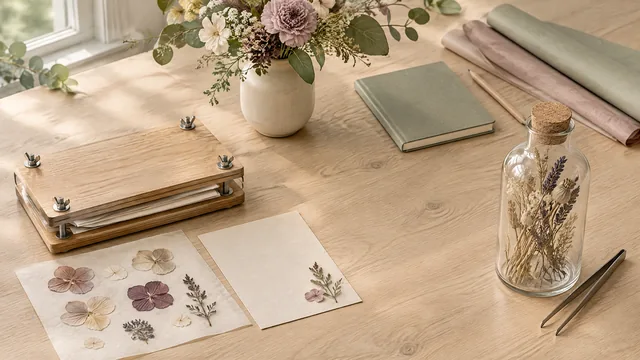
Start with the skill, not the souvenir
A photograph shows the result, not the learning. A beautiful framed flower piece might involve arranging already-dried petals rather than pressing fresh plants. Likewise, a business-themed class might introduce commercial questions without giving individual practice in costing. Write one sentence describing your aim before comparing options: ‘I want to prepare flowers for flat artwork’ is more useful than ‘I want something floral.’
Use the table to identify the evidence you need from a course outline. The outcomes below are questions to explore, not promises about any particular provider.
| Your goal | Direction to explore | Evidence to request |
|---|---|---|
| Assess a flower-business idea | Startup-focused learning | An exercise covering costs, wastage and customer requirements |
| Prepare plants for flat artwork | Flower pressing | A pressing demonstration plus drying and follow-up instructions |
| Compose a decorative botanical bottle | Bottle-craft learning | Material details, placement practice and safe finishing guidance |
| Handle fresh stems confidently | Flower arranging | Individual cutting, positioning and care practice |
Startup learning should make business decisions visible
For a possible floral business, ask to work through an unpriced sample order. What must be purchased? What happens to unusable stems? How do preparation, packaging and customer revisions affect the work? A useful exercise separates materials from labour and overheads rather than treating the selling price as the cost of flowers plus an arbitrary mark-up.
The Florist startup class page is a resource to explore when framing a business-learning enquiry. Its title alone is not evidence that stock management, pricing or customer consultations form part of a confirmed syllabus. Request the teaching outline and a description of any practical business exercise before choosing it. [S1]
Keep craft competence and commercial preparation separate. Being able to repeat a design, describe acceptable substitutions and pack it securely raises different questions from understanding a business plan. For a gift recipient considering floristry, leave room for them to choose which gap matters most.
Pressed flowers: distinguish preparation from composition
Flower pressing involves flattening and drying plant material before using it in artwork. The Natural History Museum describes pressing plants between newspaper in a weighted book, checking them during drying, and mounting them only once dry. Drying depends on the plant and conditions; bulky specimens are more difficult, and dried plants can be brittle. There is no universal workshop-length drying promise. [S4]
Explore the Pressed flower workshop resource with a specific question: will you prepare fresh material, arrange prepared flowers, or do both? Ask whether the take-home item is a finished picture or a press that needs further attention. This distinction matters if learning the preparation method is your main reason for attending. [S2]
For composition practice, request a chance to test spacing before fixing anything permanently. A card or picture can become crowded when every petal is used. Ask how fragile pieces are lifted and supported, and whether the mounting and framing stages are included. Choose a modest project that lets you understand the process rather than merely complete more decoration.
Clarify what ‘herbarium’ means in the workshop
In botanical recording, a herbarium sheet carries a pressed specimen with information such as its collection location and date. The Natural History Museum explains why that record matters beyond appearance. In a decorative workshop enquiry, however, ‘herbarium’ may refer to botanical bottle craft; YumYum's navigation describes that direction through dried-flower placement and vessel shapes. Do not assume the two activities teach the same skills. [S4] [S2]
The Herbarium workshop resource gives you a starting point for checking the actual project format. Ask whether the work is a bottle or a mounted specimen, what goes inside it, and which finishing steps you will carry out yourself. [S3]
For a bottle project, clarify whether any liquid is involved and request its handling instructions. Ask about vessel material, closure, spill precautions and transport protection. Practising placement through a narrow opening is a different task from arranging petals on paper; choose according to the task you want to learn.
Fresh-flower arranging offers a separate kind of practice
If you want confidence with fresh stems, explore the Flower arranging class page and ask about individual hands-on work. Useful questions include whether you can practise cutting, decide stem positions, revise the arrangement and receive feedback. A demonstration followed by copying is not necessarily the same learning experience as making and explaining your own choices.
Do not treat fresh-flower care, flower pressing and bottle finishing as interchangeable. Ask for care instructions tailored to the actual materials you use. For a first lesson, one repeatable arrangement may be more useful than several rushed pieces, especially if your aim is to recognise why a design feels balanced rather than reproduce a reference photograph.
Compare the whole learning experience and the quote
Request a written quote that distinguishes teaching from the project materials. Check whether tools are borrowed or taken home, whether frames or vessels are included, and whether packaging is provided. If pressing continues after the session, clarify who supplies replacement paper and any follow-up guidance. Compare confirmed inclusions rather than assuming a lower headline fee means better value.
For a workshop gift, confirm the recipient's interest before fixing the project. Check teaching language, starting level, venue access and usable dates. Ask which steps need fine hand control or involve cutting tools, glass, adhesives or liquids. Agree any assistance in advance, and establish how changes or cancellations are handled in writing rather than relying on assumptions.
Send an enquiry that makes the learning goal clear
Adapt this message: ‘I am comparing floral workshops because I want to learn [business costing / flower pressing / botanical bottle composition / fresh-stem arranging]. My experience is [brief description]. Please confirm the project format, individual practice, prepared materials and feedback. Could you also send the teaching outline, language, venue, available dates, written quote with inclusions, take-home packaging and any after-class steps? My access or handling requirements are [details].’
Before leaving, check the finished piece or work-in-progress against the agreed format. Make sure its packaging supports it, and obtain material-specific instructions for anything unfinished. For business learning, collect your exercise notes; for pressing, identify the next drying check; for bottle craft, confirm closure and transport guidance. These checks turn an enjoyable activity into learning you can use again.
Questions you may be asking
Is a startup workshop enough to open a flower business?
Not by itself. Treat it as one learning step and check its actual scope. Practical floristry, repeatable costing, customer communication and business requirements need separate attention; a course title does not establish readiness.
Can I press my own flowers and finish the artwork in one session?
Ask how preparation is organised. Pressing and drying fresh plants is different from composing artwork with prepared material, and drying varies with the plant and conditions. You may need a separate follow-up stage. [S4]
Will a herbarium workshop teach plant identification?
Do not assume so. Confirm whether the project is a recorded botanical specimen or decorative bottle craft. If identification and collection records interest you, ask explicitly whether those skills are taught.
Can I bring flowers from a sentimental bouquet?
Ask before booking. Send a description of the flowers and their condition, and explain which pieces matter to you. Request advice on suitability and whether you should retain some material rather than commit the entire bouquet.
Which workshop suits someone who cannot yet choose a specialism?
Start with a small, hands-on project and a clearly stated skill goal. Ask for opportunities to make choices and receive feedback. Decide on business learning or a specialist craft after discovering which tasks you actually enjoy.