
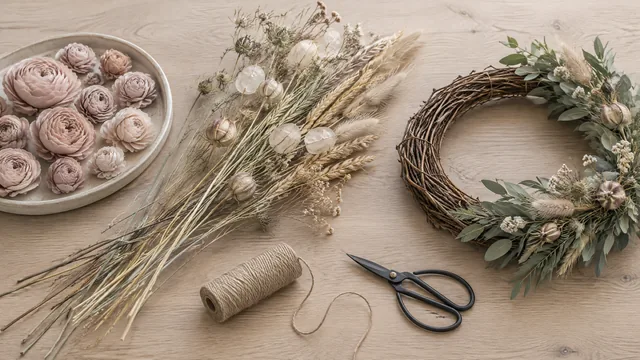
Preserved flowers: a fresh-looking finish without fresh-flower care
Preserved does not mean artificial. Specialist producer Verdissimo explains that natural flowers undergo treatment in which their sap is replaced with a preservation solution. Compared with dehydrated flowers, its preserved materials retain greater flexibility and a fresher appearance. That describes the process, not the origin or performance of any particular workshop kit. [S2]
A useful learning objective is placing focal blooms without crowding or crushing them. Ask whether the flowers arrive on stems, need support added or are already prepared for attachment. A softer-looking petal is not permission to squeeze it; request a handling demonstration before changing its position.
Explore the Preserved flower workshop page when considering this material direction. Use it to frame questions about the proposed flowers, support method and container rather than assuming a particular kit or lesson is included. [S1]
Dried flowers: texture depends on the plant and drying method
Dried is a broader visual category than beige grasses. The RHS describes air drying for flowers, grasses and seedheads, alongside silica-gel drying and pressing. These methods suit different plants and produce different shapes; pressing creates flat material rather than a three-dimensional flower head. A dried-flower class therefore needs a more precise material description than its name alone. [S3]
Look for a lesson in composition: how a seedhead establishes height, how smaller flowers fill gaps and how to distribute contrasting textures. Before repeatedly trimming or moving stems, try a loose layout. Ask which pieces tolerate adjustment and which should be handled only at their stems.
The Dried flower workshop resource is a starting point for comparing botanical textures and display formats. Clarify whether the session teaches drying itself or arranging material already dried; these are different objectives, and drying is not necessarily completed during the lesson. [S3]
A wreath adds structure, whatever its flowers are made from
A wreath can combine dried stems, preserved flowers, fresh foliage or non-botanical decorations. The important extra task is securing material to a ring. Ask what the base is, how attachments are made and whether you will build the structure or decorate a prepared one. Those differences can change the work more than the colour palette does.
For a hanging piece, discuss the hanging point and intended orientation before arranging the focal area. A design viewed upright needs a different check from one lying on a table. Leave the session knowing how the back is finished and how the complete piece should be supported.
Compare the Christmas wreath workshop direction if a seasonal ring appeals to you. The page introduces wreath-making as a craft option; ask separately about foliage condition, decorative finishes and the actual class arrangement. A Christmas title does not establish outdoor suitability. [S4]
Compare the work, not just the finished photograph
Use this table to narrow your enquiry. The rows describe possible project directions, not promised course packages. Mixed-material projects need a component list because a single display may contain several materials with different care requirements.
| Project direction | Useful learning focus | Question before booking | Display consideration |
|---|---|---|---|
| Preserved-flower container | Focal placement and careful support | Are blooms prepared for attachment? | Indoor location; request material-specific care |
| Dried-stem arrangement | Height, spacing and texture | Are stems already dried, and can they be repositioned? | Protect projecting stems from knocks |
| Dried or preserved wreath | Ring coverage and secure attachment | Do learners build or decorate the base? | Check hanging point and packed width |
| Fresh-foliage wreath | Placement plus fresh-material handling | What care does the complete construction need? | Do not apply dried-flower advice automatically |
For parent–child sessions, separate choice from tool work
A project can offer a child meaningful decisions without giving them every operation. Colour selection and arranging a trial layout can be shared; cutting, handling wire ends or using heated adhesive require a separate supervision plan. Ask which tools the proposed design actually uses rather than assuming all wreaths or flower boxes are made alike.
Explore the Parent-child flower class option with those tasks in mind. State the child's experience and support needs, then ask who manages attachment and finishing. Confirm whether an adult and child make one shared piece or separate projects, since attendee count and kit count need not match.
If a learner finds delicate positioning frustrating, ask about larger components or a prepared base. That is a design request, not a guarantee that dried material is easier or that preserved material suits every child.
Plan the display location before choosing materials
An indoor shelf and an exposed front door are different environments. Verdissimo advises indoor use for its preserved products, away from direct sunlight, excessive humidity and heat, with no watering or spraying. Ask for care instructions for the actual materials supplied rather than copying fresh-flower vase routines. [S2]
The RHS also recommends keeping dried displays out of direct sunlight and away from moist rooms such as bathrooms, where mould can develop. In a Hong Kong flat, check the proposed position for dampness and sunlight before booking. Neither preserved nor dried means indestructible or permanently unchanged. [S3]
For a mixed wreath, request instructions covering the entire construction, including the base and decorations. Keep decorative botanicals out of children's and pets' reach; do not assume treatment or drying establishes their suitability for contact or ingestion.
Send a material-led enquiry and check the handover
A ready-to-send enquiry is: ‘I am comparing a preserved-flower container, a dried arrangement and a wreath for an indoor display. Please describe each project's botanical materials, finished dimensions, attachment method and learner tasks. Does the quote separate materials, teaching, assistance and protective packaging? Please confirm any substitutions, tool supervision, care instructions and collection arrangements.’
Add your intended display location and whether each attendee needs a piece. Ask which dimensions refer to the base and which include projecting flowers. For a wreath, its decorated outer width matters when choosing a box or carrying it on public transport.
At handover, check the attachment points and ask how to hold the piece without gripping flowers. Inspect protection around projecting stems, confirm the hanging method where relevant and take home the care instructions. Decide who packs and carries it before leaving, rather than trying to improvise support on the journey.
Questions you may be asking
Are preserved flowers the same as silk flowers?
No. Preserved flowers are natural flowers that have undergone treatment; silk or other artificial flowers are manufactured substitutes. Ask for a component list if the project mixes botanical and artificial elements. [S2]
Will I learn to preserve fresh flowers during the class?
Not necessarily. A workshop may focus on arranging prepared materials. Ask whether its objective is preservation, drying, composition or construction, and what you will actually do rather than watch.
Can I hang a preserved-flower wreath outside?
Do not assume so. Verdissimo specifies indoor use for its preserved products. Describe the proposed doorway's exposure and ask whether every component in the actual wreath is suitable; a seasonal design alone is not evidence. [S2]
Does a dried-flower workshop always involve pressing?
No. Pressing produces flat botanical material, while other drying methods can retain three-dimensional forms. Confirm whether you will make a flat artwork, stem arrangement or ring before comparing courses. [S3]
Which size should I request when comparing wreaths?
Request both the base diameter and the complete decorated dimensions, plus the packed size. Flowers and foliage may extend beyond the ring, so base measurements alone do not tell you whether the finished piece fits your display space or carrying box.