
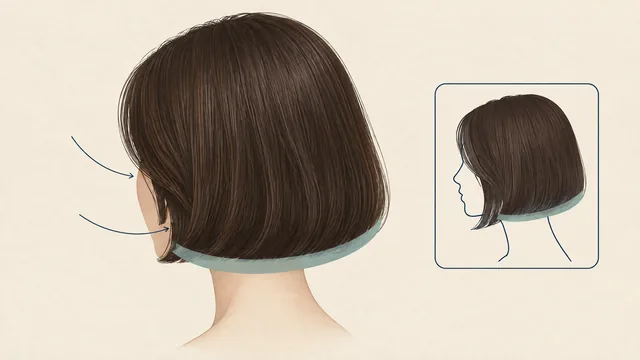
Mark the bend—and the areas you want left alone
Perhaps your chin-length bob feels right through the crown, but you would like its lower edge to turn inward. Or you like a straight, longer top with only the front ends swept away. Those are local movement requests, not invitations to change every section into waves. Begin with that distinction rather than choosing a treatment name first.
Take front, side and back photographs of your dry hair with your normal parting. On copies, circle the sections where you want movement and draw a line where it should start. Then mark the areas you want to keep relatively straight. If the whole lower edge is your target, include the back and both sides; an attractive front view leaves the nape unexplained.
Write the direction beside each marked area: inward towards the jaw, outward from the neck, or back from the face. Add one practical boundary, such as keeping the front below the chin when dry. This gives the consultation a clear priority if the original idea needs adapting. ‘Just a little curl’ describes intensity, but says very little about position.
Full and partial describe coverage, not the finished look
When considering a full head perm, ask the stylist to identify the proposed treatment areas and where visible movement would begin, rather than reading the name as a request for curls from the roots. Coverage and the outline you want are separate parts of the brief. Vit So’s service explanation distinguishes these areas and asks readers to describe what should remain straighter. [S1]
A partial perm enquiry becomes more useful when you show the selected sections and ask how their movement would meet the untreated hair. ‘Partial’ could describe your intended scope, but the menu wording alone does not confirm that every end-only, fringe or other localised request is available or suitable.
Check the boundary from more than one angle. Are you asking for only the front corners of a bob to bend, or for its entire lower edge to turn? If your natural sides already have movement, ask how the proposed section would sit beside them. If the ends cannot support the intended design, keeping more length, revising the cut or using temporary styling are options to discuss—not reasons to extend the chemical work automatically.
Read the shortest lengths alongside the cut shape
For a perm for short hair, assess the fringe, nape and shortest layers as well as the longest side pieces. Vit So’s short-hair guide notes that workable length depends on the intended movement and proposed method; it does not give one minimum measurement that settles every case. [S2]
In a blunt bob, ‘the ends’ can mean a fairly continuous lower edge. In a layered cut, ends occur at several heights. A request to curve all of them is therefore not the same design as turning only the perimeter. A longer top above closely cut sides raises another question: whether the movement belongs to the front, the top outline or both.
Use this comparison to organise questions, not to select a service without assessment. Put on your usual glasses, tuck the hair behind an ear and check the back. Keep the dry length and widest point visible in your reference, especially if preserving a compact outline matters more than showing a curl.
| Current cut | Local movement to describe | What to check before choosing coverage |
|---|---|---|
| Blunt chin-length bob | An inward turn along the lower edge | Front length when dry; whether the nape belongs in the same plan |
| Layered short bob | Perimeter movement with calmer upper layers | Which layer ends are included; the width you want around the cheeks |
| Longer top with short sides | A bend in selected longer front or top sections | The shortest proposed section and how it meets the untreated outline |
| Very short fringe or nape | A specific direction rather than an assumed loose wave | Whether there is workable length; whether to retain length or change the idea |
Agree on the cut plan before accepting an end-only plan
Bring the trim request into the same conversation. If you intend to remove the current ends, the movement must be planned around the hair that remains. Likewise, adding shorter layers changes which ends sit near your cheeks or ears. Ask the stylist to explain the cutting and perming sequence for the agreed shape rather than booking each change as an unrelated decision.
Separate your non-negotiable length from negotiable weight. You might accept a tidier nape but want the front to stay tuckable; you might want less fullness at the back without shortening the sides. State these priorities before asking for movement, so a curl reference does not become accidental approval for a different outline.
Provide a processing history by area: colour, bleach, straightening and previous perms, including older work still at the ends. Ask whether the selected sections are suitable for the proposed process. The fact that you want a small visual change does not settle that assessment, and a smaller area is not automatically the better option.
Check the cut-and-perm quote line by line
Use the published haircut and perm package details to check the named contents, then ask whether that combination fits your assessed area and cutting plan. Vit So’s listed cut-and-perm combinations specify wash, cut and blow-dry, full-head perm and pre-service hair protection; this does not establish an equivalent partial-treatment package. [S3]
Ask for a written scope covering the treated sections, the cutting changes and the finish. Establish whether washing, blow-drying and any proposed care step are included or separate. If protection is included, ask what it involves rather than treating the name as a reason to skip the suitability discussion.
Compare totals for the work you actually want. A smaller treatment area does not necessarily make the complete appointment cheaper once cutting and other agreed items are accounted for. Equally, a combination containing more work is not better value if that work does not serve your brief. Avoid comparing a standalone perm entry against a package as though both contain the same services.
If your preferred scope changes during consultation, pause and ask for the revised contents and total before proceeding. Keep future trimming and styling questions separate from today’s charge; later appointments should not be assumed part of the quoted combination.
Give the salon one bounded brief to respond to
Send your marked photographs with one reference showing the direction you like. Explain your ordinary drying routine, including whether you use a brush, leave the hair to dry naturally or regularly reset the ends. In Hong Kong’s humid weather, a useful discussion is what you are willing to do after the commute—not simply how polished you want the appointment finish to look.
For example: ‘I want the lower edge of my bob to turn inward, while keeping the crown relatively straight and the front below my chin when dry. I usually dry with my fingers and tuck one side behind my ear. Please assess the marked areas and explain which cut-and-perm scope fits, what it includes and the total.’ Add your own treatment history rather than leaving the photographs to tell it.
Before leaving, ask to see how the agreed ends are arranged using tools you will actually use. Confirm first-wash instructions for the chosen process and how a later trim would affect the movement. That closes the loop: the area, cut and daily handling all support the same modest change.
Questions you may be asking
Does movement only at the ends necessarily mean a partial service?
No. End placement describes the look you want, while a partial entry describes selected coverage. Show where the bend should begin and ask which assessed scope fits. A name alone does not establish that the required localised work is suitable or offered.
In a layered bob, should I mark every layer end?
Mark the ends you want to move, including any upper layers, and separately mark those you want calmer. Curving every layer end and turning only the lower perimeter are different requests. A side-view photograph helps reveal that distinction.
Can I retain a very short nape while adding a bend elsewhere?
Make the retained nape part of the brief and ask how the longer treated sections would meet it. The nape does not have to be treated merely because another area is discussed, but the combined outline and suitability still need assessment.
What if I already plan to cut off the ends I want curled?
Discuss the intended remaining length before choosing the treatment area. Ask which sections could support the goal after cutting and how the sequence would be organised. Your present ends should not be the only basis for a plan that includes removing them.
What should I request if the package includes a full-head service but I want local work?
Ask for a quote matching your selected areas and cutting needs, with washing, finishing and care contents stated. Do not assume the full-head combination can be substituted at the same price or that a partial standalone entry includes the cut.