
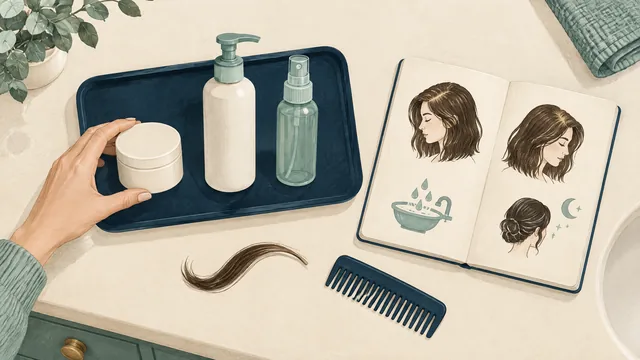
Map your products by where they actually land
Start with the products you use on an ordinary workday, not everything in your bathroom. Put the containers together or photograph their labels. Include your shampoo and conditioner, then add the wax, gel, mousse, spray, dry shampoo or leave-in product you actually reach for. Brand names alone are not enough: the useful detail is where each product goes and whether you add more later.
Record application in plain language: ‘wax worked through the front with my fingers’, ‘spray aimed at the parting’ or ‘leave-in cream on the ends only’. A product intended for the lengths might still reach the roots during application. You do not need to decide whether a formula is responsible for anything; you are showing the salon how you use it.
Make a separate note for event days. A morning blow-dry followed by an evening restyle may involve more layers than your usual routine. Record approximate amounts in terms you can repeat, such as one pump or a fingertip-sized amount. Include any previous product reaction, but do not buy a new product simply to complete the list.
Keep the record small enough to use
A phone note with four entries per product is enough: name, application area, approximate amount and touch-ups. This is preparation for a conversation, not an ingredient investigation.
Trace one ordinary wash rather than inventing an ideal routine
Choose a recent, typical wash and write down what happened before and afterwards. Had you applied styling product that morning? Did you shampoo, rinse only, or postpone washing? Note where you applied conditioner and how you dried your hair. Then record when you noticed the coated or greasy feeling: before styling, directly afterwards or later in the day.
The American Academy of Dermatology advises washing according to how often hair becomes dirty or oily. It also recommends applying shampoo to the scalp to remove accumulated products and excess oil. That is a reason to discuss your normal washing method, not to assume everyone needs the same timetable or an intensive salon appointment. [S2]
Include differences that matter to your week. Perhaps you wash before an early meeting but change the routine after exercise, or use fewer products on days at home. A comparison between those days is useful context; it does not prove what is causing a scalp concern.
If exercise and work are the main scheduling difficulty, use the gym-to-office hair-routine guide alongside this record. Keep the practical question separate: which washing and drying steps can you realistically repeat?
Give ‘cleaner-feeling’ a meaning the salon can discuss
‘Clean’ can mean several things in a beauty enquiry. You might want less stickiness near the fringe, a finish without a fresh layer of root product, or a comfortable wash with a particular water temperature. Rank your main preference before discussing additional steps. A request for everything at once makes it harder to compare the proposed work.
When enquiring about scalp cleansing, describe the area and timing of the feeling you want addressed, then ask which cleansing steps would be proposed. The service information treats this as a cosmetic goal rather than a diagnosis. [S1]
Use the table to turn vague words into a useful brief. Notice that rough ends and a coated root area can appear in the same account without being the same request. If detangling or softness is your priority, the smoother-feel or straighter-shape guide helps you frame that separate conversation.
| What you mean | What to record | What to ask |
|---|---|---|
| The hairline feels sticky | Where it happens and which products were applied | What cleansing approach would you consider for this cosmetic concern? |
| I want a lighter finish | Whether you want styling product reapplied | Can we agree on the drying and finishing steps? |
| I want a comfortable wash | Water-temperature, scent and touch preferences | Which parts of the proposed appointment can be adjusted? |
| My ends feel rough | Where combing becomes difficult | Is care for the lengths a separate service? |
| My scalp stays itchy or sore | Duration and any visible changes | Seek healthcare advice rather than choose a stronger cosmetic cleanse |
Separate a cosmetic preference from a symptom enquiry
Product notes are useful, but they cannot establish a scalp condition. Flakes are not proof that you have failed to wash properly: NHS guidance says dandruff is not caused by poor hygiene. The NHS also advises medical help for symptoms that persist or become painful, and a GP enquiry for a very itchy, red or swollen scalp. [S3]
If that describes your concern, put healthcare advice ahead of selecting a beauty service. Describe what you have noticed and how long it has lasted rather than trying to name a condition yourself. A salon cleanse is not the route for diagnosing those symptoms or treating scalp disease. [S1]
For a cosmetic appointment, still mention earlier reactions and any scalp-care routine recommended by your healthcare professional. Ask whether the proposed salon work is appropriate alongside it. Your aim is to make the relevant history visible, not to replace healthcare instructions with a spa menu.
Comfort matters during the visit too. Tell the person carrying out the service if a product, water temperature or touch feels uncomfortable, and ask to pause the step. You do not need to wait until the finish to raise a concern.
Compare the proposed steps, not the strength of the label
A useful scalp treatment enquiry asks what products and processes are involved, whether massage is part of the option, and how the hair will be finished. Vit So’s description places these services within cosmetic cleanliness and comfort, not hair regrowth. [S1]
Ask the salon to explain the sequence in ordinary terms. Is there a cleansing product, a rinse and drying? Are any other steps proposed? If a word such as ‘deep’ appears, ask what it changes in the actual process. A descriptive name is not a full contents list, and a more elaborate option may not match your simple preference for a product-light finish.
Then confirm the total charge for the agreed scope. Ask whether drying, your requested finish or any additional care for the lengths is included or quoted separately. State your hair length and recent colour, bleach, perm or straightening history so the discussion starts with relevant information.
Finally, ask how much time to allow and whether any preparation is requested. Do not guess a duration from the word ‘spa’, or alter your washing routine just because you assume the salon wants unwashed hair.
Send a brief that leaves room for a useful reply
If you are comparing local options, Vit So’s scalp treatment sheung wan page gives the cosmetic service context and the appointment address at 252 Hollywood Road, Sheung Wan. Send hairstyle and salon-service enquiries to Vit So through its own service channels, rather than TCM Weight Lab’s medical contact route. [S1]
Adapt this message to your actual routine: ‘I use wax near the fringe most workdays and sometimes add spray before evening plans. I shampoo [describe your usual pattern]. I want to discuss the sticky feeling around my hairline and leave with minimal product at the roots. My recent hair services were [details]. Could you explain the proposed cleansing steps, finish, total charge and any preparation? My possible dates are [dates].’
Attach your product-label photographs if helpful, and add comfort preferences or relevant history. If you have a commitment afterwards, explain the finish you need and when you must leave. The headshot-to-evening-event planning guide can help you separate those two styling priorities.
Wait for confirmation of the scope and arrangements before travelling. Keep your notes afterwards so a later conversation can refer to your ordinary wash and styling routine, rather than only how polished the hair looked when you left.
Questions you may be asking
Should dry shampoo go in the inventory even if I use it only on the fringe?
Yes. Record the area where you apply it and whether you add more later. A fringe-only product can be relevant to a hairline concern even when the rest of your hair has a different routine. Include occasional products used before an event as well as daily ones.
Do I need to leave my hair unwashed before a scalp-care visit?
Ask Vit So what preparation is wanted for the particular service being discussed. Do not deliberately build up product or skip a normal wash to make the appointment seem more worthwhile. Tell the salon when you last washed and what you applied afterwards.
Can I ask for no styling product to be added at the end?
Make that preference part of the enquiry and confirm the available finish. Explain whether you want your usual parting, natural texture or a more polished blow-dry. Check what the proposed service includes rather than assuming every finishing arrangement is covered.
If I see flakes, should I request a more vigorous cleanse?
Flakes alone do not identify the cause or establish that stronger cleaning is appropriate. NHS guidance says dandruff is not caused by poor hygiene. Persistent symptoms, pain or a very itchy, red or swollen scalp warrant healthcare advice rather than a stronger salon step. [S3]
How should I describe sticky roots and tangled ends in the same message?
Give each area its own sentence and say which matters most. For example, describe the hairline feeling after wax, then explain where combing the lengths is difficult. Ask whether the proposed scalp work addresses your main goal and whether care for the ends requires a separate discussion.